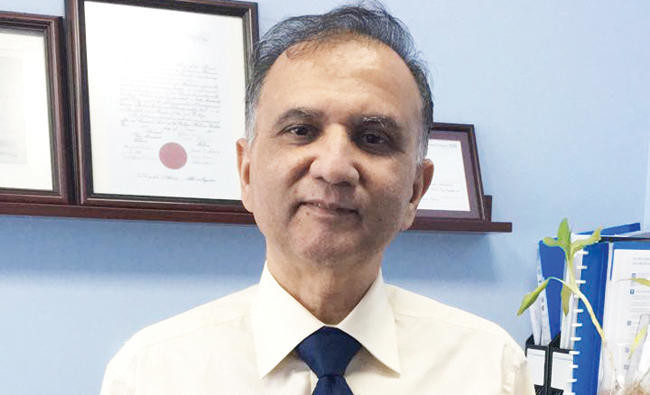
ABU DHABI: For more than six years now, Abu-Dhabi-based diabetologist Dr. Asjad Hameed has religiously followed one routine: Five working days in the emirate and two days of weekend in Islamabad, Pakistan.
He travels there to oversee construction of his dream hospital and treat patients at a mobile clinic.
Helped by friends, Hameed is building the first ever diabetes hospital in South Asia that will provide free treatment and preventive education to poor patients. He has been pursuing this project for seven years now.
“Almost every day, dozens of blue-collar workers, especially taxi drivers, approach me in the mosque for medical advice,” Hameed told Arab News, adding that at least 90 percent of Pakistani taxi drivers in the UAE suffer from diabetes because of an unhealthy lifestyle, work and emotional stress. “It was an eye-opener for me.”
Genesis
In 2001, he decided to take the plunge. During a winter morning walk near the corniche, he shared his idea of establishing such a hospital in Pakistan with two close friends. There has been no looking back since.
“We started the project with four close friends, and now we have a big team of Pakistani professionals working in the UAE,” he said.
“More than 72 percent of the hospital construction work has been completed. We’re hoping by the first quarter of 2018, the first phase of the hospital will be operational.”
It will have 12 departments to provide comprehensive care for patients suffering from the complexities of this deadly disease. The hospital will be able to serve 600–800 patients per day.
Diabetes in Pakistan
For Hameed, charity begins at home, and he did not have to go too far away from his home turf as Pakistan is among the top 10 countries globally for diabetes prevalence.
“Diabetes is one of the leading causes of morbidity and mortality throughout the world,” he said.
“It’s associated with a high rate of hospitalization, blindness, amputation, heart disease and kidney failure, among many other complications.”
It is one of the most common non-communicable diseases globally. According to a World Health Organization (WHO) report in 2011, some 13 million people suffer from diabetes in Pakistan, and many more are unaware.
According to Hameed, an estimated one in 10 Pakistanis is diabetic. “We believe that we have a collective responsibility to improve our nation’s health through diabetes awareness, education and health care delivery,” he said.
Mobile clinic
With the rapid rise in diabetes cases among poor people, Hameed realized that it is not wise to wait for the hospital’s completion. So he and his team set up a mobile clinic near the hospital site to cater to immediate needs.
Since 2014, a team of 11 fulltime and visiting specialist doctors, and 20 support staff, has treated more than 47,000 patients for free. The clinic serves around 500 patients per week.
The cost
So far, $3.7 million has been spent on the skeleton of the hospital. Another $2.5 million is required to complete the project.
“Installation of air conditioning, an IT network and interiors has started,” said Hameed. “The project has reached this point with the support of the expat community in the Gulf. We sincerely hope expats, especially Pakistanis in the region, will continue to help us complete the hospital on time.”
Medical tourism
He said he is committed to equipping the hospital with state-of-the-art services, not just for Pakistanis but for everyone.
“We believe in humanity. We don’t care about the nationality or faith of our patients,” he said.
“We welcome everyone who is suffering from this silent killing disease to contact us. We’ll help them fight diabetes.”
Hameed added: “We’re confident the center will bring medical tourism to Pakistan. People from Afghanistan are already visiting our mobile clinic, and we’re taking very good care of them.”


![]()
Pakistani doctor’s quest for diabetes hospital bearing fruit
Pakistani doctor’s quest for diabetes hospital bearing fruit


Latest updates


© 2026 SAUDI RESEARCH & PUBLISHING COMPANY, All Rights Reserved And subject to Terms of Use Agreement.