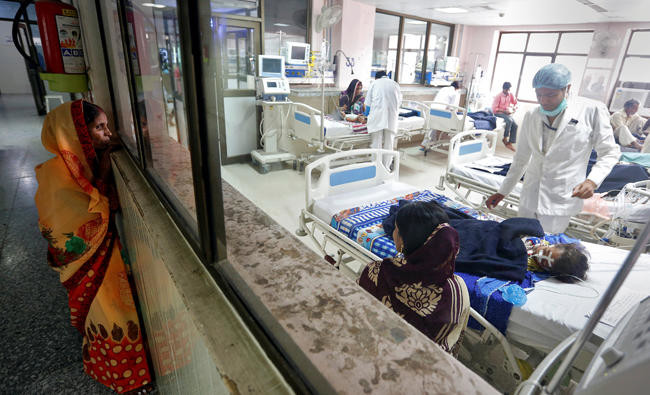
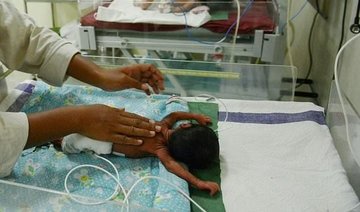
GORAKHPUR, India: Indian health authorities on Monday delivered oxygen to a public hospital where 63 people have died of encephalitis in recent days, nearly half of them children, as it ran out of medical supplies because of unpaid bills, triggering public outrage.
The deaths of the children have again exposed India’s underfunded and poorly managed public health care despite Prime Minister Narendra Modi government’s vows to revamp the system.
Hundreds of people die each year in India of encephalitis, a mosquito-borne disease common during the monsoon season, and no medical official directly linked the recent deaths to a lack of oxygen.
But complaints that the hospital in the eastern city of Gorakhpur did not have enough supplies has stoked anger against the ruling Bharatiya Janata Party which governs Uttar Pradesh state.
“We now have adequate supplies of oxygen cylinders, there was a shortage last week... but I am not in a position to say whether they were the cause behind the deaths,” R.K. Sahai, a senior medical officer in the hospital, said.
Television images of parents emerging from the hospital carrying the bodies of infants and alleging they died because there they didn’t get oxygen have led to a firestorm of criticism of chief minister Yogi Adityanath, a saffron-robed Hindu hard-liner who took office earlier this year.
Bipin Singh said his six-year-old daughter died on Thursday because of lack of oxygen and he had seen six other children die for the same reason.
“My daughter and other children were unable to breathe. We kept telling the nurses that they should call the doctors. The doctors said they have ordered for oxygen cylinders but we never saw them being used.”
Bahadur Nishad, who lost a four-year-old son suffering from encephalitis, said he was ready to pay for the oxygen cylinders himself.
“They told me there was a shortage of cylinders,” he said and turned his wrath on chief minister Yogi Adityanath whose electoral constituency is Gorakhpur.
Other parents spoke of desperately trying to arrange basic materials such as cotton gauze, glucose injections and blood supplies as their children struggled for life in the wards.
Patients continued to stream into the hospital over the weekend. Some 450 patients suffering from encephalitis were admitted on Saturday alone, of whom 200 were children under 12, hospital records showed.
Many were being treated on the floor and near toilets due to the shortage of beds.
Government expenditure on public health is about one percent of GDP, among the world’s lowest. In recent years, Modi’s government has increased health spending and vowed to make health care more affordable.
The Uttar Pradesh government fired the head of the hospital as well as the doctor who headed the paediatrics department to head off criticism from the opposition.
But Rajeev Misra, the sacked chief of the hospital, told reporters he had repeatedly written to the state administration to release funds to pay suppliers.
Sahai, the medical officer at the hospital, said authorities were investigating the reasons for the shortage of oxygen cylinders.

India restores hospital oxygen supply as anger mounts over child deaths

Hegseth says US ‘can’t stop everything’ that Iran fires even as he asserts air dominance
WASHINGTON (AP): Defense Secretary Pete Hegseth acknowledged Wednesday that some Iranian air attacks may still hit their targets even as he asserted that US military superiority is quickly giving it control of the Islamic Republic’s airspace.
The US has spared “no expense or capability” to enhance air defense systems to protect American forces and allies in the Middle East, Hegseth told reporters at the Pentagon days after the US and Israel attacked Iran in a war that has widened throughout the region.
“This does not mean we can stop everything, but we ensured that the maximum possible defense and maximum possible force protection was set up before we went on offense,” he said.
The acknowledgement that additional drone or missile strikes in the region could cause damage and harm to troops comes as President Donald Trump and top defense leaders have warned that additional American casualties were expected in a conflict that could last months.
US service members “remain in harm’s way, and we must be clear-eyed that the risk is still high,” Gen. Dan Caine, chairman of the Joint Chiefs of Staff, said at the same press conference.
Six soldiers were killed when an Iranian drone strike hit an operations center Sunday in the heart of a civilian port in Kuwait, miles away from the main Army base. The husband of one of the slain soldiers, who was part of a supply and logistics unit based in Iowa, says the center was a shipping container-style building and had no defenses.
Hegseth also signaled a possible longer time frame for the conflict than has previously been floated by the Trump administration, saying it could last eight weeks but that the US has the munitions and the equipment to beat Iran in a war of attrition. He declined to set a specific time range, saying the specific duration of the war would depend on how it unfolds.
“You can say four weeks, but it could be six, it could be eight, it could be three,” he said. “Ultimately, we set the pace and the tempo. The enemy is off balance, and we’re going to keep them off balance.”
More forces continue to arrive in the region, including jet fighters and bombers, Hegseth said, and the US “will take all the time we need to make sure that we succeed.”
Tehran has vowed to completely destroy the Middle East’s military and economic infrastructure — signaling the war was nowhere near over and could expand further.
President Donald Trump said this week the campaign are likely to last four to five weeks but that he was prepared “to go far longer than that.”
The US has spared “no expense or capability” to enhance air defense systems to protect American forces and allies in the Middle East, Hegseth told reporters at the Pentagon days after the US and Israel attacked Iran in a war that has widened throughout the region.
“This does not mean we can stop everything, but we ensured that the maximum possible defense and maximum possible force protection was set up before we went on offense,” he said.
The acknowledgement that additional drone or missile strikes in the region could cause damage and harm to troops comes as President Donald Trump and top defense leaders have warned that additional American casualties were expected in a conflict that could last months.
US service members “remain in harm’s way, and we must be clear-eyed that the risk is still high,” Gen. Dan Caine, chairman of the Joint Chiefs of Staff, said at the same press conference.
Six soldiers were killed when an Iranian drone strike hit an operations center Sunday in the heart of a civilian port in Kuwait, miles away from the main Army base. The husband of one of the slain soldiers, who was part of a supply and logistics unit based in Iowa, says the center was a shipping container-style building and had no defenses.
Hegseth also signaled a possible longer time frame for the conflict than has previously been floated by the Trump administration, saying it could last eight weeks but that the US has the munitions and the equipment to beat Iran in a war of attrition. He declined to set a specific time range, saying the specific duration of the war would depend on how it unfolds.
“You can say four weeks, but it could be six, it could be eight, it could be three,” he said. “Ultimately, we set the pace and the tempo. The enemy is off balance, and we’re going to keep them off balance.”
More forces continue to arrive in the region, including jet fighters and bombers, Hegseth said, and the US “will take all the time we need to make sure that we succeed.”
Tehran has vowed to completely destroy the Middle East’s military and economic infrastructure — signaling the war was nowhere near over and could expand further.
President Donald Trump said this week the campaign are likely to last four to five weeks but that he was prepared “to go far longer than that.”
© 2026 SAUDI RESEARCH & PUBLISHING COMPANY, All Rights Reserved And subject to Terms of Use Agreement.