

Kenya’s Odinga mulls next move on disputed election

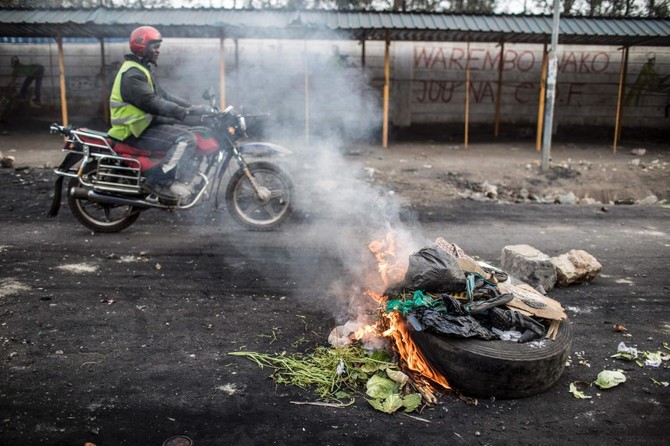
A man on a motorcycle drives past a burning tire and waste in the Nairobi slum of Mathare on August 12, 2017, where demonstrations continued overnight following the announcement that President Uhuru Kenyatta had won the presidential election. Three people, including a child, have been shot dead in Kenya in opposition protests which raged overnight into Saturday after the hotly disputed election victory of President Kenyatta. Demonstrations and running battles with police broke out in Nairobi slums after anger in opposition strongholds against an election that losing candidate Raila Odinga claims was massively rigged. (AFP)
Updated 14 August 2017
Follow

Kenya’s Odinga mulls next move on disputed election

NAIROBI: Kenya’s opposition leader Raila Odinga was weighing his next move Monday to contest an election he claims was rigged after defying pressure at home and from abroad to take his complaints to the courts.
The 72-year-old insists he was the rightful winner of a “stolen” election last week and has urged his supporters to stay away from work Monday to mourn the deaths of those killed in angry protests against the re-election of President Uhuru Kenyatta.
However, after nearly a week in limbo in which businesses remained shut and workers stayed home, Nairobi largely came back to life on Monday with many unable to afford any more time away from their livelihoods.
Fruit vendor Alex Kilonzo returned to his stand on a busy street corner, even though many nearby had not reopened. “If I had money I could strike,” he told AFP.
“Life has to move on,” said IT worker Kenneth Kiruja as he headed into the office for the first time since Tuesday’s election, adding the opposition should take their grievances to court.
Odinga, a veteran opposition leader in Kenya, lost his fourth shot at the presidency, according to official results, and has repeated claims he made in 2007 and 2013 that the vote was rigged against him..
His loss sparked angry protests on Friday night and Saturday in his strongholds in the west of the country and in Nairobi slums, leaving 16 people dead according to an AFP tally. This includes a nine-year-old girl hit by a stray bullet.
Police have denied that innocent protesters have been killed, saying those shot dead had been armed and attacked officers, many while carrying out criminal acts such as rape and looting.

The dispute has plunged Kenya into its worst political crisis since Odinga lost a 2007 election that many observers agreed was riddled with irregularities.
That election exposed decades-old political and ethnic grievances over access to power and land that sparked two months of violence in which 1,100 were killed and 600,000 displaced.
Three of Kenya’s four presidents have been Kikuyu and the other Kalenjin, leaving Luos and other major ethnic groups feeling excluded from power and marginalized for over half a century.
While there have been efforts to dilute the winner-takes-all nature of Kenyan politics, notably by devolving power to the counties, critics argue the underlying fault lines have merely been papered over.
As a grim reminder of this, members of Odinga’s Luo ethnic group and those from Kenyatta’s Kikuyu group clashed violently in Nairobi’s Mathare slum late Sunday with sticks, rocks, bows and arrows.
Mobs set on a Luo man, and then later in revenge a Kikuyu man, leaving them bloodied and motionless, as captured by two AFP photographers.
Nairobi police chief Japheth Koome denied the incident.
“We don’t have attacks in Mathare,” he told journalists.
Despite this isolated incident, protests in Odinga’s strongholds appeared to largely have fizzled out, as his supporters await his next move.
“We are not done yet. We will not give up. Wait for the next course of action which I will announce the day after tomorrow (Tuesday),” Odinga told a crowd of thousands in Nairobi’s Kibera slum on Sunday.
Later on Twitter he wrote: “There is no turning back.”
The United Nations, Britain, France and the European Union have beseeched Odinga to use legal means to address his concerns. Kofi Annan, who mediated the 2007/08 crisis, has warned Kenya’s political leaders to “be careful with their rhetoric and actions.”
Odinga and his National Super Alliance (NASA) claim the results from Tuesday’s election which came in via an electronic tallying system were hacked and manipulated.
Documents he has provided as evidence so far have been dismissed by the electoral commission, and it is unclear what Odinga will do next.
He lost a court dispute in 2013 when he alleged an election was rigged, and this time NASA has said court is not an option.
Odinga has until Friday to lodge a court complaint.

US and Ukraine reach consensus on key issues aimed at ending the war but territorial disputes remain

Updated 56 min 14 sec ago
Follow

US and Ukraine reach consensus on key issues aimed at ending the war but territorial disputes remain

  • Russia continues to assert maximalist demands, insisting that Ukraine relinquish the remaining territory in Donbas that it has not captured, an ultimatum that Ukraine has rejected

KYIV: The United States and Ukraine have reached a consensus on several critical issues aimed at bringing an end to the nearly four-year conflict, but sensitive issues around territorial control in Ukraine’s eastern industrial heartland, along with the management of the Zaporizhzhia nuclear power plant, remain unresolved, Ukraine’s president said.
Volodymyr Zelensky spoke as the US showed the 20-point plan, hammered out after marathon talks in Florida in recent days, to Russian negotiators. A response is expected from Moscow on Wednesday, Zelensky said.
The Ukrainian president briefed journalists on each point of the plan on Tuesday. His comments were embargoed until Wednesday morning. The draft proposal, which reflects Ukraine’s wishes, intertwines political and commercial interests to safeguard security while boosting economic potential.
At the heart of the negotiations lies the contentious territorial dispute concerning the Donetsk and Luhansk regions, known as the Donbas. This is “the most difficult point,” Zelensky said. He said these matters will be discussed at the leaders level.
Russia continues to assert maximalist demands, insisting that Ukraine relinquish the remaining territory in Donbas that it has not captured — an ultimatum that Ukraine has rejected. Russia has captured most of Luhansk and about 70 percent of Donetsk.
In a bid to facilitate compromise, the United States has proposed transforming these areas into free economic zones. Ukraine insists that any arrangement must be contingent upon a referendum, allowing the Ukrainian people to determine their own fate. Ukraine is demanding the demilitarization of the area and the presence of an international force to ensure stability, Zelensky said.
How the Zaporizhzhia nuclear power plant, the largest plant in Europe which is under Russian occupation, will be managed is another contentious issue. The US is proposing a consortium with Ukraine and Russia, with each party having an equal stake in the enterprise.
But Zelensky countered with a joint venture proposal between the US and Ukraine, in which the Americans are able to decide how to distribute their share, presuming it would go to Russia.
“We did not reach a consensus with the American side on the territory of the Donetsk region and on the ZNPP,” Zelensky said, referring to the power plant in Zaporizhzhia. “But we have significantly brought most of the positions closer together. In principle, all other consensus in this agreement has been found between us and them.”
A free economic zone compromise
Point 14, which covers territories that cut across the eastern front line, and Point 12, which discusses management of the Zaporizhzhia plant, will likely be major sticking points in the talks.
Zelensky said: “We are in a situation where the Russians want us to leave the Donetsk region, and the Americans are trying to find a way so that it is ‘not a way out’ — because we are against leaving — they want to find a demilitarized zone or a free economic zone in this, that is, a format that can provide for the views of both sides.”
The draft states that the contact line, which cuts across five Ukrainian regions, be frozen once the agreement is signed.
Ukraine’s stance is that any attempt to create a free economic zone must be ratified by a referendum, affirming that the Ukrainian people ultimately hold the decision-making power, Zelensky said. This process will require 60 days, he added, during which time hostilities should stop to allow the process to happen.
More difficult discussions would require hammering out how far troops would be required to move back, per Ukraine’s proposal, and where international forces would be s tationed. Zelensky said ultimately “people can choose: this ending suits us or not,” he said.
The draft also proposes that Russian forces withdraw from Dnipropetrovsk, Mykolaiv, Sumy, Kharkiv regions, and that international forces be located along the contact line to monitor the implementation of the agreement.
“Since there is no faith in the Russians, and they have repeatedly broken their promises, today’s contact line is turning into a line of a de facto free economic zone, and international forces should be there to guarantee that no one will enter there under any guise — neither ‘little green men’ nor Russian military disguised as civilians,” Zelensky said.
Managing Zaporizhzhia power plant
Ukraine is also proposing that the occupied city of Enerhodar, which is connected to the Zaporizhzhia power plant, be a demilitarized free economic zone, Zelensky said. This point required 15 hours of discussions with the US, he said.
For now, the US proposes that the plant be jointly operated by Ukraine, the US and Russia, with each side receiving dividends from the enterprise.
“The USA is offering 33 percent for 33 percent for 33 percent, and the Americans are the main manager of this joint venture,” he said. “It is clear that for Ukraine this sounds very unsuccessful and not entirely realistic. How can you have joint commerce with the Russians after everything?”
Ukraine offered an alternative proposal, that the plant be operated by a joint venture with the US in which the Americans can determine independently how to distribute their 50 percent share.
Zelensky said billions in investments are needed to make the plant run again, including restoring the adjacent dam.
“There were about 15 hours of conversations about the plant. These are all very complex things.”
A separate annex for security guarantees
The document ensures that Ukraine will be provided with “strong” security guarantees that mirror NATO’s Article 5, which would obligate Ukraine’s partners to act in the event of renewed Russian aggression.
Zelensky said that a separate bilateral document with the US will outline these guarantees. This agreement will detail the conditions under which security will be provided, particularly in the event of a renewed Russian assault, and will establish a mechanism to monitor the ceasefire.
This mechanism will utilize satellite technology and early warning systems to ensure effective oversight and rapid response capabilities.
“The mood of the United States of America is that this is an unprecedented step toward Ukraine on their part. They believe that they are giving strong security guarantees,” he said.
The draft contains other elements including keeping Ukraine’s army at 800,000 during peace time, and by nailing down a specific date for ascension to the European Union.
Elections and boosting the economy
The document proposes accelerating a free trade agreement between Ukraine and the US once the agreement is signed. The US wants the same deal with Russia, said Zelensky.
Ukraine would like to receive short-term privileged access to the European market and a robust global development package, that will cover a wide-range of economic interests, including a development fund to invest in industries including technology, data centers and artificial intelligence, as well as gas.
Also included are funds for the reconstruction of territories destroyed in the war.
“Ukraine will have the opportunity to determine the priorities for distributing its share of funds in the territories under the control of Ukraine. And this is a very important point, on which we spent a lot of time,” Zelensky said.
The goal will be to attract $800 billion through equity, grants, loans and private sector contributions.
The draft proposal also requires Ukraine to hold elections after the signing of the agreement. “This is the partners’ vision,” Zelensky said.
Ukraine is also asking that all prisoners since 2014 be released at once, and that civilian detainees, political prisoners and children be returned to Ukraine.