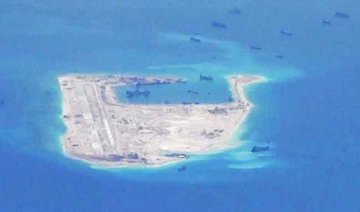
MANILA: China is expanding artificial islands in disputed South China Sea areas despite saying it stopped two years ago, according to a security think tank that released satellite images it said showed the land reclamation.
Beijing claims most of the sea and has been turning reefs in the Spratly and Paracel chains into islands, installing military aircraft and missile systems on them — an activity the Asia Maritime Transparency Initiative (AMTI) said was continuing.
“China’s own reclamation work did not end in mid-2015 with the completion of its artificial islands in the Spratlys. Beijing continues to reclaim land farther north, in the Paracel Islands,” the security think tank said on its website.
Chinese Foreign Minister Wang Yi told reporters on the sidelines of the Association of Southeast Asian Nations (ASEAN) regional forum in Manila on Monday that Beijing completed its South China Sea reclamation activities two years ago.
“I also wanted to tell you that two years ago, China had already completed the reclamation. That is something I can tell you for sure,” Wang said, adding “it is not China” which was conducting ongoing reclamation activities.
The AMTI website on Wednesday posted satellite pictures that it said showed Wang’s statements were “false.”
China has since 2015 dredged a new harbor and added 10 hectares of land on Tree island in the Paracels, and has recently completed a new helipad and installed wind turbines and photovoltaic solar arrays there, it said.
Since reclamation work to connect two other Paracel islands was washed out by a typhoon last October, China has undertaken additional reclamation and built new structures there, it added.
China claims nearly all of the strategically vital sea, through which $5 trillion in annual shipping trade passes and is believed to sit atop vast oil and gas deposits.
Its sweeping claims overlap with those of ASEAN members Vietnam, the Philippines, Malaysia and Brunei, as well as Taiwan.
China on Sunday scored a diplomatic coup when foreign ministers from the 10-member ASEAN bloc released a diluted joint statement on the dispute that failed to mention China on the issue and agreed to its terms on how to negotiate a resolution.
Nevertheless, China was angered by wording in the statement pushed by Vietnam that expressed concerns by some about land reclamations, even though it did not name Beijing.
The Philippines had for many years stood alongside Vietnam as one of the strongest opponents to Chinese expansionism.
A UN-backed tribunal ruled last year that China’s territorial claims in the sea were without legal basis.
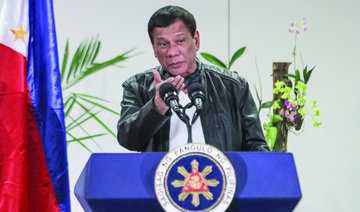
But the Philippines, under President Rodrigo Duterte, decided not to use the verdict to pressure. It instead built closer ties with China in return for billions of dollars worth of investments and aid.
Philippine Foreign Secretary Alan Peter Cayetano told reporters on Tuesday he had lobbied against referring to land reclamation in the ASEAN statement because he believed China had stopped.
“They (Chinese) are not reclaiming land anymore,” Cayetano said.

Beijing still expanding South China Sea islands, says think tank
Japan ruling party approves plans to beef up intelligence
TOKYO: Japanese Prime Minister Sanae Takaichi’s ruling party has approved plans to beef up the country’s intelligence capability, a party official said Friday, as the premier pushes ahead with a defense overhaul.
Newly empowered after a landslide victory in snap elections this month, Takaichi has vowed to make Japan “strong and prosperous” through key policy changes including in defense and intelligence.
The plans come as a months-long diplomatic row between Japan and China over comments Takaichi made on Taiwan rumbles on.
The proposal, agreed by the intelligence strategy headquarters of the Liberal Democratic Party (LDP), includes establishing an upgraded intelligence bureau and strengthening “foreign intelligence collection capabilities,” an LDP official told AFP.
It calls for a mandatory registration system for foreign agents — such as individuals and corporations lobbying within Japan on behalf of other governments — as part of counterintelligence measures.
The plan, which also includes a ban on the use of mobile phones in key government buildings, is expected to be submitted to Takaichi next week, the Asahi Shimbun and other local media reported.
“One of the central pillars of the major policy shift (under Takaichi) is a fundamental strengthening of intelligence,” the LDP’s policy chief Takayuki Kobayashi said at the meeting Thursday where plans were approved.
“Simply creating an organization on paper is utterly meaningless; the question is how we can turn it into a truly living, functioning body,” he said.
Separately, the LDP on Wednesday proposed changes to Japan’s stringent rules on exporting military equipment so as to enable exports of lethal weapons, local reports said.
The LDP official could not immediately confirm the proposal.
Takaichi has also said that she plans to revise three key national security policy documents this year to reflect the changing security environment.
The premier, seen as a China hawk before becoming premier in October, suggested in November that Japan could intervene militarily if Beijing sought to take Taiwan by force.
China, which regards the democratic island as part of its territory and has not ruled out force to annex it, was furious.
It summoned Tokyo’s ambassador, warned Chinese citizens against visiting Japan and in December J-15 jets from China’s Liaoning aircraft carrier twice locked radar on Japanese aircraft in international waters near Okinawa, according to Japan.
Takaichi has vowed that Japan will steadfastly protect its territory, territorial waters and airspace.
Beijing’s top diplomat Wang Yi told the Munich Security Conference earlier this month that forces in Japan were seeking to “revive militarism.”
While she has said in parliament she will not change the rules, local media have reported that Takaichi is considering allowing US nuclear weapons into Japanese territory, a revision to the country’s non-nuclear principles of not producing, possessing or permitting the introduction of the weapons into the country.
Newly empowered after a landslide victory in snap elections this month, Takaichi has vowed to make Japan “strong and prosperous” through key policy changes including in defense and intelligence.
The plans come as a months-long diplomatic row between Japan and China over comments Takaichi made on Taiwan rumbles on.
The proposal, agreed by the intelligence strategy headquarters of the Liberal Democratic Party (LDP), includes establishing an upgraded intelligence bureau and strengthening “foreign intelligence collection capabilities,” an LDP official told AFP.
It calls for a mandatory registration system for foreign agents — such as individuals and corporations lobbying within Japan on behalf of other governments — as part of counterintelligence measures.
The plan, which also includes a ban on the use of mobile phones in key government buildings, is expected to be submitted to Takaichi next week, the Asahi Shimbun and other local media reported.
“One of the central pillars of the major policy shift (under Takaichi) is a fundamental strengthening of intelligence,” the LDP’s policy chief Takayuki Kobayashi said at the meeting Thursday where plans were approved.
“Simply creating an organization on paper is utterly meaningless; the question is how we can turn it into a truly living, functioning body,” he said.
Separately, the LDP on Wednesday proposed changes to Japan’s stringent rules on exporting military equipment so as to enable exports of lethal weapons, local reports said.
The LDP official could not immediately confirm the proposal.
Takaichi has also said that she plans to revise three key national security policy documents this year to reflect the changing security environment.
The premier, seen as a China hawk before becoming premier in October, suggested in November that Japan could intervene militarily if Beijing sought to take Taiwan by force.
China, which regards the democratic island as part of its territory and has not ruled out force to annex it, was furious.
It summoned Tokyo’s ambassador, warned Chinese citizens against visiting Japan and in December J-15 jets from China’s Liaoning aircraft carrier twice locked radar on Japanese aircraft in international waters near Okinawa, according to Japan.
Takaichi has vowed that Japan will steadfastly protect its territory, territorial waters and airspace.
Beijing’s top diplomat Wang Yi told the Munich Security Conference earlier this month that forces in Japan were seeking to “revive militarism.”
While she has said in parliament she will not change the rules, local media have reported that Takaichi is considering allowing US nuclear weapons into Japanese territory, a revision to the country’s non-nuclear principles of not producing, possessing or permitting the introduction of the weapons into the country.
© 2026 SAUDI RESEARCH & PUBLISHING COMPANY, All Rights Reserved And subject to Terms of Use Agreement.