Taylor Swift’s mom wanted to keep groping allegation private

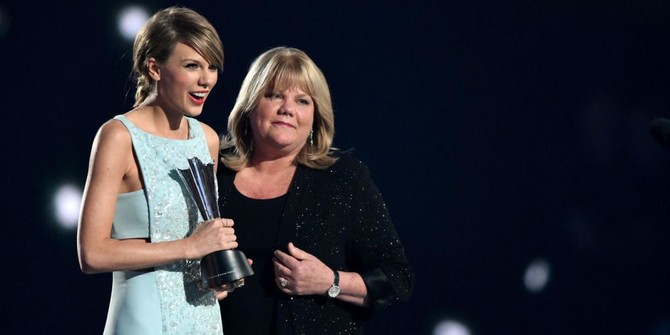
Pop singer Taylor Swift (L) and her mother Andrea Finlay. (Photo courtesy: social media)
Updated 10 August 2017
Follow

Taylor Swift’s mom wanted to keep groping allegation private

DENVER, USA: Taylor Swift’s mother said she didn’t call police to report allegations that a radio station DJ groped her daughter before a concert because she didn’t want the moment to define the pop star’s life. Likewise, a liaison for Taylor Swift who deals with radio stations across the country asked the DJ’s boss to keep a photo of the alleged assault confidential.
Wednesday’s testimony highlighted an initial attempt to keep the encounter in Denver out of the spotlight. Yet four years later, Swift and former DJ David Mueller are embroiled in a widely publicized federal court case.
“I did not want to make her relive this moment over and over again,” said a tearful Andrea Swift, who described her daughter as “humiliated” and “really shaken” after a meet-and-greet with Mueller.
“We absolutely wanted to keep it private, but we didn’t want him to get away with it,” she said.
Mueller sued Taylor Swift after her team told his bosses at a country music station that he had reached under her dress and touched her backside during a photo op in 2013. He is seeking at least $3 million, saying the allegation cost him his job and reputation.
Swift countersued Mueller, claiming sexual assault. She is seeking a symbolic $1, saying she wants to serve as an example to other women who have been assaulted.
Andrea Swift testified Wednesday that her daughter never urged any specific action against Mueller.
She also said the encounter changed their interactions with the public, explaining that Taylor Swift’s meet-and-greets are now smaller and her interaction with fans at concerts is more limited.
“It absolutely shattered our trust,” Andrea Swift said. “It scared us, scared us very badly.”
The final testimony of the day came from Frank Bell, Swift’s liaison.
He said he e-mailed the photo of Swift, Mueller and Mueller’s girlfriend to Robert Call, KYGO’s general manager, for use in Call’s investigation of Mueller. In the e-mail sent the morning after the concert, Bell asked Call to keep the photo confidential.
Bell, a longtime friend of the singer-songwriter’s father, also said he didn’t ask that Mueller be fired but that “appropriate action be taken.”
Earlier in the day, Mueller testified that the photo taken before the concert was “weird and awkward,” but he insisted that he touched Swift in the ribs, not in the rear, as she alleges in her lawsuit.
Swift’s attorney Douglas Baldridge repeatedly asked Mueller why his right hand was behind Swift in the picture.
Mueller said his hand was touching Swift’s skirt after he put his arm around her and their arms got crossed.
“My hand was at rib-cage level and apparently it went down,” Mueller said.
In the image, shown to jurors during opening statements but not publicly released, Mueller’s hand is behind Swift, just below her waist. Both are smiling.
McFarland told jurors that the photo does not show Mueller’s hand under Swift’s skirt and that the skirt was not rumpled.
Baldridge, however, said several people noticed the pop star was upset after meeting with Mueller.
Her bodyguard, Greg Dent, has testified in a deposition that he saw Mueller lift Swift’s skirt, Baldridge told jurors.
In addition, Baldridge quoted a deposition by Swift’s photographer Stephanie Simbeck, who said Swift uttered “that guy” had grabbed her behind.
Dent and Simbeck are listed as possible witnesses at the trial.
Baldridge told jurors in his opening statement that Swift is “absolutely certain” she was sexually assaulted by Mueller, and the photo is “damning” proof of it.


Eating snow cones or snow cream can be a winter delight, if done safely

Updated 28 January 2026
Follow

Eating snow cones or snow cream can be a winter delight, if done safely

  • As the storm recedes, residents of lesser-affected areas might be tempted to whip up bowls of “snow cream”
  • Fassnacht said he tried “snow cream” for the first time last year when some students made him some

WASHINGTON: Take two snowballs and call me in the morning?
Dr. Sarah Crockett, who specializes in emergency and wilderness medicine, doesn’t explicitly tell her patients at New Hampshire’s Dartmouth-Hitchcock Medical Center to swallow snow, but she often prescribes more time outside. If that time includes eating a handful of ice crystals straight or adding ingredients to make snow cones and other frozen treats, she’s all for it.
“To stop and just be present and want to catch a snowflake on your tongue, or scoop up some fresh, white, untouched snow that’s collected during something as exciting as a snowstorm, I think that there’s space in our world to enjoy that,” Crockett said. “And while we need to make good choices, I think these are simple things that can bring joy.”
Getting outdoors to enjoy simple pleasures is unlikely to be front of mind for people in a 1,300-mile (2,100-kilometer) stretch of the United States where a massive weekend storm brought deep snow and bitter cold. Freezing rain and ice brought down power lines and tree limbs, leaving hundreds of thousands of homes without power or heating in the South, while snow upended road and air travel from Arkansas to New England.
As the storm recedes, residents of lesser-affected areas might be tempted to whip up bowls of “snow cream” — snow combined with milk, sugar and vanilla — after seeing techniques demonstrated on TikTok. Others might want to try “sugar on snow,” a taffy-like confection made by pouring hot maple syrup onto a plate of snow.
Despite its pristine appearance, snow isn’t always clean enough to consume. Crockett and other experts shared advice for digging in safely while digging out.
The science of snow
Whether it’s rain or snow, precipitation cleans the atmosphere, picking up pollutants as it falls, said Steven Fassnacht, a professor of snow hydrology at Colorado State University. But snowflakes pick up more impurities because they fall more slowly and have more exposed surface areas than raindrops, he said.
That means snow that falls near coal plants or factories that emit particulates into the air contains more contaminants, said Fassnacht, who was in Shinjo, Japan, last week studying the salt content of snow. He said he wouldn’t have hesitated to take a taste there because there weren’t any big industrial complexes upwind.
“Snow can be eaten, but you want to think about the trajectory. Where did that snow come from?” he said.
Timing is another consideration, according to Crockett. The first wave of snow holds the most particulate matter, she said, so waiting until a storm is well underway before putting out a bowl to collect falling snow is one precaution to take.
Ground contamination is an additional factor, experts say. Avoiding yellow snow, which may be tainted by urine or tree bark, is conventional wisdom, but it’s also a good idea to stay away from any snow pushed by snowplows and packed with road salt, deicing chemicals and debris.
Snack versus survival
What about eating snow to survive? Crockett, who oversees the wilderness medicine program at Dartmouth College’s Geisel School of Medicine, says that’s a bad idea.
The energy it takes to melt snow in your mouth as you’re eating it essentially counteracts the hydration benefit, plus it decreases your core body temperature and increases the risk of hypothermia. While outdoor enthusiasts who plan to spend days in the mountains often melt and boil snow to purify it for drinking, it shouldn’t be viewed as an immediate hydration source, she said.
“If you are disoriented on a local hike, I would say your number one priority is to try to reach out for help in any way you can, ... not ‘Can I eat enough snow?’” Crockett said.
Focus on rewards, not risks
Fassnacht, who has studied snow for more than 30 years, said he tried “snow cream” for the first time last year when some students made him some. He described it as a fun experience that got him thinking about flavors and textures, not contaminants.
“It’s a whimsical thing,” he said. “It made me think about what are the characteristics of that freshly fallen snow, and how does that change the taste sensation?”
Crockett likewise is a fan of finding inspiration and wonder in nature. She worries that overprotective parenting has contributed to anxiety in some young people, and that excessive warnings about eating snow could add to that.
“We have to strike that right balance of making sure we’re avoiding danger while not being so protective that we encourage this ‘Everything is going to harm me’ mentality, particularly for children,” she said.
Crockett has four children, including a daughter she described as a “passionate snow eater.” As the recent winter storm got underway, she asked her why she liked eating snow so much and was told, “It makes me feel connected to the Earth.”
“That is actually something that’s really important to me, that we all have this connection to nature,” Crockett said.