

Taliban release 235 hostages after Afghanistan ‘massacre’

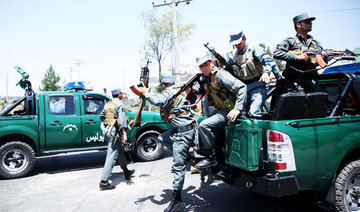
In this July 25, 2017 photo, Afghan mourners carry the coffin of one of the 26 victims killed in a car bombing in Kabul, one of the latest violence inflicted by the Taliban in the war-ravaged country. On Tuesday, the Taliban released 235 hostages from a remote village in the north where it allegedly massacred around 50 civilians along with Daesh insurgents.(AFP file photo)
Updated 09 August 2017
Follow

Taliban release 235 hostages after Afghanistan ‘massacre’

MAZAR-I-SHARIF, Afghanistan: The Taliban released 235 hostages from a remote village in northern Afghanistan where it allegedly massacred around 50 civilians along with Daesh insurgents but others were still feared held, officials said Tuesday.
“This evening 235 people including women and children were released from Mirzawalang as a result of mediation by the local elders and provincial officials,” Zabihullah Amani, a spokesman for the provincial governor, told AFP.
“They have been safely evacuated to Sar-e Pul city, but there are still an unknown number of people being kept hostage there,” he added.
An Afghan security source said he thought there were still around 100 people being held hostage in Mirzawalang, situated in the Sayad district of Sar-e Pul province, after insurgents captured it at the weekend.
Taliban and Daesh fighters killed around 50 men, women and children in the mainly Shiite village on Saturday after overrunning a government-backed militia in a 48-hour battle, according to local officials, who also said they took a number of residents captive.
“Despite the efforts of elders the bodies of the victims have not been recovered,” Mohammad Zaher Wahdat, the provincial governor, told Tolo News, an Afghanistan television news channel.
“Two hundred and thirty-five hostages have been released. They are so shocked they can’t even speak to tell us about anymore other hostages,” he added.
Amani, the provincial spokesman, has said that dozens of Taliban and Daesh group fighters, under the command of a local Taliban commander who he claimed pledged allegiance to Daesh, launched a co-ordinated attack on the area on Thursday.
They defeated the Afghan Local Police (ALP) after a 48-hour battle before massacring civilians, he claimed. The majority of those killed were Shiites. Most were shot or beheaded, he said.

Village isolated
Afghan defense ministry spokesman Dawlat Waziri told AFP that 34 civilians were known to have been killed.
The discrepancy highlights the difficulty of verifying information from poor, mountainous areas of Afghanistan made inaccessible by fighting and with patchy communications. AFP was not able to access the village.
Before confirmation of the release of hostages Amani said that 150 families were being held while Waziri said “an unknown number of people” had been taken hostage. 
“Since the villages is cut off, we can’t confirm any new killings by the terrorists,” Amani told AFP.
The Taliban confirmed capturing Mirzawalang but said it did so alone. It has also denied allegations it had killed civilians.
Taliban and IS fighters have regularly clashed in Afghanistan over the past two years but security sources say they have teamed up in the past to strike Afghan forces in certain areas.
“Commando forces have been deployed to the area, air strikes are being carried out as we speak, and commanders on the ground are busy planning the recapture of the valley,” said Waziri, the defense spokesman.
“The operation to retake the valley will happen soon, and the terrorists will pay for their crimes,” he added.
Sediq Sediqi, a spokesman for the Afghan government, told AFP it was difficult to know numbers of civilians concerned but said “President Ashraf Ghani has instructed everyone to do everything to safeguard those people.”

Pakistan Embassy denies role in Kabul visa black market as Afghans turn to agents

Updated 5 sec ago
Follow

Pakistan Embassy denies role in Kabul visa black market as Afghans turn to agents

  • Arab News investigation earlier found how Afghans resort to tour agents, pay up to $1,800 to obtain Pakistani visas
  • Any additional money charged by travel agents is ‘outside the purview’ of the embassy, spokesperson says

KABUL: The Pakistani Embassy in Kabul has rejected reports of knowledge of a black market for Pakistani visas, emphasizing its unwavering commitment to a fair and accessible visa system for Afghans.

An Arab News investigation published last month found Afghans resorting to tour agents and paying exorbitant prices to obtain Pakistani travel documents, with desperate applicants paying between $1,300 and $1,800 for visas that officially cost more than 50 times less.

In a rebuttal shared with Arab News, the Embassy of Pakistan in Kabul said it “has no official agents, intermediaries, or affiliated travel companies authorized to collect money” from visa applicants.

“The embassy’s official visa fee is published transparently and must be paid directly via credit card. We are aware that many applicants lack credit cards and often rely on local agents for assistance with the online payment,” Sayed Khizar Ali, the embassy’s press counsellor, said in a statement to Arab News.

“Our commitment to a transparent, fair, and accessible visa system for our Afghan brothers remains unwavering.”

Multiple travel agencies in Kabul and Nangarhar that earlier confirmed to Arab News that Pakistani visas are traded on the black market have maintained their statements.

“How can it be outside their control when we send applications and they come back approved within three days?” one manager of a travel agency who declined to be named told Arab News this week.

“The embassy stamps the visas. They know where they come from.”

He said his agency has been processing dozens of visas weekly since October, after tensions between Afghanistan and Pakistan rose following a week of deadly clashes at their shared border.

“The travel agencies that are registered with them, we are the only way. If you don’t go through us, you won’t get a visa,” he said.

Despite the embassy’s denial that it does not work through travel agents, public advertisements by several tour agents offering services for “guaranteed” medical and tourist visas can be seen both online and on their storefronts. Though prices are negotiated privately, many openly promise quick turnarounds of just a few days.

The Afghan Ministry of Interior and Ministry of Foreign Affairs did not respond to requests for comment, despite repeated attempts by Arab News.

Pakistan’s visa fee for Afghan nationals is approximately $25, paid through a fully digital online system. But applicants who attempt to follow this channel told Arab News the process often ends in silent rejection after months of waiting.

Asma, an Afghan national who has been trying to join her fiance in Switzerland, had to go through tour agents to obtain her and her father’s Pakistan visas.

“I applied online through the official channel. That was four months ago. I never heard anything back. No response, no explanation — just complete silence,” Asma told Arab News earlier.

The cost to obtain the travel documents was double for her, as her father also had to apply in order to accompany her due to Afghanistan’s strict travel rules for unmarried women.

“We heard from neighbors that some agencies in Kabul could get it done faster … We went there,” she said, adding that they received their visas on WhatsApp three days later — not through official channels but through a cousin’s contact.

One agency employee who agreed to speak anonymously earlier described a system organized around waiting lists and contacts at the Pakistani Embassy and consulates in Kabul, Nangarhar, Kandahar and Mazar-e-Sharif.

“We have lists. Each list works like seats on a plane. When one list is full, we start filling the next. Every day, a list goes out — meaning visas are issued daily,” he said.

“These days, no visa costs less than $1,300 and none exceed $1,800. This rate has been stable for over a month.”

However, the Embassy of Pakistan in Kabul maintained that these reports are “unfounded and most unfortunate.

“Any additional money these private agents may charge applicants is an illegal and unofficial practice that occurs entirely outside the purview and control of the embassy.”