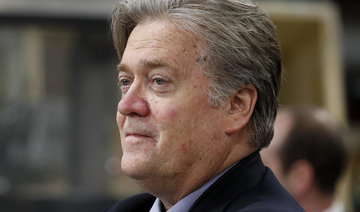
Tillerson in Thailand, as US cosies up to oldest Asian ally

Thai Prime Minister Prayut Chan-o-cha (R) shows the way to U.S. Secretary of State Rex Tillerson (L) during a meeting at Government House in Bangkok, Thailand, August 8, 2017. (REUTERS)
Updated 08 August 2017
Follow

Tillerson in Thailand, as US cosies up to oldest Asian ally

BANGKOK: US Secretary of State Rex Tillerson landed in Bangkok on Tuesday for talks with junta chief Prayut Chan-O-Cha, the highest-level American diplomatic visit since the Thai army grabbed power in a 2014 coup.
The one-day drop-in comes as Washington reboots its relationship with Thailand under President Donald Trump, whose administration has enraged rights groups by cosying up to strongmen around the globe.
The Thai army’s 2014 toppling of the civilian government pinched ties with Washington, who distanced itself from its oldest ally in Asia and trimmed back military aid.
But relations are on a better footing under Trump, with the US president extending an invitation to junta chief Prayut Chan-O-Cha.
The thaw also comes amid Washington’s growing concerns of rival superpower China’s clout in the region.
Beijing entices its smaller neighbors by offering massive investment decoupled from human rights concerns, which appeals to leaders weary of US pressure.
Thailand is a lynchpin country in China’s massive trade and infrastructure ‘One Belt, One Road’ strategy.
A US Embassy spokesperson said Tillerson would discuss regional flashpoints such as North Korea’s nuclear missile program and territorial disputes in the South China Sea.
It was not immediately clear how firmly the former oilman would push the junta government on its crackdown on political rights.
The US wants Thailand to “emerge as a strengthened democracy that respects and guarantees human rights and fundamental freedoms,” said embassy spokesperson Steve Castonguay.
Earlier in the week Susan Thornton, acting US Assistant Secretary of State for East Asian Affairs, defended America’s reach out to the military regime, as pragmatism appears to outweigh principle in Trump’s foreign affairs agenda.
“They have a road map by which they’re going to work toward a restoration of constitutional government, democratic elections,” she said.
“It’s time to go back and encourage them.”
Tillerson’s visit comes on the heels of a regional forum in Manila, where the former ExxonMobil CEO hailed a UN measure to pass tough new sanctions on North Korea over its growing nuclear arsenal.
Trump has tried to browbeat Beijing — North Korea’s ally and biggest trade partner — into reining in the hermit state’s ballistic missile program.
The US has also turned to Southeast Asian nations to help isolate Pyongyang, though it failed to persuade the regional bloc to bar North Korea’s top envoy from last week’s forum.
Tillerson is also slated to pay respects to Thailand’s late King Bhumibol Adulyadej, who has been lying in state at the Grand Palace since his death in October 2016.
Later he will travel to the Malaysian capital.


Rubio plans to visit Israel next week as US-Iran tensions remain high after latest talks

Updated 5 sec ago
Follow

Rubio plans to visit Israel next week as US-Iran tensions remain high after latest talks

TEL AVIV, Israel: US Secretary of State Marco Rubio will make a quick trip to Israel early next week, the State Department said, as tensions between the United States and Iran remain high after their latest nuclear talks and American forces gather in the region.
The US Embassy in Israel had earlier urged staff who want to leave to depart, joining other nations in encouraging people to leave the region and signaling that US military action might be imminent. The announcement of Rubio’s visit could indicate a longer timeline for any potential strike.
A confidential report from the UN nuclear watchdog meanwhile confirmed that Iran has not offered inspectors access to sensitive nuclear sites since they were heavily bombed during the 12-day war launched by Israel last June. As a result, it said it could not confirm Iran’s claims that it stopped uranium enrichment after the US and Israeli strikes.
The report was circulated to member countries and seen by The Associated Press.
US President Donald Trump has threatened military action if Iran does not agree to a far-reaching deal on its nuclear program. Iran insists it has the right to enrich uranium for peaceful purposes and denies seeking a nuclear weapon.
Those wishing to leave ‘should do so TODAY’
The State Department said in a statement that Rubio would visit Israel on Monday and Tuesday to “discuss a range of regional priorities including Iran, Lebanon, and ongoing efforts to implement President Trump’s 20-Point Peace Plan for Gaza.” It offered no other details.
Israeli Prime Minister Benjamin Netanyahu has long urged tougher US action against Iran, and has warned that Israel will respond to any Iranian attack.
The announcement of Rubio’s visit came just hours after the US Embassy in Jerusalem implemented “authorized departure” status for non-essential personnel and family members, which means that eligible staffers can leave the country voluntarily at government expense.
In an email, US Ambassador Mike Huckabee urged staff considering departure to do so quickly, advising them to focus initially on getting any flight out of Israel and to then make their way to Washington.
“Those wishing to take AD should do so TODAY,” Huckabee wrote, using an acronym for “authorized departure.”
“While there may be outbound flights over the coming days, there may not be,” he added, in an email that was recounted to The Associated Press by someone involved with the US mission who wasn’t authorized to share details.
On a town hall meeting Friday after the email was sent, Huckabee told staff that he was encouraging airlines to keep flying.
Vance to meet with mediator
Iran and the United States on Thursday walked away from another round of nuclear negotiations in Geneva without a deal. Technical discussions are scheduled to take place in Vienna next week.
US Vice President JD Vance was to meet later on Friday in Washington with Oman’s foreign minister, Badr Al-Busaidi, who has been mediating the talks, according to a person with knowledge of the meeting who spoke on condition of anonymity because the meeting is private.
Earlier, Al-Busaidi said that there had been significant progress made on Thursday, though officials from Iran and the United States haven’t announced steps forward.
Iranian Foreign Minister Abbas Araghchi on Thursday said “what needs to happen has been clearly spelled out from our side,” without offering specifics. Iran has long demanded relief from heavy international sanctions in return for taking steps to limit but not end its nuclear program.
The UN chief meanwhile urged Iran and the US “to focus on the diplomatic track” even as tensions rise and a potential for a US strike remains very possible.
“We’re seeing both positive messages coming out of the diplomatic tracts, which we’re continuing to encourage,” UN Secretary-General António Guterres said, according to his spokesperson Stephane Dujarric. “We’re also seeing very worrying military movements. throughout the region, which is extremely concerning as well.”
Flights suspended as people are urged to leave

The US has gathered a massive fleet of aircraft and warships in the Middle East, with one aircraft carrier already in place and another heading to the region. Iran says it will respond to any US attack by targeting American forces in the region, potentially including those stationed in US bases in allied Arab countries.
Airlines such as Netherlands-based KLM have already announced plans to suspend flights out of Tel Aviv’s Ben Gurion International Airport, and other embassies have also made plans for authorized departures from Israel and neighboring countries.
Britain’s Foreign Office said that “due to the security situation, UK staff have been temporarily withdrawn from Iran.” It said the embassy was operating remotely.
In Israel, the UK said Friday it moved some diplomatic staff and their families from Tel Aviv to another, unspecified location in Israel “as a precautionary measure.” In an update to its travel advice, the Foreign Office added that the country’s embassy in Tel Aviv is operating as normal but that the situation “could escalate quickly and poses significant risks.”
British Prime Minister Keir Starmer said Thursday the UK was focused on “supporting the political process” between Washington and Tehran.
Australia on Wednesday “directed the departure of all dependents of Australian officials posted to Israel in response to the deteriorating security situation in the Middle East.” China, India and several European countries with missions in Iran have advised citizens to avoid travel to the country.
China’s Foreign Ministry also advised its citizens already in Iran to leave, according to a statement reported by Chinese state media.