MANILA: North Korea on Monday angrily insisted tough new United Nations sanctions would not stop it from developing its nuclear arsenal, and warned it would not negotiate while being threatened by the United States.
The message of defiance was the first major response to the US-drafted sanctions that the UN Security Council unanimously approved over the weekend that could cost North Korea $1 billion a year while restricting crucial economic links with China.
The sanctions were a “violent violation of our sovereignty,” Pyongyang said in a statement carried by its official Korea Central News Agency.
“We will not put our self-defensive nuclear deterrent on the negotiating table” while it faced threats from Washington, it said, “and will never take a single step back from strengthening our nuclear might.”
North Korea threatened to make the United States “pay the price for its crime... thousands of times.”
The statement came as North Korea’s Foreign Minister Ri Yong-Ho was in the Philippine capital of Manila for a security forum with the top diplomats from the United States, China, Russia and other Asia-Pacific nations.
US Secretary of State Rex Tillerson on Monday ruled out a quick return to dialogue with North Korea, saying the new sanctions showed the world had run out of patience with Pyongyang’s nuclear weapons ambitions.
Speaking to reporters at the forum, Tillerson said Washington would only consider talks if Pyongyang halted its ballistic missile program.
“The best signal that North Korea could send that they’re prepared to talk would be to stop these missile launches,” he said.
Tillerson held out the prospect of US envoys at some point sitting down with Pyongyang’s isolated regime and avoiding war, although he refused to say how long the North might have to refrain from testing more long-range missiles.
“I’m not going to give someone a specific number of days or weeks. This is really about the spirit of these talks,” he said.
The sanctions were in response to the North conducting its first two intercontinental ballistic missile tests last month that Kim boasted showed he could strike any part of the United States.
Tillerson’s remarks followed a rare exchange on Sunday between Ri and his South Korean counterpart, Kang Kyung-Wha, at a dinner to welcome all the foreign ministers.
Kang urged Ri to accept Seoul’s offers of military talks to lower tensions on the divided peninsula and for discussions on a new round of reunions for divided families, according to South Korea’s Yonhap news agency.
But Yonhap reported that Ri retorted: “Given the current situation in which the South collaborates with the US to heap pressure on the North, such proposals lacked sincerity.”
US President Donald Trump and his South Korean counterpart, Moon Jae-In, spoke on the phone on Sunday and agreed the North “poses a grave and growing direct threat,” according to a White House statement.
Trump later took to social media to hail the vote, thanking Russia and China in a Twitter post for backing the sanctions that either could have halted with their UN veto.
Trump said he was “very happy and impressed with 15-0 United Nations vote on North Korea sanctions.”
Tillerson, who held separate talks in Manila with foreign ministers Wang Yi of China and Sergei Lavrov of Russia on Sunday, also sought to emphasize a united stance against the North.
“It’s quite clear in terms of there being no daylight between the international community as to the expectation that North Korea will take steps to achieve all of my objectives, which is a denuclearised Korean peninsula,” he said.
In pointed criticism of Beijing and Moscow, Pyongyang’s fiery statement said other nations that “received appreciation from the US” for supporting the resolution would also be “held accountable for escalating tension on the peninsula.”
Washington has recently stepped up pressure on Beijing to rein in its unpredictable neighbor, which relies heavily on China for aid and trade.
Signalling that differences remained between the world powers on how to handle the North, Wang on Sunday reiterated China’s position that sanctions alone would not solve the problem and called again for the US to talk to the North.


![]()
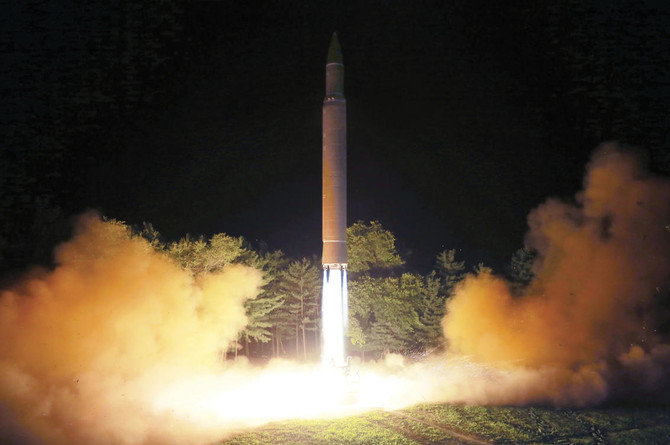

North Korea defiant after new sanctions, rejects talks
North Korea defiant after new sanctions, rejects talks
Trump’s new tariffs shift focus to balance of payments; economists see no crisis
President Donald Trump’s temporary 15 percent tariffs to replace those struck down by the US Supreme Court are meant to resolve a problem that many economists say does not exist: a US balance of payments crisis, making them potentially vulnerable to new legal challenges.
Hours after the high court on Friday struck down a huge swath of tariffs Trump had imposed under the International Emergency Economic Powers Act, the president announced the new duties under Section 122 of the Trade Act of 1974 — a never-used statute that even his own legal team dismissed as irrelevant months ago.
Collections of the new 15 percent tariffs began at midnight on Tuesday as IEEPA tariff collections of 10 percent to 50 percent halted.
The Section 122 law allows the president to impose duties of up to 15 percent for up to 150 days on any and all countries to address “large and serious” balance-of-payments deficits and “fundamental international payments problems.”
Trump’s tariff order argued that a serious balance of payments deficit existed in the form of a $1.2 trillion annual US goods trade deficit and a current account deficit of 4 percent of GDP and a reversal of the US primary income surplus.
Some economists, including former International Monetary Fund First Deputy Managing Director Gita Gopinath, disagreed with the Trump administration’s alarm.
“We can all agree that the US is not facing a balance of payment crisis, which is when countries experience an exorbitant increase in international borrowing costs and lose access to financial markets,” Gopinath told Reuters.
Gopinath rejected the White House’s claim that a negative balance on the US primary income for the first time since 1960 was evidence of a large and serious balance of payment problem.
She attributed the negative balance to a large increase in foreign purchases of US equities and risky assets over the past decade, which outperformed foreign equities over this period.
Mark Sobel, a former US Treasury and IMF official, said that balance of payments crises are more associated with countries that have fixed exchange rates, and noted that the floating-rate dollar has been steady, the 10-year Treasury yield fairly stable, with US stocks performing well.
Josh Lipsky, chair of international economics at the Atlantic Council think tank, agreed, noting that a balance of payments crisis occurred when a country could not pay for what it was importing or was unable to service foreign debt. That was fundamentally different from a trade deficit, he added.
Brad Setser, a currency and trade expert at the Council on Foreign Relations who served as a senior adviser to the US Trade Representative in the Biden administration, took a somewhat contrarian view, arguing in lengthy X posts on Sunday that the Trump administration may have a reasonable case that there is a “large and serious” balance of payments deficit.
He noted that the current account deficit was far higher than when then-president Richard Nixon erected tariffs in 1971 to address a balance of payments crisis, and the US net international investment position is much worse. This “gives the administration a real argument,” in favor of its tariffs, Setser wrote.
The White House, US Treasury and US Trade Representative did not immediately respond to requests for comment about the use of Section 122.
WRONG STATUTE FOR THE JOB
Despite the Trump administration’s new focus on balance of payments, the Justice Department had previously argued that Section 122 was the wrong statute to handle a national emergency over the trade deficit.
In court filings in its defense of IEEPA tariffs, the Justice Department said Section 122 would not have “any obvious application here, where the concerns the president identified in declaring an emergency arise from trade deficits, which are conceptually distinct from balance-of-payments deficits.”
Neal Katyal, who argued at the Supreme Court on behalf of plaintiffs challenging the IEEPA tariffs, told CNBC that the Trump administration’s stance against the use of Section 122 for a trade deficit will make those tariffs vulnerable to litigation.
“I’m not sure it will necessarily even need to get to the Supreme Court, but if the president adheres to this plan of using a statute that his own Justice Department has said he can’t use, yeah, I think that’s a pretty easy thing to litigate,” Katyal said.
It is unclear who might take the lead in challenging the Section 122 tariffs.
Sara Albrecht, chair of the Liberty Justice Center, a nonprofit, public-interest law firm representing several small businesses that challenged the IEEPA tariffs, said the group would closely monitor any new statutes being invoked.
Albrecht did not reveal any future litigation strategy, adding: “Our immediate focus is simple: making sure the refund process begins and that checks start flowing to the American businesses that paid those unconstitutional duties.”
In its ruling, the Supreme Court did not give instructions regarding refunds, instead remanding the case to a lower trade court to determine next steps.
Hours after the high court on Friday struck down a huge swath of tariffs Trump had imposed under the International Emergency Economic Powers Act, the president announced the new duties under Section 122 of the Trade Act of 1974 — a never-used statute that even his own legal team dismissed as irrelevant months ago.
Collections of the new 15 percent tariffs began at midnight on Tuesday as IEEPA tariff collections of 10 percent to 50 percent halted.
The Section 122 law allows the president to impose duties of up to 15 percent for up to 150 days on any and all countries to address “large and serious” balance-of-payments deficits and “fundamental international payments problems.”
Trump’s tariff order argued that a serious balance of payments deficit existed in the form of a $1.2 trillion annual US goods trade deficit and a current account deficit of 4 percent of GDP and a reversal of the US primary income surplus.
Some economists, including former International Monetary Fund First Deputy Managing Director Gita Gopinath, disagreed with the Trump administration’s alarm.
“We can all agree that the US is not facing a balance of payment crisis, which is when countries experience an exorbitant increase in international borrowing costs and lose access to financial markets,” Gopinath told Reuters.
Gopinath rejected the White House’s claim that a negative balance on the US primary income for the first time since 1960 was evidence of a large and serious balance of payment problem.
She attributed the negative balance to a large increase in foreign purchases of US equities and risky assets over the past decade, which outperformed foreign equities over this period.
Mark Sobel, a former US Treasury and IMF official, said that balance of payments crises are more associated with countries that have fixed exchange rates, and noted that the floating-rate dollar has been steady, the 10-year Treasury yield fairly stable, with US stocks performing well.
Josh Lipsky, chair of international economics at the Atlantic Council think tank, agreed, noting that a balance of payments crisis occurred when a country could not pay for what it was importing or was unable to service foreign debt. That was fundamentally different from a trade deficit, he added.
Brad Setser, a currency and trade expert at the Council on Foreign Relations who served as a senior adviser to the US Trade Representative in the Biden administration, took a somewhat contrarian view, arguing in lengthy X posts on Sunday that the Trump administration may have a reasonable case that there is a “large and serious” balance of payments deficit.
He noted that the current account deficit was far higher than when then-president Richard Nixon erected tariffs in 1971 to address a balance of payments crisis, and the US net international investment position is much worse. This “gives the administration a real argument,” in favor of its tariffs, Setser wrote.
The White House, US Treasury and US Trade Representative did not immediately respond to requests for comment about the use of Section 122.
WRONG STATUTE FOR THE JOB
Despite the Trump administration’s new focus on balance of payments, the Justice Department had previously argued that Section 122 was the wrong statute to handle a national emergency over the trade deficit.
In court filings in its defense of IEEPA tariffs, the Justice Department said Section 122 would not have “any obvious application here, where the concerns the president identified in declaring an emergency arise from trade deficits, which are conceptually distinct from balance-of-payments deficits.”
Neal Katyal, who argued at the Supreme Court on behalf of plaintiffs challenging the IEEPA tariffs, told CNBC that the Trump administration’s stance against the use of Section 122 for a trade deficit will make those tariffs vulnerable to litigation.
“I’m not sure it will necessarily even need to get to the Supreme Court, but if the president adheres to this plan of using a statute that his own Justice Department has said he can’t use, yeah, I think that’s a pretty easy thing to litigate,” Katyal said.
It is unclear who might take the lead in challenging the Section 122 tariffs.
Sara Albrecht, chair of the Liberty Justice Center, a nonprofit, public-interest law firm representing several small businesses that challenged the IEEPA tariffs, said the group would closely monitor any new statutes being invoked.
Albrecht did not reveal any future litigation strategy, adding: “Our immediate focus is simple: making sure the refund process begins and that checks start flowing to the American businesses that paid those unconstitutional duties.”
In its ruling, the Supreme Court did not give instructions regarding refunds, instead remanding the case to a lower trade court to determine next steps.
Latest updates


© 2026 SAUDI RESEARCH & PUBLISHING COMPANY, All Rights Reserved And subject to Terms of Use Agreement.