LONDON: Former Bank of England chief Mervyn King on Saturday warned that the UK needs a “credible fallback” in case no EU trade deal is reached during Brexit negotiations.
Lord King, who served as Bank of England governor for a decade, which included the 2008 global financial crisis, said that “no deal” was not the first preference of anybody.
He also admitted he did not know what the economic consequences of Britain’s decision to leave the European Union (EU) would be.
Speaking to the BBC Today program, the banker said: “We are where we are, and we are in a negotiation and it’s important that the negotiation succeeds.
“But it cannot succeed without a credible fallback position and that is something which I think is a practical thing that the civil service ought to be taking a lead on.”
Prime Minister Theresa May has long argued that “no deal is better than a bad deal”, the key phrase repeated by her since outlining her Brexit blueprint in January.
That would mean Britain relying on World Trade Organization rules in its trading with its former partners in Europe.
As Britain begins the arduous task of negotiating a favorable trading relationship with the EU it has simultaneously embarked on a trade offensive beyond the bloc — including the Gulf states which a number of senior ministers have visited over the last year.
“It’s a do-able proposition if we start now. We’ve probably wasted a year but we need to be much further along the road to making that a credible fallback position,” Lord King told the program.


Britain needs a Brexit backup, warns former Bank of England chief
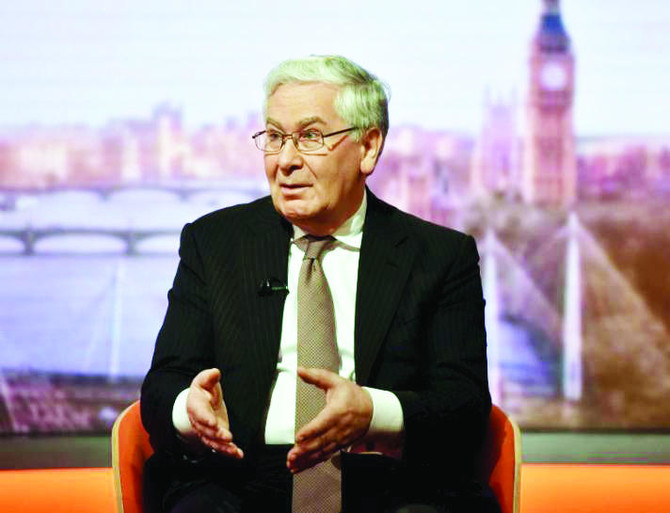
Britain needs a Brexit backup, warns former Bank of England chief


Global Markets: Record selloff in Seoul leads stock rout as markets brace for energy shock
- S. Korea head for heaviest selloff on record
- US and European equity futures slip
SINGAPORE: Asian stocks tanked on Wednesday,with a record-breaking market crash in Seoul, as investors dumped crowded bets on chipmakers on worries a widening Middle East war will drive an oil shock that raises inflation and delays interest rate cuts.
Asia is heavily dependent on energy imports shipped through the near-shuttered Strait of Hormuz and nowhere was the strain clearer than in Seoul, where the session finished with the market plunging 12 percent, the largest drop on record.
Over two days the benchmark has lost more than 18 percent of its value while the currency has slumped to a 17-year low.
Japan’s Nikkei fell 3.9 percent and Taiwan stocks dropped 4.3 percent as investors raced out of what has been one of the hottest bets of the last few months in semiconductor makers — likely as cover for losses elsewhere and to cut down on risks.
“Asia’s selloff is turning disorderly because markets are no longer treating this as a ‘one-week headline shock,’ said Charu Chanana, chief investment strategist at Saxo in Singapore.
“The ‘sell-what-you-can’ phase is spreading.”
S&P 500 futures wobbled 0.6 percent lower and European futures gave up an early bounce to trade flat.
Goldman Sachs CEO David Solomon said he’d been surprised at markets’ “benign” reaction up to now to the building risks.
“There’s a cumulative effect of everything that’s happening and a much harsher reaction. Up to this point, we haven’t seen that cumulative effect,” he said in a speech in Sydney.
“I think it’s gonna take a couple of weeks for markets to really digest the implications of what has happened both in the short term and medium term, and I can’t speculate as to how that would play out,” he said.
Rate cuts in question
Benchmark Brent crude oil futures were on the rise and up more than 13 percent for the week at $82.08 a barrel, though prices have come off highs since US President Donald Trump ordered an insurance guarantee on Gulf shipping and said the navy may escort oil tankers through the Strait of Hormuz.
US and Israeli forces have pounded Iran since Saturday and Iranian drones and missiles have struck Gulf oil refineries and also US embassies in Saudi Arabia and Kuwait.
“Oil infrastructure seems to be under attack ... so people are having to think about what is the duration of all of that,” said Damien Boey, portfolio strategist at Wilson Asset Management in Sydney.
Bond markets, after an initial rally, are now under pressure as investors bet higher oil prices will stoke inflation and delay rate cuts. Traders now see the Federal Reserve as more likely than not to hold rates in June.
“For the United States, this is very clearly inflationary ... so the market’s reassessing whether the Fed can actually deliver any rate cuts at all this year,” said Andrew Lilley, chief rates strategist for Australian investment bank Barrenjoey.
Dash for cash
That’s left cash as the beneficiary, with flow rushing in to money-market funds from riskier bets. Even gold took a hit overnight, along with the Australian dollar, which was still under pressure as investors close winning trades.
Gold steadied at $5,163 per ounce in Asia, while the Aussie dipped just below 70 cents. Overnight on Wall Street, indexes pared heavier losses and the S&P 500 closed 0.8 percent lower.
The euro was pinned at $1.16 by higher energy costs. Benchmark European gas prices have jumped about 66 percent in two days.
Coal prices are also starting to move in response to the energy crunch, with Australia’s benchmark Newcastle price up almost 17 percent this week.
“For markets to find a floor, we need signs of de-escalation on the war front or status quo, which could then move the focus back to fundamentals,” said Rupal Agarwal, Asia quant strategist at Bernstein in Singapore.


