Doha ‘losing fight for US public opinion’

Updated 14 August 2017
Follow

Doha ‘losing fight for US public opinion’

LONDON: Qatar is losing its battle to win favorable public opinion in the US, with more than a third of Americans linking Doha with accusations of terror financing, an Arab News/YouGov poll has found.
The poll of 2,263 US citizens, conducted in July, suggests that Qatar is “failing miserably” in its effort to convince Americans it is in the right over the row with its Arab neighbors, according to one analyst.
Saudi Arabia, the UAE, Egypt and Bahrain cut diplomatic ties with Qatar two months ago, accusing Doha of supporting terror groups and meddling with their internal affairs.

The Arab News/YouGov poll found that 71 percent of Americans are aware, to various extents, of the diplomatic row.
It also found that those who are aware of it have a good understanding of the reasons behind the crisis, with 67 percent correctly identifying the factors behind it.
In the wake of the diplomatic row, the poll found that the US public view Qatar in a negative light.
Just 27 percent of Americans consider Qatar as a friend or ally to the US, while 31 percent consider Qatar to be an enemy of their country. Almost half either don’t know or are unsure about how to classify the relationship with Doha. 
Oubai Shahbandar, a Syrian-American analyst and fellow at the New America Foundation’s International Security Program, said that the data show that Qatar is losing the fight for American public opinion.
“The numbers make a fairly strong case that despite its best efforts, Qatar is failing miserably in attempting to convince Americans that it is in the right,” Shahbandar told Arab News.


“Perhaps Doha would be best served in saving the millions that it will spend in its public relations campaign in the US and instead just do the right thing and agree to meaningful steps that end financial support to terror and extremist incitement.”
Shahbandar added that the poll has helped clarify where Americans stand on the diplomatic rift between Doha and the Anti-Terror Quartet — namely Saudi Arabia, the UAE, Egypt and Bahrain.

“Deciding who was the villain and which side stood by principles that coincided with US strategic interests was no easy matter for thought leaders and your average American voter. That said, the recent data from YouGov has helped crystalize just where the American public stands — and the data is damning for the Qatari side,” he said.
Shahbandar pointed to the millions of dollars that Doha spends on lobbying and public relations campaigns in the US — much of which is centered around the US military presence in Qatar.
The Al-Udeid Air Base currently hosts more than 11,000 American soldiers. However, 49 percent of Americans say they are unsure if it is best for the base to remain there, while 20 percent thought that it should be moved somewhere else, according to the Arab News/YouGov poll. Only 31 percent said the base should remain in Qatar.

“The center of the Qatari media strategy is to highlight to the American public the defense cooperation between the two countries — anchored by the presence in Qatar of Al-Udeid Air Base,” Shahbandar said.

“Despite that, 43 percent of Americans are unsure if Qatar is an ally or an enemy of the US. This is a startling find ... that a country which has hosted thousands of American military men and women for over a decade is still unable to garner the goodwill of the American public.”

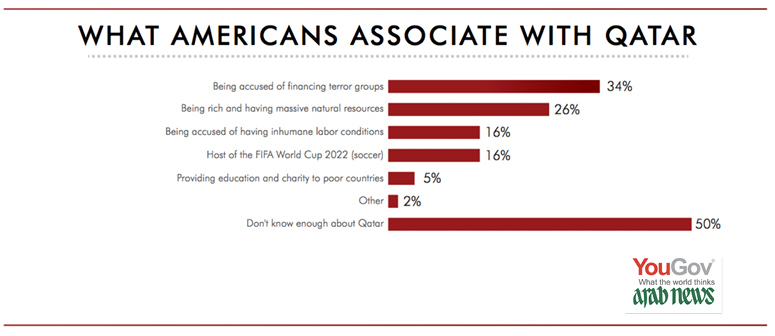
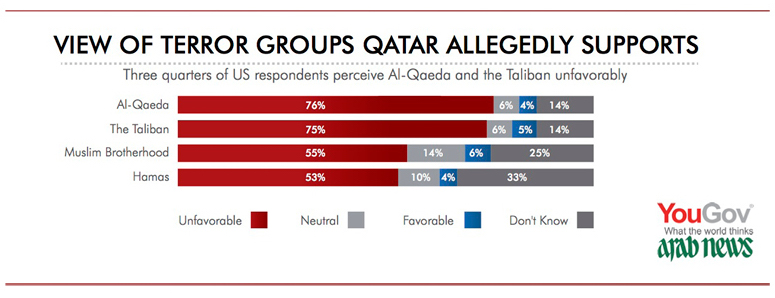
The poll found that very few US citizens associate Qatar with the 2022 World Cup, with more making the link to the terror financing allegations against Doha.

“What should concern Doha is that of those Americans who were aware of the crisis, a significant amount (two-thirds) of those polled blamed Qatar for initiating the dispute due to support of terror groups,” Shahbandar said.
“The Qatari public relations narrative has attempted to paint the dispute as a result of an effort by the Anti-Terror Quartet Arab states to impose control over Doha’s sovereignty. Nonetheless, that line seems to have fallen on deaf ears amongst a wide swath of Americans.”

• For full report and related articles please visit : YouGov Qatar Poll


What we know about alleged strike on Iran school

Updated 10 March 2026
Follow

What we know about alleged strike on Iran school

  • The New York Times has authenticated video uploaded by Iran’s semi-official Mehr News showing a US Tomahawk cruise missile striking a structure described as a clinic inside a Revolutionary Guards’ base next to the school

PARIS,  France: A new investigation by the New York Times has shed more light on events surrounding a reported attack on a school in Iran at the start of the Middle East war.
Iran has accused Israel and the United States of conducting a strike on an elementary school in the southern city of Minab, which it said killed more than 150 people.
US President Donald Trump has blamed Iran, while the Pentagon has said it is investigating the incident.
AFP has been unable to access the location to independently verify the circumstances or the toll from any such incident.
Iranian authorities have to give explicit approval to foreign media organizations wishing to report outside Tehran.

- Tomahawk -

The New York Times has authenticated video uploaded by Iran’s semi-official Mehr News showing a US Tomahawk cruise missile striking a structure described as a clinic inside a Revolutionary Guards’ base next to the school.
According to the Times, in this war, the only military using Tomahawks is the United States.
The footage showed dust and smoke rising from the direction of the school, indicating at least one earlier explosion.
“A body of evidence assembled by The Times — including satellite imagery, social media posts and other verified videos — indicates that the SHajjarah Tayyebeh elementary school building was severely damaged by a precision strike that occurred at the same time as attacks on the naval base,” the paper said.
US Central Command has released footage of Tomahawk launches filmed on February 28, the day Minab was hit, while senior US officers briefed that early salvoes included Navy Tomahawks across Iran’s southern flank.
The Times had previously reported that US military statements indicating forces were attacking naval targets near the strategic Strait of Hormuz, where a Revolutionary Guards’ base is located, “suggest they were most likely to have carried out the strike.”

- Near strategic waterway -

Earlier footage filmed from a parking lot showed black smoke billowing from a damaged building adorned with murals featuring drawings of crayons, children and an apple.
AFP has geolocated the clip to a building in Minab, though it has not been able to independently verify the nature of the site.
AFP has confirmed the building was located in close proximity to two sites controlled by the Revolutionary Guards.
The Shahid Absalan clinic, under the supervision of the Guards navy’s medical command, lies 238 meters (780 feet) from the site, while the Seyed Al-Shohada IRGC cultural complex is 286 meters away.
AFP could not independently verify the date the footage from the car park was filmed.

- What Iran says -

Iran has said more than 150 people were killed in what President Masoud Pezeshkian described as US-Israeli strikes on the school.
According to state media, Iran held funerals for at least 165 people including students killed in the alleged attack.
State television carried images showing a large crowd of mourners weeping over what appeared to be bodies wrapped in white shrouds.
Other images released by state media showed individuals preparing coffins draped in the Iranian flag — some bearing photographs of children.
Another aerial image showed excavators digging out at least 100 graves at an unidentified mass burial site.
AFP has been unable to independently verify the date the images were taken or access the location to verify the circumstances surrounding the events.

- Trump blames Iran -

President Trump has blamed Iran.
“We think it was done by Iran. Because they are very inaccurate, as you know, with their munitions. They have no accuracy whatsoever,” Trump told reporters aboard Air Force One on Saturday.
On Monday, Trump said the United States was investigating the strike “right now.”
“Whatever the report shows, I’m willing to live with that report,” Trump said, adding he did not “know enough about” the strike while also suggesting Iran may have used a Tomahawk missile — a weapon it does not possess — to hit the school itself.
US Secretary of State Marco Rubio last week said the United States would not intentionally target a school and said the Pentagon was investigating.
“The United States would not deliberately target a school. Our objectives are missiles, both the ability to manufacture them and the ability to launch them,” he told reporters.
US Democratic lawmakers on Monday urged the Pentagon to conduct an impartial probe into what happened.

- Israel not aware -

Israel’s military said it was not aware of any US or Israeli strike on a school.
“At this point not aware of an Israeli or an American strike there... We’re operating in an extremely accurate manner,” military spokesman Lt. Col. Nadav Shoshani told reporters.

- Human rights group -

Norway-based rights group Hengaw said the school was holding its morning session at the time of the reported attack and had about 170 students present.