US judge sets $30,000 bail for British hacker who stopped WannaCry

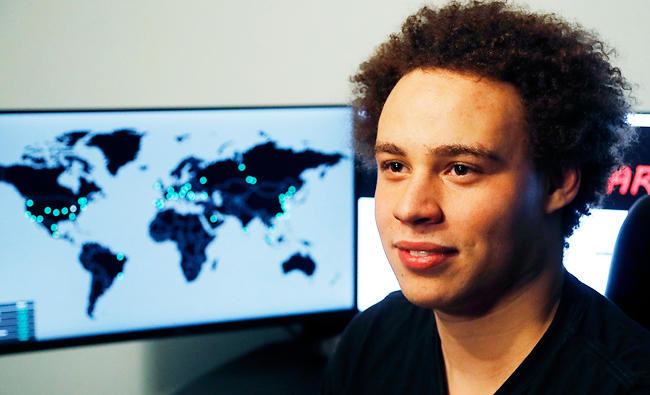
This May 15, 2017, file photo shows British IT expert Marcus Hutchins, branded a hero for slowing down the WannaCry global cyberattack, during an interview in Ilfracombe, England. (AP)
Updated 05 August 2017
Follow

US judge sets $30,000 bail for British hacker who stopped WannaCry

LAS VEGAS: A US judge in Las Vegas set a $30,000 bail on Friday for a famed British cybersecurity researcher accused of advertising and selling malicious code used to pilfer banking and credit card information.
Marcus Hutchins, 23, gained international celebrity status within the hacker community in May when he was credited with neutralizing the global “WannaCry” ransomware attack.
His attorney, Adrian Lobo, told reporters Hutchins would not be released on Friday because the clerk’s office for the court closed 30 minutes after his hearing concluded, leaving his defense team not enough time to post the bail.
Lobo told a local NBC affiliate that Hutchins will be released on Monday and that she expected him to be on a flight on Tuesday to Wisconsin, where a six-count indictment against him was filed in US District Court. He was receiving support from a “variety of sources” around the world to post his bail, she said.
Judge Nancy Koppe dismissed a federal prosecutor’s claim that Hutchins was a flight risk. If released, Hutchins will be barred from computer use or Internet access.
Hutchins, also known online as MalwareTech, was indicted along with an unnamed co-defendant on July 12. The case remained under seal until Thursday, a day after his arrest in Las Vegas, where he and tens of thousands of others flocked for the annual Black Hat and Def Con security conventions.
Hutchins allegedly advertised, distributed and profited from malware code known as “Kronos” between July 2014 and 2015, according to the indictment. If downloaded from e-mail attachments, Kronos left victims’ systems vulnerable to theft of banking and credit card credentials, which could have been used to siphon money from bank accounts.
He achieved overnight fame in May when he was credited with detecting a “kill switch” that effectively disabled the WannaCry worm, which infected hundreds of thousands of computers in May and caused disruptions at car factories, hospitals, shops and schools in more than 150 countries.
Hutchins was “doing well, considering what’s gone on,” Lobo, told reporters. She said Hutchins never expected to be in his current situation and that she did not know the identity of his co-defendant.
News of Hutchins’ arrest on Wednesday shocked other researchers, many of whom rallied to his defense and said they did not believe he had ever engaged in cybercrime.


Moscow made an offer to France regarding a French citizen imprisoned in Russia, says Kremlin

Updated 5 sec ago
Follow

Moscow made an offer to France regarding a French citizen imprisoned in Russia, says Kremlin

  • Laurent Vinatier, an adviser for Swiss-based adviser Center for Humanitarian Dialogue, Vinatier was arrested in Moscow in June 2024
  • He is accused of failing to register as a “foreign agent” while collecting information about Russia’s “military and military-technical activities” 

The Kremlin on Thursday said it was in contact with the French authorities over the fate of a French political scholar serving a three-year sentence in Russia and reportedly facing new charges of espionage.
Kremlin spokesman Dmitry Peskov told reporters that Russia has made “an offer to the French” regarding Laurent Vinatier, arrested in Moscow last year and convicted of collecting military information, and that “the ball is now in France’s court.” He refused to provide details, citing the sensitivity of the matter.
French President Emmanuel Macron is following Vinatier’s situation closely, his office said in a statement. French Foreign Ministry spokesperson Pascal Confavreux said Thursday that all government services are fully mobilized to pay provide consular support to Vinatier and push for his liberation as soon as possible.
Peskov’s remarks come after journalist Jérôme Garro of the French TF1 TV channel asked President Vladimir Putin during his annual news conference on Dec. 19 whether Vinatier’s family could hope for a presidential pardon or his release in a prisoner exchange. Putin said he knew “nothing” about the case, but promised to look into it.
Vinatier was arrested in Moscow in June 2024. Russian authorities accused him of failing to register as a “foreign agent” while collecting information about Russia’s “military and military-technical activities” that could be used to the detriment of national security. The charges carry a maximum penalty of five years in prison.
The arrest came as tensions flared between Moscow and Paris following French President Emmanuel Macron’s comments about the possibility of deploying French troops in Ukraine.
Vinatier’s lawyers asked the court to sentence him to a fine, but the judge in October 2024 handed him a three-year prison term — a sentence described as “extremely severe” by France’s Foreign Ministry, which called for the scholar’s immediate release.
Detentions on charges of spying and collecting sensitive data have become increasingly frequent in Russia and its heavily politicized legal system since Moscow invaded Ukraine in February 2022.
In addition to criticizing his sentence, the French Foreign Ministry urged the abolition of Russia’s laws on foreign agents, which subject those carrying the label to additional government scrutiny and numerous restrictions. Violations can result in criminal prosecution. The ministry said the legislation “contributes to a systematic violation of fundamental freedoms in Russia, like the freedom of association, the freedom of opinion and the freedom of expression.”
Vinatier is an adviser for the Center for Humanitarian Dialogue, a Switzerland-based nongovernmental organization, which said in June 2024 that it was doing “everything possible to assist” him.
While asking the judge for clemency ahead of the verdict, Vinatier pointed to his two children and his elderly parents he has to take care of.
The charges against Vinatier relate to a law that requires anyone collecting information on military issues to register with authorities as a foreign agent.
Human rights activists have criticized the law and other recent legislation as part of a Kremlin crackdown on independent media and political activists intended to stifle criticism of the war in Ukraine.
In August 2025, Russian state news agency Tass reported that Vinatier was also charged with espionage, citing court records but giving no details. Those convicted of espionage in Russia face between 10 and 20 years in prison.
Russia in recent years has arrested a number of foreigners — mainly US citizens — on various criminal charges and then released them in prisoner swaps with the United States and other Western nations. The largest exchange since the Cold War took place in August 2024, when Moscow freed journalists Evan Gershkovich and Alsu Kurmasheva, fellow American Paul Whelan, and Russian dissidents in a multinational deal that set two dozen people free.