Gaza team wins Palestine Cup despite Israeli restrictions

1 / 2
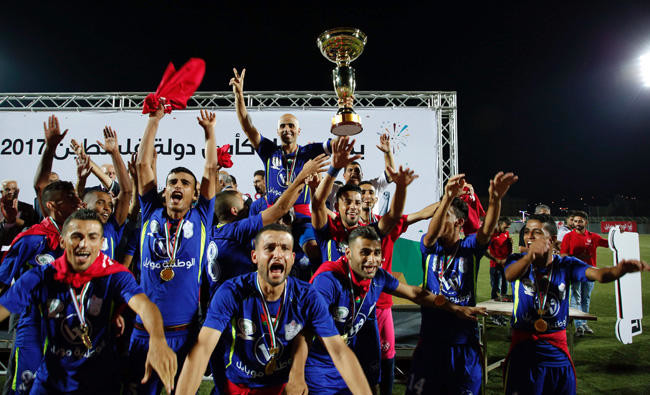
Players of the Gaza-side Shabab Rafah football team celebrate with the Palestinian cup following their victory in the second leg of the Palestinian Cup final at the stadium in the city of Dura, near the West Bank town of Hebron, on Friday. (AFP / HAZEM BADER)
2 / 2
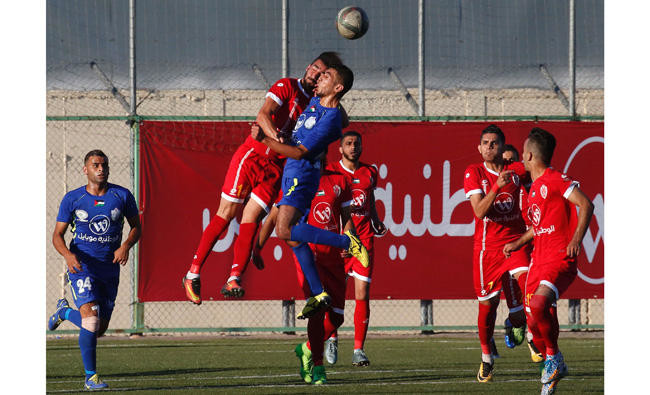
A player from the Gaza-side Shabab Rafah football team (blue) jumps to head the ball against a member of Hebron's Ahly Al-Ahli team during the second leg of the Palestinian Cup final at the stadium in the city of Dura, near the West Bank town of Hebron, on Friday. (AFP / HAZEM BADER)
Updated 04 August 2017
Follow

Gaza team wins Palestine Cup despite Israeli restrictions

HEBRON, Palestinian Territories: Shabab of Rafah became the first Gazan team to win football’s Palestine Cup in more than a decade Friday, despite Israeli restrictions keeping 10 of its players off the pitch.
Rafah and Ahly Al-Khalil from the southern West Bank city of Hebron which hosted the game ended the second leg nil-nil, but Rafah’s 2-0 first leg lead meant it took the title.
The Gazan club had to field a weakened side, with only 15 of its 25 members of the playing squad given Israeli permits to travel.
Rafah director Khaled Kweik told AFP it was the first time the team had ever won the cup, calling it a “historic” victory.
“We were harassed as we entered the West Bank and the Israelis banned 10 players from entering,” he said after the final whistle.
“But the rest of the players were able to protect the draw and take the title.”
The West Bank and Gaza are separated by Israel, and Palestinians looking to travel between the two must apply for Israeli permits.
Ahly won the cup in 2015 and 2016, but its home advantage in this year’s second leg was not enough to see it overturn the two-goal deficit.
The annual fixture pits the winners of separate cup competitions in Gaza and the West Bank over a two-leg final — one in each of the Palestinian territories.
The cup did not take place for 15 years largely over problems with Israeli permits, but resumed in 2015 after world football body FIFA intervened.
On Thursday, Shabab announced that 10 of their players had been prevented from entering Israel through the Erez border crossing with Gaza.
COGAT, the Israeli defense ministry agency responsible for civilian affairs in the Palestinian territories, said the ban was for “security reasons” compounded by a late submission of paperwork.


Spain will host 2030 World Cup final, says RFEF president

Updated 28 January 2026
Follow

Spain will host 2030 World Cup final, says RFEF president

  • Louzan did not say whether the match would be played at Santiago Bernabeu or Camp Nou
  • Once completed in late 2028, the new stadium in Morocco is expected to hold 115,000 spectators

MADRID: Spanish Football Federation (RFEF) President Rafael Louzan has said that Spain will stage the final of the 2030 World Cup, which will be co-hosted by Spain, Portugal and Morocco.
Morocco wants to stage the game in Casablanca at the Grand Stade Hassan II, a huge stadium currently under construction north of the city.
“Spain has proven its organizational capacity over many years. It will be the leader of the 2030 World Cup and the final of that World Cup will be held here,” Louzan said late on Monday ⁠at an event organized by the Madrid Sports Press Association.
Louzan did not say whether the match would be played at Madrid’s Santiago Bernabeu or Barcelona’s Camp Nou, the two leading candidates.
Once completed in late 2028, the new stadium in Morocco is expected to hold 115,000 spectators. Morocco’s Royal Football Federation (FRMF) ⁠President Faouzi Lekjaa last year expressed his wish to see a final against Spain in Casablanca.
Louzan also alluded to the challenges Morocco faced during its hosting of the last Africa Cup of Nations, including the chaotic scenes during the final between Senegal and Morocco this month.
That match, which Senegal won 1-0, was overshadowed by fan disruptions and player protests that temporarily halted play.
“Morocco is really undergoing a transformation in every sense, with magnificent stadiums,” Louzan said. “We must ⁠recognize what has been done well. But in the Africa Cup of Nations, we have seen scenes that damage the image of world football.”
FIFA and the Portuguese and Moroccan football federations have not responded to requests for comment on the final’s location.
FIFA told Reuters last year it was premature to decide the venue for the 2030 final, saying the host city for the 2026 World Cup final was revealed only two years before the tournament. World soccer’s ruling body has the final say on where the match will be played.