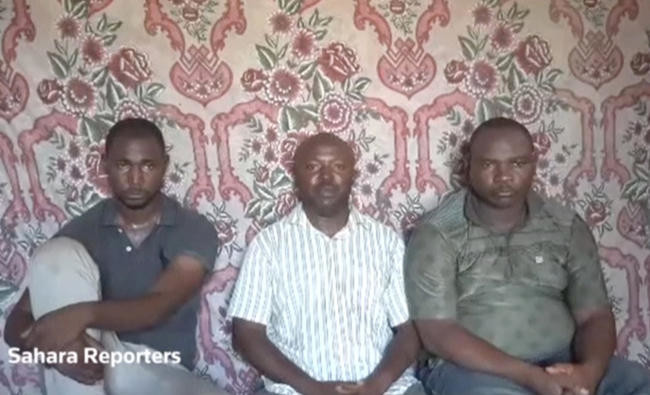
LAGOS, Nigeria: A Boko Haram faction with ties to Daesh and responsible for the kidnapping of a Nigerian oil prospecting team which led to at least 37 people being killed has become a deadly force capable of carrying out highly-organized attacks.
Nigerian government forces have focused on crushing the best-known branch of the militant group whose leader Abubakar Shekau has led an eight-year insurgency in the northeast, which has killed thousands.
But while Nigeria has claimed the capture of Shekau’s main base in the Sambisa forest and freed many of more than 200 schoolgirls abducted by his faction in April 2014 in Chibok town, a rival wing has developed the capacity to carry out attacks on a larger scale.
At least 37 people, including members of the team, rescuers from the military and vigilantes, died last week when security forces tried to free those being held by the Boko Haram faction led by Abu Musab Al-Barnawi who is trying to thwart government efforts to explore for oil in the Lake Chad Basin.
That wing is “much better organized than the Shekau faction,” which typically stages suicide bombings in mosques and markets, said Malte Liewerscheidt, senior Africa analyst at Verisk Maplecroft consultancy group.
“The Shekau faction does not seem to have a clear ideology or any strategy,” said Liewerscheidt. That makes it easier for Al-Barnawi’s faction to recruit whereas Shekau’s faction was not trusted by locals, he said.
And despite the assessment that it is less organized, Shekau’s faction has stepped up suicide bombings in the last few weeks, killing at least 113 people since June 1, according to a Reuters tally.
The combined attacks by the two wings marks a resurgence by the group, months after President Muhammadu Buhari’s announcement in December 2016 that Boko Haram’s stronghold in the Sambisa forest had been captured.
Boko Haram, which has killed more than 20,000 people and forced some 2.7 million to flee their homes since 2009, split last year.
The division led by Shekau, Boko Haram’s most recognizable figure known for videos taunting Nigerian authorities circulated on social media, operates in the northeastern Sambisa forest and usually deploys girls as suicide bombers.
Al-Barnawi
But, since Daesh named Al-Barnawi as Boko Haram’s leader in August 2016 after the west African militants pledged allegiance the previous year, his Lake Chad-based faction has been moving fighters and ammunition across porous borders in northeast Nigeria, Cameroon, Niger and Chad.
The head of a private Nigerian security firm, who did not want to be named, said Al-Barnawi’s Daesh affiliation meant his wing benefits from sub-Saharan trade routes to ship weapons from lawless Libya where Daesh is active.
His group has been planning a larger scale attack for some time, said a Western diplomat, speaking anonymously.
Boko Haram launched two attacks in June — the most prolonged raid on the northeastern city of Maiduguri in 18 months and an attack on a police convoy — which were more ambitious than routine suicide attacks. Shekau’s faction is widely believed to have its hands in the two attacks.
Buhari has repeatedly said the insurgents are on the verge of defeat since the army, helped by neighboring countries, wrested back most of the land in Nigeria’s northeast, an area the size of Belgium, that the militants took in early 2015.
But security experts say the territorial gain has given a false impression because much of the liberated areas beyond main roads patrolled by the army remain no-go areas where displaced people cannot return to farm.
“While insurgent-held territory has been recaptured, this was conflated with a military victory,” said Ryan Cummings, director of Africa-focused risk management company Signal Risk.
“All that has happened is that Boko Haram has reverted to the asymmetrical armed campaign it had waged for the seven out of the eight years of its armed campaign against the Nigerian state,” he said.
The military has been forced to concentrate forces around Maiduguri, capital of the insurgency’s birthplace, Borno state, where Shekau’s faction has stepped up suicide bombings, which now occur on a near-daily basis.
Ransom money
A security analyst said Shekau’s wing used ransom money paid by the government to free Chibok girls to buy weapons and recruit fighters — the attacks stepped up after a deal was brokered in May to free 82 of them.
The return of experienced commanders freed in exchange for the girls had also bolstered his group, said the analyst, who asked not to be named. “The fact that they were held for some time suggests they were serious players,” he said.
Acting-President Yemi Osinbajo, in power while Buhari takes medical leave in Britain for an unspecified ailment, responded to the oil team’s abduction and frequent attacks by ordering military chiefs to “scale up their efforts” in Borno, according to a statement.
The military said armed forces chiefs relocated to Maiduguri on Aug. 1. “This move and action are expected to give impetus to the military effort,” it said, without elaborating. The theater army commander is already based in the city.


![]()
New Boko Haram faction marks resurgence in militancy
New Boko Haram faction marks resurgence in militancy
Latest updates


© 2026 SAUDI RESEARCH & PUBLISHING COMPANY, All Rights Reserved And subject to Terms of Use Agreement.