The Edinburgh Festival Fringe celebrates its 70th anniversary this month, having grown into the largest arts extravaganza in the world. Organized over 25 days in the Scottish capital, it annually attracts in excess of two million visitors attending 300-plus venues to witness some of the more than 50,000 performances, ranging from magic to music, cabaret to comedy.
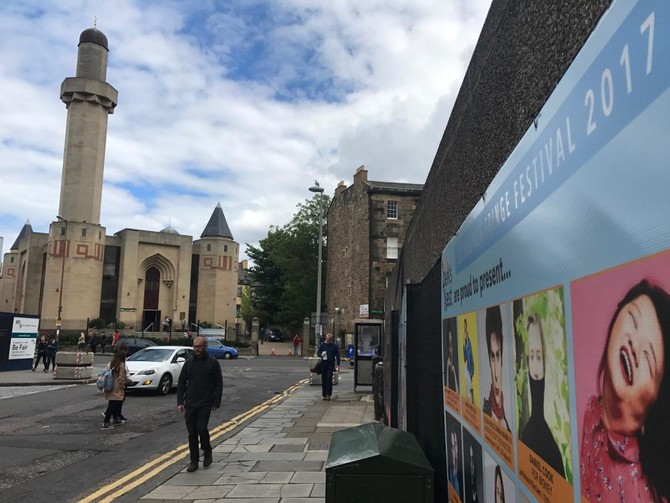
Yet away from the circus and the spoken word, the Edinburgh Central Mosque will once again host an exhibition offering respite from the Fringe’s famous raucousness. This year, the Islamic Festival will be an official part of the Fringe — yet organizers have had to overcome more problems than ever to ensure the exhibition is ready to open its doors.
Event planners usually extend an invite to three or four prominent Muslim guest speakers six months in advance, allowing time to arrange travel to and accommodation in a city where it is said the population triples during the Fringe. It is an approach that has worked well, with the likes of Jamal Badawi, professor Emeritus at St. Mary’s University in Canada, and the late Idris Tawfik, a former Roman Catholic priest who later converted to Islam, having spoken at previous events.
Recent festivals have included Islamic calligraphy classes, arts and crafts for children, mosque tours and access to relevant, thought-provoking lectures with titles such as “Islam and ISIS: How did the religion of peace come to be a tool for terror?” and “Muslim women: Oppressed or empowered?”
The festival’s accessible approach has been a success with Scottish visitors, some who have returned the following year with other family and friends. As Tawfiq wrote in his book “Talking to Muslims in the West:” “If … you want to know how to tell people about Islam, come and spend a couple of days in Edinburgh and see how it is done.”
However, this year’s event, which starts on August 4, had to be organized in the space of only a few weeks after a messy change of management earlier in 2017 left event manager Janice Oliver and other volunteers playing catch-up. Oliver will work six hours every day between now and the end of the exhibition on August 24, she said.
“The Islamic Festival started out in 2000 as just a few posters slapped on the wall of a room for a week, with the goal of giving non-Muslims an idea of what Islam is about,” Oliver, a hijab-wearing Londoner who moved to Edinburgh 21 years ago, told Arab News this week from inside the bowels of the central mosque. “It has obviously grown a lot since then and requires a lot of planning, but unfortunately this year has proved very difficult.”
That is not to say the event will be any less impressive or impactful than previous editions. The primary focus this time is on the exhibition itself, which as well as featuring Islamic art, artefacts and interactive computers, also includes a “Qur’an Table” with 10-12 translated editions of the Holy Book and several detailed explanatory posters ranging from “How did Prophet Muhammad relate to Christians?” to “Islam and the Environment” and “Kindness to Animals.”
Subhi Hashwa, a Palestinian with a long beard and Scottish accent, is the event’s education manager. He says the event has already fulfilled its aims for this year, adding that at a time when events in the world have completely distorted people’s perceptions of Islam, sharing knowledge is the goal.
“The mosque is located in the heart of the city and every nook and cranny becomes a Fringe venue, so it’s great for us because you tend to get people watching fire-eaters, jugglers and ballet dancers, then flicking through the program for something different and coming in here,” Hashwa said. “Visitors are non-Muslims, so our objective is to break down these misconceptions whereby people think mosques are places extremists are born or where women are not allowed to go. Education is key because it’s very difficult to be fooled if you know the truth.”
Oliver agrees, saying she has heard “an incredible amount” of misbeliefs surrounding her religion while working over the years. She relayed one tale of a university-educated Muslim woman who asked if it was true she could not wear pink because it is the same color as pigs. “Her mother had told her it says that in the Qur’an, but her mother could not read or write,” Oliver said. “So I explained to her that knowledge is power and that she must read the Qur’an herself — and in a language she understands.”
Those who do visit this month should not expect to feel any pressure either. While Hashwa says he prefers to leave guests to read the posters as if they were viewing exhibits in a museum, Oliver adds she actively advises volunteers against what she calls conversion-mentality: “We are not here to sell anything,” she says. “Our job is just to deliver the message — Allah is the one who guides.”