Senegal ruling party coalition claims election landslide

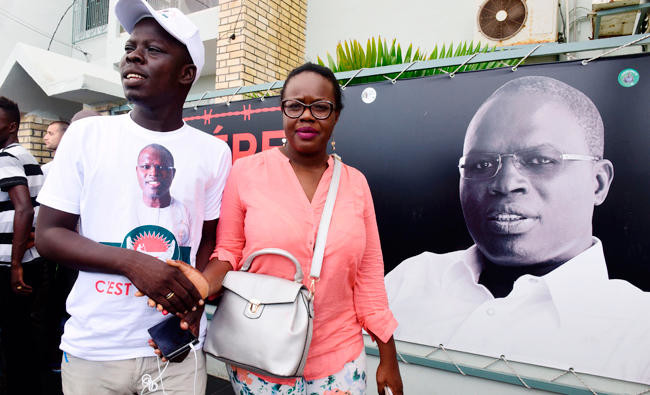
Supporters walk in front of a banner with a picture of Dakar's mayor Khalifa Sall, in jail awaiting trial for what supporters say are politically motivated embezzlement charges, on display in front of his offices in Dakar on Monday, a day after legislative elections. (AFP / SEYLLOU)
Updated 31 July 2017
Follow

Senegal ruling party coalition claims election landslide

DAKAR: The ruling coalition of Senegal’s President Macky Sall won a widely expected landslide in a legislative election, his prime minister said on Monday, bolstering Sall’s prospects for re-election in 2019.
The Benno Bokk Yakaar (BBY) coalition swept all except three of the country’s 45 electoral departments, said Prime Minister Mahammed Boun Abdallah Dionne.
The ruling coalition “emerged victorious” following the vote on Sunday, Dionne said, while the turnout was 54 percent among Senegal’s 6.2 million registered voters.
Dionne said opposition coalition lists were likely to be ahead in the departments of Kedougou, Saraya and possibly Mbacke, but otherwise the BBY list of candidates “had been voted in by the Senegalese people.”
The official results are expected later this week. Some complained of being left off the electoral rolls on Sunday, and there were delays to voting in several places, partly due to bad weather.
Sall’s main threat to increasing his power in Parliament was posed by ex-leader Abdoulaye Wade, 91, who was aiming to drum up support for his own list of candidates and his son, Karim, who is not on the ballot but has ambitions for the presidency.
His other serious opponent, Dakar Mayor Khalifa Sall (no relation), is in jail awaiting trial for what supporters say are politically motivated embezzlement charges, and headed a list while campaigning from his jail cell.
The mayor had been seen as a key contender for 2019 and a potential threat to the president in parliament until he was charged in March with allegedly misappropriating 1.83 billion CFA francs ($2.85 million) in city funds.
There were 47 lists of candidates contesting the election, with 165 lawmakers due to take seats in Parliament.


Geoeconomic confrontation tops global risks in 2026: WEF report

Updated 14 January 2026
Follow

Geoeconomic confrontation tops global risks in 2026: WEF report

  • Also armed conflict, extreme climate, public polarization, AI
  • None ‘a foregone conclusion,’ says WEF’s MD Saadia Zahidi

DUBAI: Geoeconomic confrontation has emerged as the top global risk this year, followed by state-based armed conflict, according to a new World Economic Forum report.

The Global Risks Report 2026, released on Wednesday, found that both risks climbed eight places year-on-year, underscoring a sharp deterioration in the global outlook amid increased international competition.

The top five risks are geoeconomic confrontation (18 percent of respondents), state-based armed conflict (14 percent), extreme weather events (8 percent), societal polarization (7 percent) and misinformation and disinformation (7 percent).

The WEF’s Managing Director Saadia Zahidi said the report “offers an early warning system as the age of competition compounds global risks — from geoeconomic confrontation to unchecked technology to rising debt — and changes our collective capacity to address them.

“But none of these risks are a foregone conclusion.”

The report assesses risks across three timeframes: immediate (2026); short-to-medium term (next two years); and long term (next 10 years).

Economic risks show the largest overall increase in the two-year outlook, with both economic downturn and inflation jumping eight positions.

Misinformation and disinformation rank fifth this year but rise to second place in the two-year outlook and fourth over the 10-year horizon.

The report suggests this reflects growing anxiety around the rapid adoption of artificial intelligence, with adverse outcomes linked to AI surging from 30th place in the two-year timeframe to fifth in the 10-year outlook.

Uncertainty dominates the global risk outlook, according to the report.

Surveyed leaders and experts view both the short- and long-term outlook negatively, with 50 percent expecting a turbulent or stormy global environment over the next two years, rising to 57 percent over the next decade.

A further 40 percent and 32 percent, respectively, describe the outlook as unsettled across the two- and 10-year timeframes, while just 1 percent anticipate a calm global outlook in either period.

Environmental risks ease slightly in the short-term rankings. Extreme weather fell from second to fourth place and pollution from sixth to ninth. Meanwhile, critical changes to Earth systems and biodiversity loss dropped seven and five positions, respectively.

However, over the next decade, environmental threats re-emerge as the most severe, with extreme weather, biodiversity loss, and critical changes to Earth systems topping the global risk rankings.

Looking ahead over the next decade, around 75 percent of respondents anticipate a turbulent or stormy environmental outlook, making it the most pessimistic assessment across all risk categories.

Zahidi said that “the challenges highlighted in the report underscore both the scale of the potential perils we face and our shared responsibility to shape what comes next.”

Despite the gloomy outlook, Zahidi signaled a positive shift in global cooperation.

 “It is also clear that new forms of global cooperation are already unfolding even amid competition, and the global economy is demonstrating resilience in the face of uncertainty.”

Now in its 21st year, the Global Risks Report highlights a core message: global risks cannot be managed without cooperation.

As competition intensifies, rebuilding trust and new forms of collaboration will be critical, with the report stressing that today’s decisions will shape future outcomes.

The report was released ahead of WEF’s annual meeting, which will be held in Davos from Jan. 19 to 23.