PAKISTAN: Pakistan’s Supreme Court on Friday disqualified Prime Minister Nawaz Sharif over long-running corruption allegations, a highly anticipated decision that forces him out of office.
“He is disqualified as a member of the parliament so he has ceased to be holding the office of Prime Minister,” Justice Ejaz Afzal Khan told the packed courtroom.
The court also asked the national anti-corruption bureau to launch a further probe into the allegations against Sharif, which stem from the Panama Papers leak last year linking the premier’s family to lucrative offshore businesses.
No Pakistani prime minister has ever completed a full five-year term.
Most have seen their tenures cut short by the powerful military or interference from the Supreme Court. Others have been ousted by their own party, forced to resign — or been assassinated.
It is the second time in Pakistan’s 70-year history that the Supreme Court has disqualified a sitting prime minister.
In 2012 then-prime minister Yousaf Raza Gilani was disqualified over contempt of court charges for refusing to reopen a corruption case against the sitting president Asif Ali Zardari.
The Supreme Court’s unceremonious end to Sharif’s tenure represents a record third time he has been ousted as leader before completing his term.
In 1993 he was sacked by the then-president over graft allegations, while in 1999 he was ousted in a military coup.


![]()
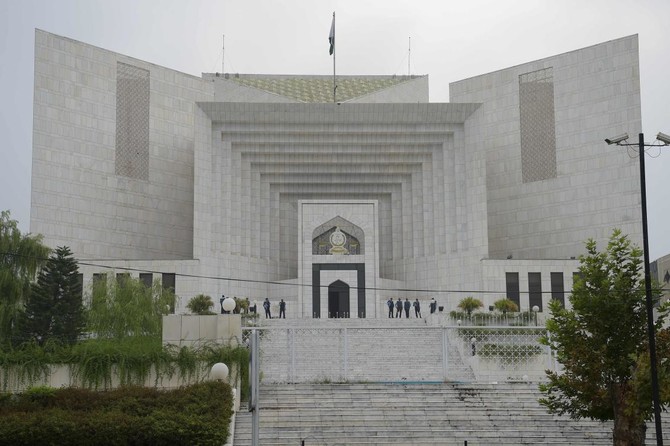

Pakistan court disqualifies PM Sharif from office
Pakistan court disqualifies PM Sharif from office
Iran-linked hackers claim cyberattack on Albanian parliament
- Albania hosts several thousand members of the People’s Mujahedin of Iran (PMOI or MEK), an organization that Iran has denounced as 'terrorist'
- Albania’s IT services were targeted, in 2022, prompting the Balkan country to sever diplomatic ties with Iran
TIRANA: Albania’s parliament on Tuesday said it had been hit with a “sophisticated cyberattack,” after Iran-linked hackers claimed to have stolen lawmakers’ data.
A group called “Homeland Justice,” which has previously been linked to Iran and claimed responsibility for past cyberattacks in Albania, announced the hack on Telegram.
“All conversations and correspondence of corrupt MPs from recent months are in the hands of Homeland Justice,” the post said.
“We are much closer to you than you think.”
Albania hosts several thousand members of the People’s Mujahedin of Iran (PMOI or MEK), an organization that Iran has denounced as “terrorist.”
Experts have warned that as the war in the Middle East continues, highly capable hackers linked to Iran have broadened their activities.
In a statement, the Albanian parliament said its computer systems had been hit with a “sophisticated cyberattack aimed at deleting data and compromising several internal systems.”
“It was found that information had been deleted from several accounts belonging to administration employees,” it added, saying “the main working infrastructure” did not appear to be affected and that measures had been taken “to neutralize the attack.”
The country’s National Cyber Security Authority said it had teams investigating the attack.
“Further information will be made public after the technical assessment is completed,” the authority’s director, Saimir Kapllani, told AFP.
In June, Homeland Justice also attacked the information technology services of the Albanian capital, Tirana.
In 2022, Albania’s IT services were also targeted, prompting the Balkan country to sever diplomatic ties with Iran.
A group called “Homeland Justice,” which has previously been linked to Iran and claimed responsibility for past cyberattacks in Albania, announced the hack on Telegram.
“All conversations and correspondence of corrupt MPs from recent months are in the hands of Homeland Justice,” the post said.
“We are much closer to you than you think.”
Albania hosts several thousand members of the People’s Mujahedin of Iran (PMOI or MEK), an organization that Iran has denounced as “terrorist.”
Experts have warned that as the war in the Middle East continues, highly capable hackers linked to Iran have broadened their activities.
In a statement, the Albanian parliament said its computer systems had been hit with a “sophisticated cyberattack aimed at deleting data and compromising several internal systems.”
“It was found that information had been deleted from several accounts belonging to administration employees,” it added, saying “the main working infrastructure” did not appear to be affected and that measures had been taken “to neutralize the attack.”
The country’s National Cyber Security Authority said it had teams investigating the attack.
“Further information will be made public after the technical assessment is completed,” the authority’s director, Saimir Kapllani, told AFP.
In June, Homeland Justice also attacked the information technology services of the Albanian capital, Tirana.
In 2022, Albania’s IT services were also targeted, prompting the Balkan country to sever diplomatic ties with Iran.
Latest updates


© 2026 SAUDI RESEARCH & PUBLISHING COMPANY, All Rights Reserved And subject to Terms of Use Agreement.