TEHRAN: Iran on Thursday “successfully” tested a satellite-launch rocket, days after warning Washington of a response to new US sanctions over the Islamic republic’s ballistic missile program, state television said.
It said the launch vehicle, named Simorgh after a bird in Iranian mythology, was capable of propelling a satellite weighing 250 kilograms (550 pounds) to an altitude of 500 kilometers (300 miles) above earth.
The launch marked the official inauguration of Iran’s Imam Khomeini space center, named after the late founder of the Islamic republic, built for sending satellites into space, the television said.
State television broadcast footage of the takeoff from the space center in eastern Iran’s Semnan province, the site of past such launches.
The center, whose exact location was not disclosed, is on “an immense site used for the preparation, launch, control and guidance of all satellite launch vehicles,” said the defense ministry which is in charge of Iran’s space program.
“We can do it,” read a slogan on the rocket.
Western states suspect Iran of developing the technology capable of launching long-range ballistic missiles with conventional or nuclear payloads, a charge denied by Tehran which insists its space program has purely peaceful aims.
Iran’s four other launches of domestically produced satellites since 2009 have all sparked condemnation in the West.
President Hassan Rouhani said Wednesday that Iran would respond in kind to any breach by the United States of a 2015 nuclear deal after the House of Representatives passed a new sanctions bill.
“If the enemy steps over part of the agreement, we will do the same, and if they step over the entire deal, we will do the same too,” Rouhani said at a cabinet meeting.
The Iranian parliament’s national security and foreign affairs committee said it would hold an extraordinary session on Saturday to discuss its formal response.
The parliament voted earlier this month to fast-track a bill introduced in June that would increase funds for Iran’s missile program and Revolutionary Guards.
“We must always develop our defense capability and we will strengthen our defensive weapons regardless of the opinion of others,” Rouhani said.
The US House passed a new sanctions bill on Tuesday targeting the Revolutionary Guards over its missile program.
As part of its space program, Iran has also sent two capsules into space, the first in February 2010 carrying a rat, tortoises and insects, and the other in January 2013 when a monkey was sent into space and returned to earth safely, according to official media.


![]()
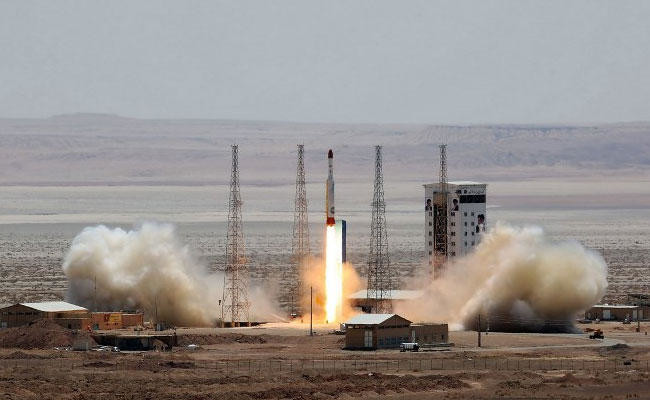
Iran in ‘successful’ test of satellite-launch rocket
Iran in ‘successful’ test of satellite-launch rocket



Latest updates


© 2026 SAUDI RESEARCH & PUBLISHING COMPANY, All Rights Reserved And subject to Terms of Use Agreement.