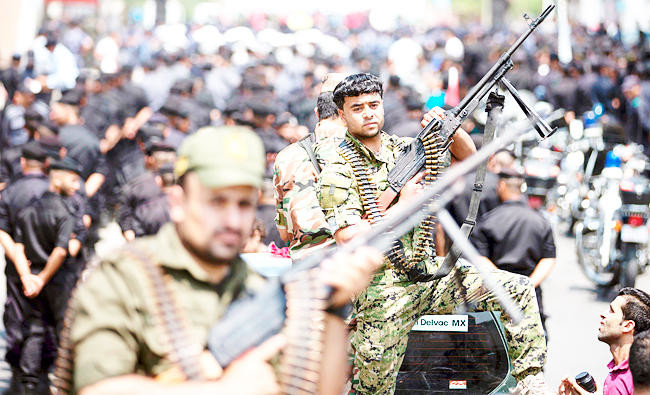
LONDON: The EU’s top court opted to keep Palestinian group Hamas on the EU terrorism blacklist on Wednesday.
Judges at the European Court of Justice (ECJ) overruled the General Court’s view of 2014 that the Council of the EU had insufficient evidence to maintain asset freezes and travel bans on Hamas.
The lower court had found that the listing was based on media and Internet reports rather than decisions by a “competent authority.” But the ECJ said such decisions were not required for groups to stay on the list, only for their initial listing.
Experts offered mixed opinions on what the decision might mean. Scott Lucas, professor of international politics at the University of Birmingham, told Arab News that “on the face of it, the decision is based on a legal interpretation but there is a wider political context around this. The political environment today is very concerned about extremists. Terrorism is higher up on the agenda than it was in 2014.”
Lucas said that should the General Court not decide to review the ruling in the near future, this move “would contextualize Hamas as ‘terrorists’ and set the political tone for the EU going forward.”
The professor added that he would be “interested to see if the UK creates its own ruling on Hamas following its divorce from the EU in the coming years.”
Tally Helfont, director of the Foreign Policy Research Institute’s Programme on the Middle East, said that Hamas has not taken any actions that would warrant its removal from the EU terrorism blacklist.
She told Arab News: “Daily activities in Gaza are evidence of this. What’s more, the recent amendment of Hamas’ charter seems to have brought no substantive change to the militant group’s activities, amounting to little more than a poorly received PR stunt.”

EU keeps Hamas on terror blacklist
UN urges all sides to ‘see reason’ in Iran-US conflict
- “I deplore the military strikes across Iran this morning by Israel and the USA, and the subsequent retaliatory strikes by Iran,” Turk said
- “To avert these terrible consequences for civilians, I call for restraint and implore all parties to see reason, to de-escalate”
GENEVA: The United Nations’ rights chief deplored Saturday’s strikes in the Middle East and urged all parties to return to negotiations, saying attacks would only result in “death, destruction and human misery.”
“I deplore the military strikes across Iran this morning by Israel and the United States of America, and the subsequent retaliatory strikes by Iran,” Volker Turk said in a statement.
“As always, in any armed conflict, it is civilians who end up paying the ultimate price.
“Bombs and missiles are not the way to resolve differences but only result in death, destruction and human misery.
“To avert these terrible consequences for civilians, I call for restraint and implore all parties to see reason, to de-escalate, and for a return to the negotiating table where they had been actively seeking a solution only hours earlier,” he said.
“Failing to do so risks an even wider conflict, that will inevitably lead to further senseless civilian deaths and destruction on a potentially unimaginable scale, not just in Iran but across the Middle East region.”
On Thursday, US and Iranian negotiators held indirect talks in Geneva, through Omani mediators, on Tehran’s nuclear program — within sight of Turk’s offices in the Swiss city.
He reminded all parties that the protection of civilians was paramount in armed conflict, insisting that those who violated the rules of war must be held accountable.
Tedros Adhanom Ghebreyesus, head of the World Health Organization, said the agency was concerned by the “grave risk to people’s health” from the expanding conflict.
“The threat of nuclear facilities being impacted is especially worrying,” he said.
“All must be done to reduce any nuclear safety risk, which may affect people in the region,” he added.
“We urge leaders to choose the challenging path of dialogue over the senseless route of destruction.”