WASHINGTON: Summers in Washington are usually quiet for think tanks, but this summer has been busy.
The dispute between Qatar and the Anti-Terror Quartet (ATQ) — comprising Saudi Arabia, the UAE, Bahrain and Egypt — over Doha’s foreign policies has generated a lively debate in Washington over the past several weeks.
On Tuesday, a well-known think tank, the Hudson Institute, organized a panel titled “Saudi Arabia, the Gulf Cooperation Council (GCC) and the Trump Administration: Stability or Upheaval?” The panel included well-known American and Saudi scholars and analysts.
They delved into the crisis and its origins, and provided an assessment and update on the ambitious package of economic and social reforms that was introduced in Saudi Arabia in May 2016 by Crown Prince Mohammed bin Salman.
Saudi analyst and the non-resident fellow at the Atlantic Council, Mohammed K. Al-Yahya, began the session by saying the crisis with Doha was a “long-simmering” conflict that could be traced to the 1995 bloodless coup in Qatar.
Ever since, Al-Yahya argued, Doha has been trying to exert its influence via economic investments in the West, providing basing rights to the US and supporting a wide array of militant groups across the Arab and Muslim worlds.
Qatar’s tiny native population of some 300,000 and its deep financial coffers, allowed it to continue these policies with little risk.
Qatar, Al-Yahya said, “has no skin in the game,” and it was its neighbors who bore the brunt of its policies, which routinely violated the norms of international relations.
Shifting the discussion to economic and social reforms in Saudi Arabia, Fatimah Baeshen — a Saudi analyst and director of the Washington-based Arabia Foundation — focused on the tangible strides that have been made in the Kingdom toward empowering women, reforming the education system and the ever-expanding public discourse.
Countering the impressions of casual observers, Baeshen said women have made real progress in recent years by virtue of their increased access to the political decision-making process and the expanding opportunities now available to them in the work force.
Speaking about the multipronged approach Riyadh has adopted to education reform, Baeshen advised the audience to “localize the measuring stick” when assessing the progress the Kingdom has made toward establishing state-of-the-art educational institutions and better students and teachers. She also commended Saudi educators’ focus on stem subjects.
Adding an American perspective to the discussion, Hudson Institute’s adjunct fellow and military veteran Mike Pregent took a broad view of US interests in the region, saying America continues to face “determined enemies” such as Iran’s Revolutionary Guard Corps (IRGC), Al-Qaeda and its various affiliates, and Daesh.
But he took solace in the fact that the US continues to have reliable allies such as Saudi Arabia, the UAE, Egypt and Jordan. “We can’t defeat” Daesh without Saudi Arabia, Pregent said.
Speaking about the crisis with Doha, he said Qatar cannot continue to have a US base and be the host of the 2022 football World Cup while allowing financiers of terrorist groups to roam freely on its territory.
He commended the ATQ’s efforts to hold Qatar accountable for its contradictory and destabilizing policies.
Pregent drew a sharp distinction between the policies of the Trump administration and those of the previous Obama administration. “(President Donald) Trump’s visit to Saudi Arabia was a message to Iran,” he said.


![]()
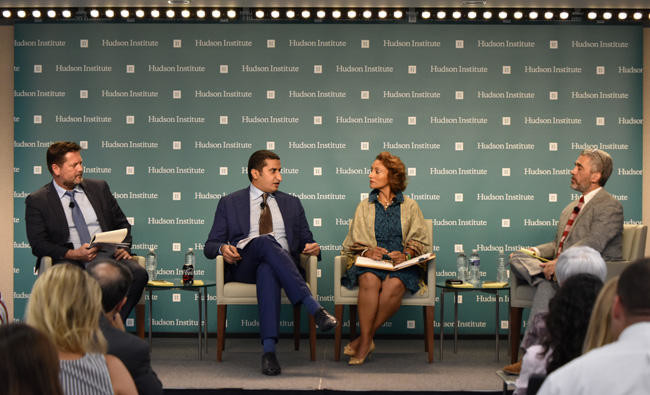
Experts assess Qatar crisis, Saudi reforms and US policy
Experts assess Qatar crisis, Saudi reforms and US policy
Latest updates


Recommended


© 2026 SAUDI RESEARCH & PUBLISHING COMPANY, All Rights Reserved And subject to Terms of Use Agreement.