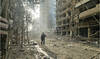
UKRAINE: As clashes drag on in east Ukraine between government forces and Russian-backed rebels, health activist Natalia Gurova is fighting another battle of her own.
Gurova manages a project in her insurgent-controlled home city of Lugansk handing out clean syringes and condoms to drug-users and sex workers who are most at risk from HIV and hepatitis.
That puts her at the forefront of the perilous struggle against the spread of infections as more than three years of conflict and rebel rule have hit vital treatment programs.
“Everything has worsened,” Gurova, from the All-Ukrainian Public Health Association, a charitable organization, told AFP.
Getting supplies such as condoms, lubricants and hygienic wipes into rebel-held territory remains a constant challenge as they run the gauntlet of checkpoints to cross the tightly guarded frontline.
While Gurova still manages to keep these programs going, substitute treatments for drug addicts including methadone have stopped entirely.
This has seen users who were being weaned away from injecting themselves turn to dangerous local alternatives — and bolstered the threat of the spread of diseases.
“There are more cases of HIV infections among users and it is very difficult to make contact with them,” Gurova said.
Alongside this problem, activists say there has been a rise in the number of sex workers in the grey zone along the frontline.
Prior to the start of the conflict in April 2014, ex-Soviet Ukraine — especially in its eastern regions of Donetsk and Lugansk — was already battling one of the most severe HIV epidemics in Eastern Europe.
But thanks to progressive policies the country was making progress and had managed to reduce the rate of HIV infections, most dramatically among young drug users.
After the war flared up in 2014, experts soon warned that the conflict risked jeopardizing any gains that had been made.
As Kiev lost control over Donetsk and Lugansk, health services and key treatments for infections were hit.
In 2015, international actors managed to stave off an imminent crisis by negotiating with Kiev and the rebels to keep supplying antiretroviral drugs to thousands of HIV positive people in the separatist territories.
Emergency funds were provided and the United Nations now estimates that about 10,000 adults and children with HIV in rebel-held areas are receiving the drugs.
But while negotiations have been successful in getting the most urgent treatments through for now, in terms of prevention the situation still looks dire.
Doctor Igor Pirogov, who works at a hospital treating drug users in rebel capital Donetsk, said that the war has seriously disrupted attempts to curb addiction.
“Most of our patients put on a uniform, got a weapon and went off to fight” for the insurgents, Pirogov said.
“Many even said openly that they were using more drugs during the war than when it was peaceful.”
The internationally approved opioid replacement treatments that had become the norm in Ukraine have ended.
Due to security restrictions the Ukrainian authorities say they are unable to deliver substitute drugs across the frontline.
For their part the rebels seem to have followed in the footsteps of their backers in Russia — where methadone is banned — and turned the clock back on progressive treatments.
Activist Gurova said that about 900 patients had lost access to the methadone program, leading many to turn instead to dangerous local alternatives.
At the same time she said more women around the conflict zone have turned to prostitution — also putting them at greater risk.
“There are no jobs, no work, no earnings — this is the only option for them — so it all leads to an increase in the number of sex workers,” she explained.
As it has waged war against the insurgents on the battlefield, the government in Kiev has shown a tendency to disown the health crisis in rebel regions.
While the situation in areas under insurgent control has deteriorated, the rest of the country has continued to make headway tackling HIV as authorities have pushed on with the policies that were yielding results.
“The decline in the rates of HIV epidemic growth is encouraging,” Pavlo Skala from the Alliance for Public Health told AFP.
But experts warn that any improvements being made risk being undermined by a uptick of infections in Ukraine’s rebel-held regions and that Kiev cannot turn a blind eye to the problems happening across the frontline.
“Soldiers stand on the demarcation line between the two territories and they can control the border,” Skala said.
“But they cannot control the spread of epidemics.”


In rebel-held Ukraine, activists struggle to stem HIV spread

In rebel-held Ukraine, activists struggle to stem HIV spread

Kremlin welcomes US sanctions waiver says US and Russia share interest in stable energy markets
DUBAI: Russia sees a U.S. sanctions waiver on its oil as an attempt by Washington to stabilise global energy markets, and the two countries have a shared interest in this, Kremlin spokesman Dmitry Peskov said on Friday.
"We see actions by the United States aimed at trying to stabilise energy markets. In this respect, our interests coincide," he said.
US Treasury Secretary Scott Bessent announced a temporary authorisation allowing countries around the world to purchase Russian oil currently stranded at sea on Thursday extending a measure that had previously been granted only to Indian refiners.
Bessent stressed in a post on X that the authorisation would not provide significant financial benefit to the Russian government.
“This narrowly tailored, short-term measure applies only to oil already in transit and will not provide significant financial benefit to the Russian government, which derives the majority of its energy revenue from taxes assessed at the point of extraction,” Bessent said on a post on X.
However, the measure received mix reviews in European capitals, with many fearing it could help replenish Russia's assualt on Ukraine.
"I am concerned that we are further filling Putin's war chest," German Economy Minister Katherina Reiche said in Berlin on Friday.
Reiche said that she saw both sides to the United States' decision to issue a 30-day waiver for the purchase of Russian oil products, understanding the increasing ecnomic and political turnout from the oil crisis, particurlarly in South Korea and Japan.
"It seems to me that domestic political pressure in the United States is very, very high," Reiche said.
German Chancellor Friedrich Merz was more direct, saying on Friday that it was wrong to ease sanctions against Russia for whatever reason. The sentiment was echoed by Norway’s Prime Minister, who also said sanctions should not be eased.
Oil prices held gains above $100 Friday and most equity markets dropped after Iran's leader called for the blocking of the crucial Strait of Hormuz and the opening up of new fronts in the war against the United States and Israel.
With the conflict heading towards its third week and showing no signs of ending, investors are growing increasingly worried about an extended crisis that could fan inflation and hammer the global economy.