BEIRUT: In a city full of hair stylists, Muhannad Khaled Omar stands out.
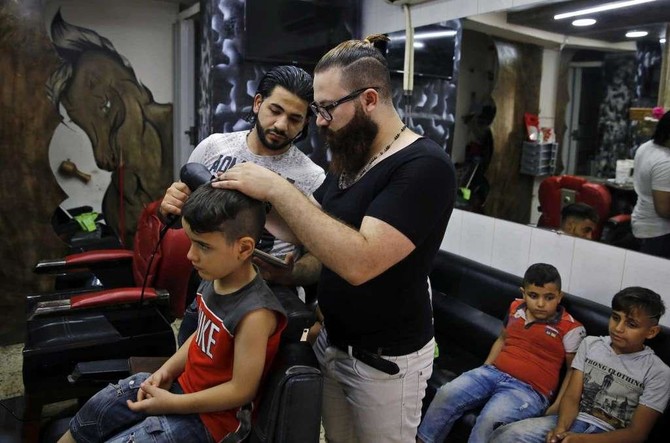
Omar, 26, is a Palestinian-Syrian stylist known for shaving celebrity portraits into clients’ hair.
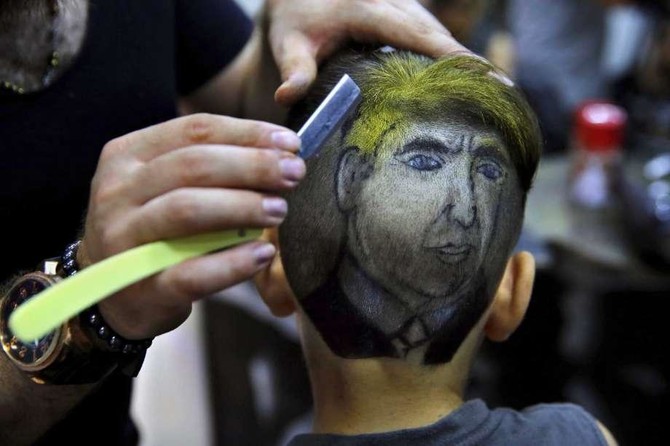
On a recent Friday at his Beirut salon, Omar shaved a portrait of US President Donald Trump into the hair of a young customer’s head. With a painter’s precision, he created the contours of the president’s face, cutting at various lengths to give the image depth. A spray of gold hair coloring added to the effect.
“I started this profession when I was in 9th grade,” Omar said. “I was studying at the same time, learning how to cut hair. I’ve had a talent since I was young, a talent for drawing.”
Omar was raised in the Yarmouk refugee camp in Damascus, Syria, but moved to Lebanon in 2011 after a crackdown against demonstrations in Syria grew violent.
Omar said his vocation in hair styling is an extension of his passion for art.
“I started my baccalaureate studies and I studied psychology. When I came here to Lebanon, I mixed psychology, cutting hair and drawing into one profession,” he said.
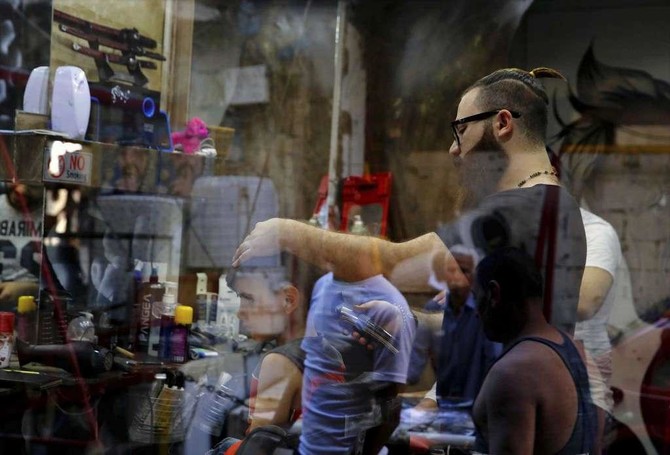
Hair salons are a staple in every Middle East city, a place for friends to gather and gossip ahead of the weekends. They are usually segregated by sex.
Omar manages his own salon in the Bourj Al-Barajneh refugee camp in south Beirut, established in 1948 to accommodate Palestinians made refugees by the creation of the state of Israel. The camp’s population has swelled with the influx of Syrian refugees — some of them also Palestinians — who have come to escape the violence of the war next door. The United Nations says Lebanon is home to 1 million Syrian refugees.
Syrians are vulnerable to workplace and housing abuses in Lebanon because they lack basic legal protections. Many find it easier to live and work in Palestinian camps.
Omar said he hopes that someone will invest in his work one day and sponsor him to emigrate to Europe.
“I want to start something new, but not in this area, something outside of the Arab world, to show that we are capable, we can produce things,” he said.


Syrian barber creates portraits on canvas — clients’ heads

Syrian barber creates portraits on canvas — clients’ heads

Cambodia takes back looted historic artifacts handled by British art dealer
- The objects were returned under a 2020 agreement between the Ministry of Culture and Fine Arts and the family of the late Douglas Latchford, a British art collector and dealer who allegedly had the items smuggled out of Cambodia
PHNOM PENH, Cambodia: Cambodian officials on Friday received more than six dozen historic artifacts described as part of the country’s cultural heritage that had been looted during decades of war and instability.
At a ceremony attended by Deputy Prime Minister Hun Many, the 74 items were unveiled at the National Museum in Phnom Penh after their repatriation from the United Kingdom.
The objects were returned under a 2020 agreement between the Ministry of Culture and Fine Arts and the family of the late Douglas Latchford, a British art collector and dealer who allegedly had the items smuggled out of Cambodia.
“This substantial restitution represents one of the most important returns of Khmer cultural heritage in recent years, following major repatriations in 2021 and 2023 from the same collection,” the Culture Ministry said in a statement. “It marks a significant step forward in Cambodia’s continued efforts to recover, preserve, and restore its ancestral legacy for future generations.”
The artifacts were described as dating from the pre-Angkorian period through the height of the Angkor Empire, including “monumental sandstone sculptures, refined bronze works, and significant ritual objects.” The Angkor Empire, which extended from the ninth to the 15th century, is best known for the Angkor Wat archaeological site, the nation’s biggest tourist attraction.
Latchford was a prominent antiquities dealer who allegedly orchestrated an operation to sell looted Cambodian sculptures on the international market.
From 1970 to the 1980s, during Cambodia’s civil wars and the communist Khmer Rouge ‘s brutal reign, organized looting networks sent artifacts to Latchford, who then sold them to Western collectors, dealers, and institutions. These pieces were often physically damaged, having been pried off temple walls or other structures by the looters.
Latchford was indicted in a New York federal court in 2019 on charges including wire fraud and conspiracy. He died in 2020, aged 88, before he could be extradited to face charges.
Cambodia, like neighboring Thailand, has benefited from a trend in recent decades involving the repatriation of art and archaeological treasures. These include ancient Asian artworks as well as pieces lost or stolen during turmoil in places such as Syria, Iraq and Nazi-occupied Europe. New York’s Metropolitan Museum of Art is one of the prominent institutions that has been returning illegally smuggled art, including to Cambodia.
“The ancient artifacts created and preserved by our ancestors are now being returned to Cambodia, bringing warmth and joy, following the country’s return to peace,” said Hun Many, who is the younger brother of Prime Minister Hun Manet.