BERLIN: Germany has frozen all arms deliveries to Turkey, a newspaper reported Friday, amid a row between the NATO partners that has sharply worsened since Ankara arrested several human rights activists.
Berlin stepped up its travel advisory for Turkey on Thursday and warned it would review state guarantees for foreign investment there — measures which Ankara labelled “blackmail and threats.”
As part of a sweeping overhaul of bilateral ties, Germany is also “freezing all planned and ongoing arms deliveries to Turkey,” the top-circulation Bild newspaper reported without citing a source.
Chancellor Angela Merkel’s right-hand man, Peter Altmaier, did not confirm or deny the report in a ZDF television interview but warned that “we will at any time consider whether further measures are necessary.”
Relations between Turkey and Germany, home to three million ethnic Turks, have been badly strained, particularly since a failed coup a year ago against President Recep Tayyip Erdogan.
In the months after the July 2016 coup attempt, Germany already blocked 11 separate arms export shipments to Turkey, including handguns, ammunition or weapons components, according to media reports.
Relations sharply deteriorated after a Turkish court Tuesday ordered six rights activists should remain in custody for allegedly aiding a “terror” group, among them German citizen Peter Steudtner.
In the war of words, German Finance Minister Wolfgang Schaeuble compared Erdogan’s Turkey with the former communist German Democratic Republic (GDR).
“Turkey is arresting people arbitrarily and not respecting even minimal consular standards,” said Schaeuble.
“It reminds me of the way it was in the GDR. When you traveled there, you knew, if something happens to you, nobody can help you.”
Altmaier also confirmed that Berlin would urge Brussels to freeze 4.45 billion euros ($5.2 billion) in EU funds theoretically earmarked until end-2020 for Turkey, a long-term aspirant for membership to the bloc.


Berlin freezes arms shipments to Turkey: report
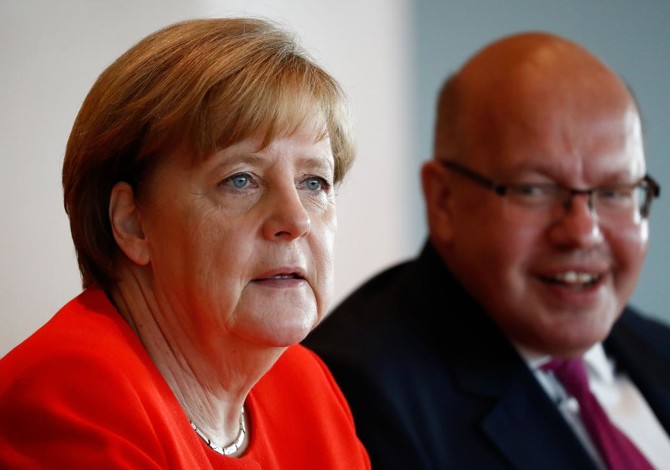
Berlin freezes arms shipments to Turkey: report

Russia says Ukraine attacked Putin’s home, Kyiv calls this ‘lie’
- Zelensky called Russia’s claim “complete fabrication” designed to derail peace process, suggested Moscow was preparing to intensify bombardment of Ukraine
KYIV: Russia accused Ukraine on Monday of having fired dozens of drones at one of President Vladimir Putin’s homes, an accusation that Ukraine called a “lie” aimed at undermining US-led efforts to end the war.
Russian Foreign Minister Sergei Lavrov, who does not typically announce drone strikes, said Ukraine had fired “91 long-range unmanned aerial vehicles” at Putin’s residence in the Novgorod region between late Sunday and early Monday, all of which were shot down.
“Given the complete degeneration of the criminal Kyiv regime, which has shifted to a policy of state terrorism, Russia’s negotiating position will be reconsidered,” Lavrov said, without elaborating.
Ukrainian President Volodymyr Zelensky, who met with US President Donald Trump on Sunday for talks on ending the war, called Russia’s claim “a complete fabrication” designed to derail the peace process and suggested Moscow was preparing to intensify its bombardment of Ukraine.
“Russia is at it again, using dangerous statements to undermine all achievements of our shared diplomatic efforts with President Trump’s team,” the Ukrainian leader wrote on X.
Russia’s accusation comes at a pivotal moment in the peace process.
Ukraine says it has agreed to 90 percent of a US-drafted peace plan — including the issue of post-war security guarantees — though the issue of territory in a post-war settlement remains unresolved.
Russia, which has stayed silent about what parts of the US plan it has agreed to, said Monday it was still committed to the peace process but would “revise” its position in light of the alleged drone attack.
Russia invaded Ukraine in February 2022, describing it as a “special military operation” to demilitarise the country and prevent the expansion of NATO.
Kyiv and its European allies say the war, the largest and deadliest on European soil since World War II, is an unprovoked and illegal land grab that has resulted in a tidal wave of violence and destruction.
Territory main sticking point
Trump has held talks with both sides in recent days, including a phone call with Putin on Monday that the White House described as “positive.”
During talks with Zelensky on Sunday, Trump offered Kyiv long-sought-after security guarantees for a period of 15 years, according to Kyiv.
But the issue of territory and the future of the Moscow-occupied Zaporizhzhia nuclear power plant in southern Ukraine remain unresolved, Zelensky said.
Zelensky said Monday that Kyiv was ready for “any” format of meetings — including with Putin if necessary — but said he still did not think the Kremlin chief wanted peace.
The current plan, revised after weeks of intense US-Ukrainian negotiations, would stop the war at the current frontlines in the eastern Donbas region and establish a demilitarised area.
But the Kremlin has shown no sign of compromise.
Putin said Monday that Russia was pressing ahead with its plan to capture four Ukrainian regions it announced the annexation of in 2022 and that his troops were “confidently advancing.”
Moscow on Monday said it took another village, Dibrova, in Ukraine’s eastern Donetsk region.


