US slaps new sanctions on Iran over ballistic missiles, terrorism support

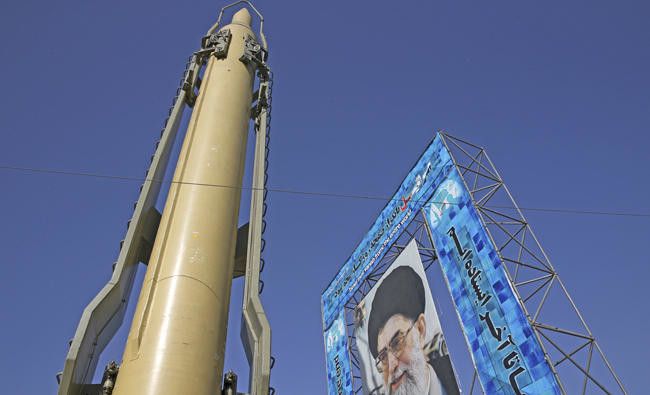
In this Sunday, Sept. 25, 2016, photo a Ghadr-F missile is displayed next to a portrait of Iranian Supreme Leader Ayatollah Ali Khamenei at a Revolutionary Guard hardware exhibition in Tehran. On July 18, 2017, the US imposed a new set of economic sanctions on Iran due to Tehran’s continuing destabilizing regional policies and activities related to its ballistic missile program. (AP Photo/Vahid Salemi, File)
Updated 19 July 2017
Follow

US slaps new sanctions on Iran over ballistic missiles, terrorism support

WASHINGTON: The US on Tuesday imposed a new set of economic sanctions on Iran due to Tehran’s continuing destabilizing regional policies and activities related to its ballistic missile program.
The US Treasury Department designated 16 entities and individuals for supporting “illicit Iranian actors or transnational criminal activity.”
“These designations include seven entities and five individuals for engaging in activities in support of Iran’s military or Iran’s Islamic Revolutionary Guard Corps (IRGC), as well as an Iran-based transnational criminal organization and three associated persons,” the department said in a statement.
Some of the activities targeted by the sanctions include developing drones, fast attack boats and other military equipment.
“The transnational criminal organization designated today, along with two Iranian businessmen and an associated entity, orchestrated the theft of US and Western software programs which, at times, were sold to the government of Iran,” the statement added.
The measures come a day after the administration of US President Donald Trump certified that Iran was in compliance with the agreement struck with the US and five other nations that puts restrictions on its nuclear energy program. But the administration made its continued concerns about various other issues very clear.
In a statement to reporters Monday night, a White House official suggested that the Trump administration was departing from the approach of former US President Barack Obama’s administration by addressing “the totality of Iran’s malign behavior and not narrowly focus(ing)” solely on its nuclear energy-related activities.
Mark Dubowitz, CEO of the Foundation for Defense of Democracies (FDD), a Washington-based nonpartisan policy institute, where he leads projects on Iran, sanctions, countering threat finance, and non-proliferation, said the new sanctions suggest the US is getting tougher on Tehran.
“The new sanctions are part of an escalation strategy that will see the Trump administration using all instruments of American power to roll back and subvert Iranian regime aggression,” Dubowitz told Arab News.
In comments to Arab News about the implications of the sanctions for US-Iranian relations, Alex Vatanka, an Iran scholar with the Middle East Institute said that going forward, “the ball is as much in the Iranian court, if not more so, than it is in the American court.”
He added that mixed signals from Iranian officials suggest that there is no agreement between Iranians themselves on the need for improved relations with the US.
Former US Ambassador to Iraq, James F. Jeffrey, a distinguished fellow at The Washington Institute, said: “The more important message from Washington is that it believes strongly that Iran is violating the spirit of the JCPOA with its destabilizing activities throughout the region, and that the US will live up to its May Riyadh Summit commitment to counter and contain Iran.”


Trump says ‘my own morality’ is only restraint on global power

Updated 13 sec ago
Follow

Trump says ‘my own morality’ is only restraint on global power

  • On Thursday the Senate advanced a measure to rein in presidential military action in Venezuela

WASHINGTON, United States: US President Donald Trump said in an interview published Thursday that his “own morality” was the only constraint on his power to order military actions around the world.
Trump’s comments to The New York Times came days after he launched a lightning operation to topple Venezuelan leader Nicolas Maduro, and threatened a host of other countries plus the autonomous territory Greenland.
“Yeah, there is one thing. My own morality. My own mind. It’s the only thing that can stop me,” Trump told the newspaper when asked if there were any limits on his global powers.
“I don’t need international law,” he added. “I’m not looking to hurt people.”
The Republican president then added that “I do” need to abide by international law, but said “it depends what your definition of international law is.”
The United States is not a member of the International Criminal Court (ICC), which tries war criminals, and it has repeatedly rejected decisions by the International Court of Justice (ICJ), the UN’s top court.
Trump himself has had his own run-ins with domestic law, having been impeached twice, faced a slew of federal charges including conspiring to overturn the 2020 election — which were eventually dropped after his re-election — and convicted for covering up a hush money payment to a porn star.
While proclaiming himself as “peace president” and seeking the Nobel Prize, Trump has launched a series of military operations in his second presidential term.
Trump ordered attacks on Iran’s nuclear program in June and in the past year has also overseen strikes on Iraq, Nigeria, Somalia, Syria, Yemen — and most recently on Venezuela.
Since Maduro’s capture, an emboldened Trump has threatened a string of other countries including Colombia, as well as Greenland, which is administered by fellow NATO member Denmark.
Asked whether his priority was preserving the NATO military alliance or acquiring Greenland, Trump told the Times: “it may be a choice.”
Some members of Congress, including a handful of Republicans, are trying to check Trump’s power.
On Thursday the Senate advanced a measure to rein in presidential military action in Venezuela. But even if it reaches his desk, Trump would likely veto it.
Billionaire Trump, who made his fortune as a property developer, added that US ownership of Greenland is “what I feel is psychologically needed for success.”
Trump said separately that he had no problem with his family conducting foreign business deals since his return to office.
“I prohibited them from doing business in my first term, and I got absolutely no credit for it,” Trump told the daily. “I found out that nobody cared, and I’m allowed to.”