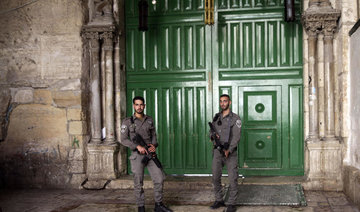
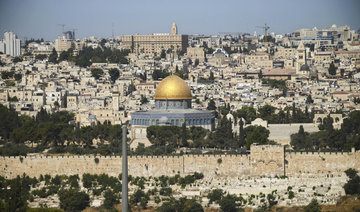
AMMAN: Al-Aqsa Mosque compound has been closed off for the second consecutive day, preventing thousands of Muslims from worshipping there, and tourists from visiting the UNESCO world heritage site.
The closure was decided by Israel after an exchange of fire at the mosque’s entrance led to the killing of three Palestinians and two Israeli policemen.
Adnan Al-Husseini, the Palestinian governor of Jerusalem, held Israel’s government responsible for any damage to the mosque area and its contents.
“There are thousands of manuscripts, rare artifacts and other precious items” in the mosque and throughout the compound. “We hold Israel responsible for their safe keeping,” he told local journalists.
Nayef Taha, a 68-year-old retired civil servant living in Jerusalem’s Old City, said he does not recall the Old City being so paralyzed for decades.
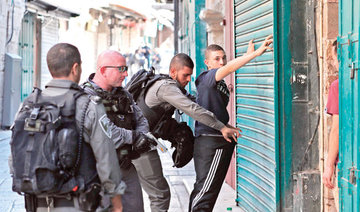
“Shop owners who are not residents of the Old City are unable to open their shops, and the Israelis allow only residents whose ID states that they live in the Old City,” he said.
Taha himself had to present his ID to Israeli soldiers manning two checkpoints in order to get home.
He told Arab News that the usually bustling Old City was a ghost town: “Saturday is usually a very busy day, but today most shops were closed and even a local clinic was unopen.”
The clinic he referred to was closed because the resident nurse, Nisreen Hijazi, who lives on the outskirts of the city, was unable to reach the clinic because her address is not in the Old City.
Palestinian officials and Jerusalem residents are worried that Israel will take advantage of the closure of the mosque compound to initiate changes that will further impede access to Islam’s third-holiest site.
Abdel Raouf Arnaout, a local journalist working for the Ramallah-based Al-Ayyam daily, told Arab News that one of the fears is the implementation of metal detectors.
“If they institute a metal detector at every one of the mosque’s gates, this would be a major problem, and will impede and delay the ability of Muslim worshippers to reach the mosque throughout the day,” he said.
Arnaout noted that on some Fridays during Ramadan, more than a quarter a million people prayed in Al-Aqsa.
“If they had metal detectors, very few people would make it in time and many would give up waiting in line.”
The mosque compound will reopen Sunday, Israeli Prime Minister Benjamin Netanyahu said.
“It has been decided to reopen the Temple Mount gradually tomorrow for the faithful, visitors and tourists,” the premier’s office said in a statement, cited by AFP. Regardless of what is decided, many Jerusalem residents said the city will no longer be the same for them.


![]()

Palestinians warn over manuscripts, rare artifacts in Al-Aqsa
Palestinians warn over manuscripts, rare artifacts in Al-Aqsa
Latest updates


© 2026 SAUDI RESEARCH & PUBLISHING COMPANY, All Rights Reserved And subject to Terms of Use Agreement.