IRBIL, Iraq: Human Rights Watch on Thursday condemned videos circulating on social media purportedly showing Iraqi forces killing and beating suspected Islamic State fighters in Mosul.
Two videos were posted to Facebook earlier this week, a day after Iraqi Prime Minister Haider Al-Abadi declared “total victory” in Mosul.
A spokesman for Iraq’s Defense Ministry said he had not seen the videos but that such incidents will not be tolerated.
Brig. Gen. Mohammed Al-Khudhari told the Associated Press by phone from Baghdad that soldiers have “very clear instructions and guidance” to hand over suspected Daesh (Islamic State) members for interrogation, “then to be sent to the court for trial.” He said any soldiers committing violations will be tried in a military court.
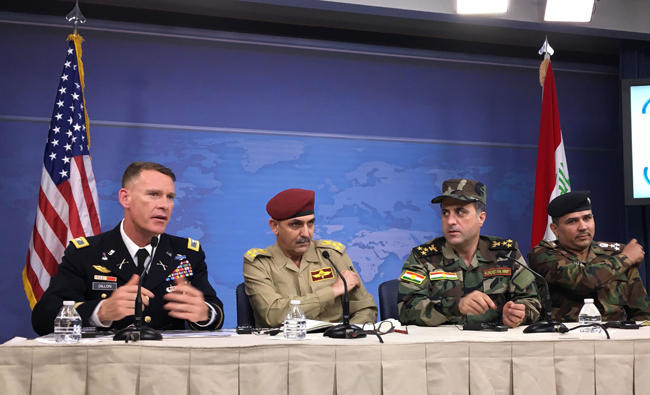
Brig. Gen. Saad Maan, spokesman for Iraq’s Interior Ministry, said officials were aware of such images and that an investigation has been launched.
“We looked and suspended a number of those forces shown in those pictures and there is currently an investigation being conducted,” he told Pentagon reporters by video conference, using an interpreter.
He added that “there might be some misbehavior or inappropriate conduct by some of the forces, yes, but the investigation is going on. We are against any violation against any human being and this is the position of the government.”
In one of the videos, soldiers are seen shouting at, kicking and beating several men — apparently captured Daesh fighters — in a room. One man’s shirt is splattered with fresh blood. Several are dragged out of the room.
“Is this one with Daesh or not?” one soldier is heard saying, using the Arabic acronym for the Daesh group and shouting at a man cowering in a corner. The man is dragged outside, and the camera follows.
The soldiers carry the man to the edge of a high wall overlooking the Tigris River. There, soldiers are shooting the bodies of two men who had already been thrown to the ground below. The soldiers throw the other man over the edge, then fire bullets into his body as well.
In the background, other soldiers are seen opening fire on a fourth man sprawled on the ground.
Another video posted Tuesday was titled: “Our heroes in the Iraqi Army 16th division executing the remnants of Daesh terrorists in Old Mosul.”
The images show a man in Iraqi army fatigues gunning down an unarmed man kneeling in front of a car. The rounds fired raised a cloud of dust into the air. The caption said the video was dedicated to the “families of the martyrs (of the Mosul operation).”
Human Rights Watch Iraq researcher Belkis Wille said Thursday that “these horrific reports of mistreatment and murder have been met by silence from Baghdad, only further fostering the feeling of impunity among armed forces in Mosul.”
Two other videos reported by HRW showed security forces beating and kicking suspects in custody.
Iraqi forces recaptured Mosul after the city was held for around three years by the Daesh group. The militants were notorious for atrocities, both against civilians and security forces, often hunting down anyone connected with the police or military after they overran territory. The nearly nine-month assault to retake Mosul also involved grinding urban warfare in which the security forces suffered heavy casualties.
That has raised concerns among rights workers now over vengeance killings.
Following the announcement of victory in Mosul, the United Nations High Commissioner for Human Rights released a statement warning Iraq that if “human rights challenges” are left unaddressed, they will “likely spark further violence and civilian suffering.”
“Horrific though the crimes of ISIL are, there is no place for vengeance,” the statement added, using an alternative acronym for Daesh.
Also Thursday, Human Rights Watch reported that Iraqi security forces forcibly moved dozens of women and children with alleged links to IS to a tent camp near Mosul that authorities describe as a “rehabilitation camp.”
The camp is located in Bartella, around 20 kilometers (12 miles) east of Mosul, and houses at least 170 families, mostly women and children from areas of western Mosul, where the last battles against Daesh took place, the New York-based group said.
The camp was opened Sunday, following a directive from Mosul’s district council that says “so-called ISIS families should be sent to receive psychological and ideological rehabilitation,” HRW said, using an alternative acronym for Daesh.
“Iraqi authorities shouldn’t punish entire families because of their relatives’ actions,” said Lama Fakih, the Mideast deputy chief at HRW. “These abusive acts are war crimes and are sabotaging efforts to promote reconciliation in areas retaken from ISIS.”


![]()
Videos appear to show Iraqi troops killing Mosul detainees
Videos appear to show Iraqi troops killing Mosul detainees
Latest updates


© 2026 SAUDI RESEARCH & PUBLISHING COMPANY, All Rights Reserved And subject to Terms of Use Agreement.