LONDON: The British government on Thursday published a draft law that would formally put an end to Britain’s membership of the EU, as a top official warned the country was unprepared for Brexit in less than two years’ time.
The new bill will repeal the 1972 law in which Britain became an EU member, and convert an estimated 12,000 existing EU regulations into British law, ending the supremacy of EU law in Britain.
“This bill means that we will be able to exit the European Union with maximum certainty, continuity and control,” Brexit Secretary David Davis said in a statement.
But Prime Minister Theresa May is braced for a battle over the bill, which also gives ministers powers to amend the EU laws as they are transferred without full parliamentary scrutiny.
These so-called “Henry VIII” powers will be limited for two years, but opposition parties have warned they will not allow the government to use the bill to push through policy changes.
May’s Conservative Party lost its majority in the June 8 election, leaving it dependent on the small Northern Irish Democratic Unionist Party to win votes in parliament.
The prime minister, who on Thursday marks one year since taking office after last year’s referendum to leave the EU, remains vulnerable and questions remain over how long she can stay.
As the bill was published, opposition Labour leader Jeremy Corbyn was in Brussels to offer his own Brexit vision to EU chief negotiator Michel Barnier.
May’s government began the two-year withdrawal process on March 29, setting Britain on an uncharted journey.
Extricating Britain from four decades of membership of the bloc is no small task: The new European Union (Withdrawal) Bill is one of eight Brexit bills the government will introduce.
But Labour’s Brexit spokesman Keir Starmer warned his party would not support the legislation as it stood.
“We have very serious issues with the government’s approach, and unless the government addresses those issues, we will not be supporting the bill,” he told The Guardian.
As well as concerns about the expansion of executive power, Labour fears an erosion of basic and workers’ rights and plans to submit amendments when the bill is debated in the autumn.
“This will be hell,” added Tim Farron, leader of the pro-European Liberal Democrats.
With the help of the 10 DUP lawmakers, May’s government has a majority of just 13 in the 650-member parliament.
Formal Brexit negotiations with the EU began last month and the two sides have already clashed over the future rights of European citizens living in Britain.
Ahead of the next round of talks starting next week, Britain on Thursday published three new papers setting out its position on nuclear cooperation, the European Court of Justice and privileges afforded to EU employees in Britain.
Barnier had warned Wednesday that the EU was waiting for more information from Britain.
“We need to know on which points we agree and on which points we disagree, so that we can negotiate in earnest,” he said.
“We cannot remain idle as the clock is ticking.”
Britain confirmed it would leave European Atomic Energy Community but said it wanted to continue working closely with Euratom to help ensure a smooth exit.
“The UK and the Euratom community have a strong mutual interest in ensuring close co-operation,” the position paper said.
London and Brussels disagree on whether the European Court of Justice will continue to have jurisdiction in Britain after Brexit.
Labour said Corbyn’s meeting with Barnier marked its growing importance in the Brexit process — although Barnier insisted he would only negotiate with the government.
The Frenchman was also due to meet Scottish First Minister Nicola Sturgeon and Welsh First Minister Carwyn Jones for private talks.
Meanwhile the head of Britain’s public spending watchdog blasted failures in government leadership over Brexit and raised fears about “vague” exit plans.
Amyas Morse said ministers were not delivering a unified front on challenges of quitting the EU and warned the response could fall apart like a “chocolate orange” — a sweet that breaks into slices — at the first tap.
The National Audit Office chief said if there was failure to prepare for customs, it would be a “horror show” if officials were forced to process imports and exports manually.
A government spokesman said: “The whole government is alive to the task ahead and working together to deliver on the will of the British people.”


![]()
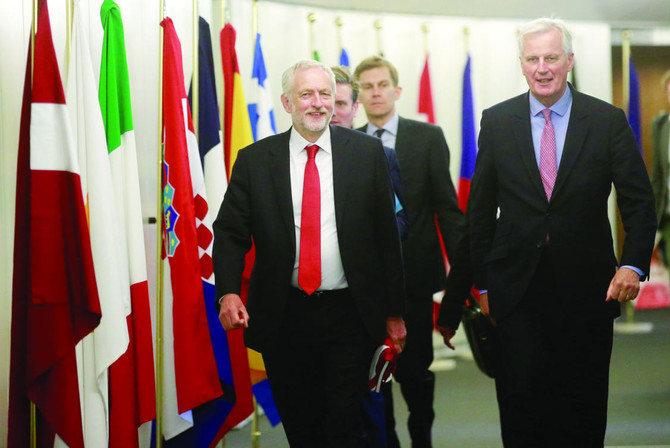
UK sets out Brexit bill to end EU membership
UK sets out Brexit bill to end EU membership
Latest updates


© 2026 SAUDI RESEARCH & PUBLISHING COMPANY, All Rights Reserved And subject to Terms of Use Agreement.