France steps up efforts to lure London banks to Paris

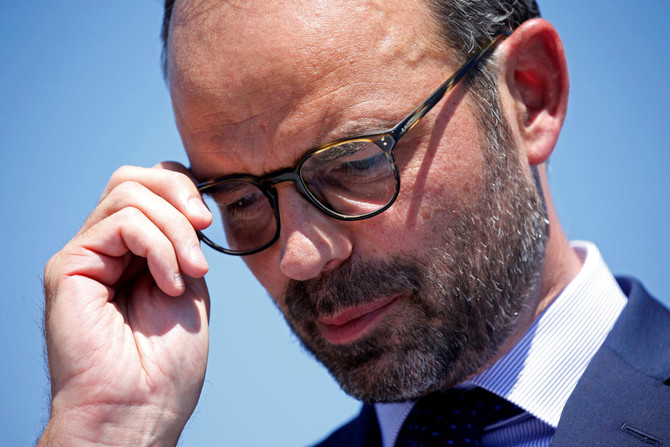
French Prime Minister Edouard Philippe. (Reuters)
Updated 07 July 2017
Follow

France steps up efforts to lure London banks to Paris

PARIS: French authorities on Friday stepped up efforts to attract London banks to Paris after Brexit by pledging to cut labor costs and ensure they do not face tougher regulations than European rivals.
Many international banks in London are trying to decide where to shift operations to maintain access to the EU’s single market after Britain leaves the EU.
There is fierce competition between Paris, Frankfurt and other European cities to woo the banks based in the City of London financial center and some have already announced plans to move staff.
Until now, Paris’ rivals, including Frankfurt, Dublin and Luxembourg, have been making the headlines as the locations banks, insurers and asset managers have chosen to open new hubs.
French Prime Minister Edouard Philippe said the government would scrap the highest bracket of payroll tax for firms like banks that do not pay value-added tax (VAT), cancel a planned extension of a tax on share trading. It would also make sure that bankers’ bonuses are no longer taken into account when labor courts decide on unfair dismissal compensation.
“Promoting the financial attractiveness of Paris, is promoting France’s economic attractiveness,” Philippe said. “Every banker, every trader ... who settles in Paris triggers the creation of other jobs.”
The payroll tax France charges banks and some other sectors such as real estate and health care is a charge that companies pay on each salaried employee. It is not levied in most other European countries.
Tax was a big concern for London bankers at a roadshow organized by a French finance industry lobby in February this year to promote Paris as a financial center.
Germany is also looking at making it easier to hire and fire senior bankers in a relaxation of its labor laws to help to attract financial firms to Frankfurt after Brexit.
Philippe also pledged to review and change on a case-by-case basis the way EU financial regulations are transposed into French law.
“The French law has sometimes opted for overregulation when the European standards for the financial sectors were transposed,” a document published by Philippe’s office said.
“This could have had imposed an additional burden on businesses, compared to European rivals.”
President Emmanuel Macron, a former investment banker, has a hard task to convince the investment community that France does not see the financial sector as an “enemy” — a phrase once used by former Socialist President Francois Hollande.
Early next week, Philippe is due to give a speech to bankers at a conference in Paris, where the chief executive of US investment bank JP Morgan Jamie Dimon is expected to attend, according to the agenda on the event’s website.
Banks are coming under some pressure to decide where to move. The European Central Bank (ECB) said on June 30 that banks should step up their Brexit preparations, while the Bank of England (BoE) wants details of financial firms’ contingency plans by July 14.
But Britain is also pushing for a Brexit deal that would allow UK-based finance firms to continue to operate relatively freely in the EU after March 2019, when Brexit is due to take effect.
Andrew Bailey, the head of Britain’s Financial Conduct Authority (FCA) said on Thursday Brexit did not necessarily mean an end to free trade in financial services.


Global brands shut Middle East stores as conflict causes chaos

Updated 03 March 2026
Follow

Global brands shut Middle East stores as conflict causes chaos

  • Luxury brands and retailers close stores in Middle East
  • Conflict threatens the region that has ‌been luxury’s fastest growing
  • Mass-market retailers monitor situation, adjust operations in region

PARIS: In Dubai and other major Middle Eastern shopping hubs, many stores are closed or operating with a skeleton staff as the escalating conflict in the ​region causes chaos for businesses and travel.

The US-Israeli air war against Iran expanded on Monday with no end in sight, with Tehran firing missiles and drones at Gulf states as it retaliates for a weekend of bombing that killed Iran’s supreme leader and reportedly killed scores of Iranian civilians, including a strike on a girls’ primary school.

Chalhoub Group, which runs 900 stores for brands from Versace and Jimmy Choo to Sephora across the region, said its stores in Bahrain were closed, while other markets, including the UAE, Saudi Arabia, and Jordan remained open though staff attendance was “voluntary.”

“We operate with a lean team formed of members who volunteered and feel comfortable to come to the store,” Chalhoub’s Vice President of Communications Lynn al ‌Khatib told Reuters, adding ‌that the company’s leadership team personally visited Dubai Mall and Mall of the Emirates ​on ‌Monday ⁠morning to check ​in ⁠with workers.

E-commerce giant Amazon closed its fulfillment center operations in Abu Dhabi, suspended deliveries across the region and instructed its employees in Saudi Arabia and Jordan to remain indoors, Business Insider reported on Monday, citing an internal memo.

Gucci-owner Kering said its stores were temporarily closed in the UAE, Kuwait, Bahrain and Qatar and it has suspended travel to the Middle East.

Luxury growth engine under threat

Shares in luxury groups LVMH, Hermes, and Cartier-owner Richemont were down 4 percent to 5.7 percent on Monday afternoon as investors digested the knock-on impacts of the conflict.

The Middle East still accounts for a small share of global spending on luxury — between 5 percent and 10 percent, according ⁠to RBC analyst Piral Dadhania. But the region was “luxury’s brightest performer” last year, according to consultancy ‌Bain, while sales of expensive handbags have stalled in the rest of the ‌world.

Now, shuttered airports have put an abrupt stop to tourism flows into ​the region and missile strikes — including one that damaged Dubai’s ‌five-star Fairmont Palm hotel — are likely to dissuade travelers, particularly if the conflict drags on.

“If you assume that it’s ‌a $5 billion to $6 billion (travel retail) market and let’s say it’s going to be shut down for a month, we are talking about hundreds of millions of dollars that are definitely at risk,” said Victor Dijon, senior partner at consultancy Kearney.

If Middle Eastern shoppers cannot travel to Paris or Milan, that could also hurt luxury sales in Europe, he added.

Luxury brands have been investing in lavish new stores and exclusive events ‌across the region. Cartier unveiled a “high-jewelry” exhibition in Dubai’s Keturah Park just days before the conflict started.

Cartier and Richemont did not reply to requests for comment.

Luxury conglomerate LVMH ⁠has also bet big on ⁠the region. Last month, its flagship brand Louis Vuitton staged an exhibition at the Jumeirah Marsa Al Arab hotel, and beauty retailer Sephora launched its first Saudi beauty brand.

LVMH does not report specific figures for the region, but in January Chief Financial Officer Cecile Cabanis said the Middle East has been “displaying significant growth.” LVMH did not reply to a request for comment on how its business may be impacted by the conflict.

The Middle East has also attracted new investment from mass-market players. Budget fashion retailer Primark said in January that it plans to open three stores in Dubai in March, April and May, followed by stores in Bahrain and Qatar by the end of the year.

“Primark is set to open its first store in Dubai at the end of March but clearly this is a fast-moving situation which we are monitoring closely,” a spokesperson for Primark-owner Associated British Foods said.

Apple stores in Dubai will remain closed until Thursday morning, the company’s website showed, while Swedish fast-fashion retailer ​H&M said its stores in Bahrain and Israel are ​closed.

Consumer goods group Reckitt has told all employees in the Middle East to work from home, temporarily closed its Bahrain manufacturing site and suspended all business travel to the region until further notice.