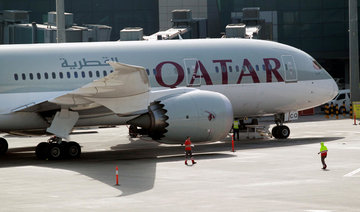
Qatar Airways cancels four Airbus A350 orders worth $1.2 billion following delays

Qatar Airways is the biggest buyer of the A350, with 80 orders before the cancelations, as well as the launch customer having taken its first plane in December 2014. (Reuters)
Updated 07 July 2017
Follow

Qatar Airways cancels four Airbus A350 orders worth $1.2 billion following delays

DUBAI: Qatar Airways has canceled orders for four A350s worth $1.2 billion (SR4.5 billion) because of delivery delays, European planemaker said Airbus said.
The cancelation comes amid an air blockade imposed against Qatar after a diplomatic breakdown with its Gulf neighbors and a dip in regional demand for air travel.
Qatar Airways chief executive Akbar Al Baker earlier said that any delays in the delivery of planes were the aircraft maker’s responsibility.
“We are asking Airbus to deliver it faster,” he told a Dublin news conference. “The delay is from Airbus.”
The Doha-based carrier is the biggest buyer of the A350, with 80 orders before the cancelations, as well as the launch customer having taken its first plane in December 2014.
Qatar Airways’ contract with Airbus on the A350 aircraft includes a clause allowing it to scrap handovers that are delayed beyond a certain point, which means the planemaker now has to look for other buyers and refit the aircraft interiors at a cost of up to $60 million (SR224 million).
Al Baker has a reputation for being demanding when reviewing aircraft for quality defects before delivery, and has previously turned down deliveries of A380, A320neo and earlier A350 planes.
He refused to accept four A320neos last year over claims of performance issues with the aircraft’s engines, made by Pratt & Whitney, saying they required additional time to start under certain conditions.
The airline has renegotiated an order with Airbus to take delivery only of larger A321 planes, but was still deciding whether to switch the engine order for the narrow-body jets from Pratt & Whitney, a unit of United Technologies, to CFM, a joint venture between General Electric and Safran of France.


Oil prices rise sharply after attacks in Middle East disrupt global energy supply

Updated 02 March 2026
Follow

Oil prices rise sharply after attacks in Middle East disrupt global energy supply

  • Traders were betting the supply of oil from Iran and elsewhere in the Middle East would slow or grind to a halt.
  • Attacks throughout the region have restricted countries’ ability to export oil to the rest of the world

NEW YORK: Oil prices rose sharply Monday as US and Israeli attacks on Iran and retaliatory strikes against Israel and US military installations around the Gulf sent disruptions through the global energy supply chain.
Traders were betting the supply of oil from Iran and elsewhere in the Middle East would slow or grind to a halt. Attacks throughout the region, including on two vessels traveling through the Strait of Hormuz, the narrow mouth of the Arabian Gulf, have restricted countries’ ability to export oil to the rest of the world. Prolonged attacks would likely result in higher prices for crude oil and gasoline, according to energy experts.
West Texas Intermediate, the light, sweet crude oil produced in the United States, was selling for about $72 a barrel early Monday, up around 7.3 percent from its trading price of about $67 on Friday, according to data from CME group.
A barrel of Brent crude, the international standard, was trading at $78.55 per barrel early Monday, according to FactSet, up 7.8 percent from its trading price of $72.87 on Friday, which had been a seven-month high at the time.
Higher global energy prices could lead to consumers paying more for gasoline at the pump and shelling out more for groceries and other goods, at a time when many are already feeling the impacts of elevated inflation.
Roughly 15 million barrels of crude oil per day — about 20 percent of the world’s oil — are shipped through the Strait of Hormuz, making it the world’s most critical oil chokepoint, according to Rystad Energy. Tankers traveling through the strait, which is bordered in the north by Iran, carry oil and gas from Saudi Arabia, Kuwait, Iraq, Qatar, Bahrain, the UAE and Iran.
Iran had temporarily shut down parts of the strait in mid-February for what it said was a military drill, which led oil prices to jump about 6 percent higher in the days that followed.
Against that backdrop, eight countries that are part of the OPEC+ oil cartel announced they would boost production of crude Sunday. The Organization of Petroleum Exporting Countries, in a meeting planned before the war began, said it would increase production by 206,000 barrels per day in April, which was more than analysts had been expecting. The countries boosting output include Saudi Arabia, Russia, Iraq, the United Arab Emirates, Kuwait, Kazakhstan, Algeria and Oman.
“Roughly one-fifth of global oil supply passes through the Strait of Hormuz, a vital artery for world trade, meaning markets are more concerned with whether barrels can move than with spare capacity on paper,” said Jorge León, Rystad’s senior vice president and head of geopolitical analysis, in an email. “If flows through the Gulf are constrained, additional production will provide limited immediate relief, making access to export routes far more important than headline output targets.”
Iran exports roughly 1.6 million barrels of oil a day, mostly to China, which may need to look elsewhere for supply if Iran’s exports are disrupted, another factor that could increase energy prices.