BERLIN: Airbus has signed an agreement to sell 140 aircraft to China, it said on Wednesday, in a deal worth almost $23 billion at list prices.
The agreement, signed during a visit by Chinese President Xi Jinping to Germany, is for 100 A320 family aircraft and 40 A350 planes, Airbus said.
"It's one of the biggest deals that we've signed in a long time," Airbus Group Chief Executive Tom Enders told journalists after signing the deal in Berlin.
The planes will be purchased by state-owned China Aviation Supplies Holding Company, which will then allocate them to Chinese airlines.
The A320 planes will be a mixture of the older CEO and the new NEO version with revamped engines, while the majority of the A350 orders are for the -900 model. The deal is flexible pending negotiations with the airlines.
Enders said he expected up to 50 percent of the A320 family planes would come from the Airbus final assembly line in China.
Enders was making his first public appearance since Airbus rolled out a new structure, completing a recent merger between its parent company and its dominant planemaking arm, changes which included a shift in the reporting line for its commercial sales team to Enders.
Enders said the shift in reporting lines for the sales team reflected the fact that commercial aircraft head Fabrice Bregier had been given more tasks in his new role as group-wide chief operating officer.
With orders slowing and the focus shifting to the backlog, Enders said the shake-up allows Bregier to concentrate on deliveries.
"This is merely a burden sharing mechanism because the focus should be on execution and this is what it's all about," Enders said.
"We have plenty of challenges on the execution side, be it the transition to the NEO, the ramp-up of the A320 family, the 350 family, not to mention the A400M, which is not entirely solved," he said.
Enders also said the group was in talks with the Chinese over the A380 superjumbo, which has suffered slow sales.
"It won't happen overnight. It has to be intensively discussed," he said.
Airbus has also urged the German government to ensure domestic firms get a big share of a near €4-billion contract earmarked for the country's next generation of heavy-lift military helicopters.
German defense officials have said they want a low-risk heavy-lift helicopter that already exists, which means the likely supplier will be one of the two biggest US weapons makers — Lockheed Martin Corp and Boeing Co.
Airbus officials say they do not have a helicopter large enough for Germany's likely military's needs, but want to take a close look at the requirements when they are released by the defence ministry, a move that could occur next year.
Europe's biggest aerospace company and seven German firms including engine maker MTU Aero Engines said on Wednesday they had teamed up to push for a management and maintenance role in the project.
"This is about the future of the German helicopter industry," Wolfgang Schoder, CEO of Airbus Helicopters Deutschland, told Reuters at a helicopter conference in northern Germany.


![]()
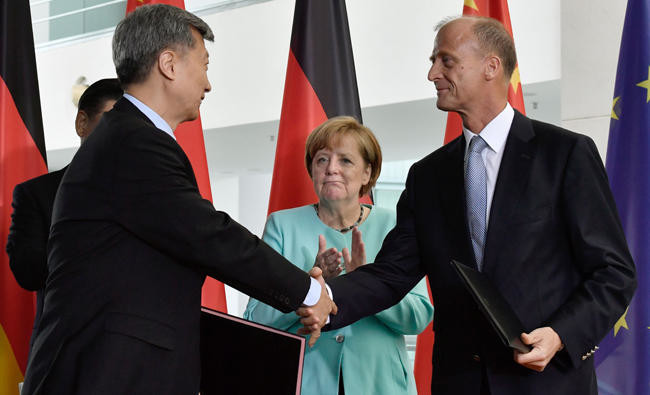
Airbus signs deal to sell 140 planes worth $23bn to China
Airbus signs deal to sell 140 planes worth $23bn to China
Latest updates


© 2026 SAUDI RESEARCH & PUBLISHING COMPANY, All Rights Reserved And subject to Terms of Use Agreement.