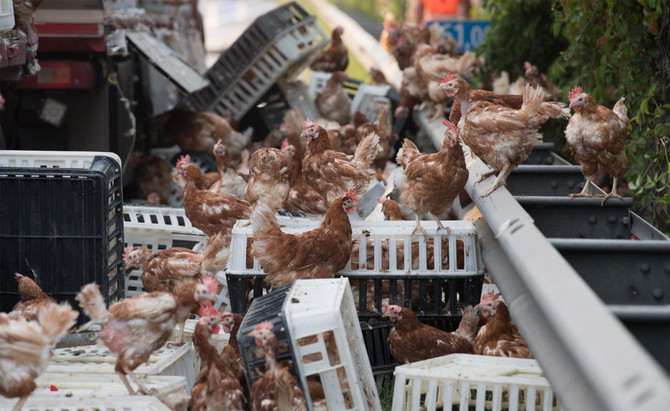
VIENNA: Emergency workers in Austria had an egg-stremely unusual operation on Tuesday removing an estimated 7,000 chickens which were blocking a busy motorway.
The birds’ unexpected break for freedom came after the lorry transporting them lost its load on the A1 autobahn near Linz in the north of the country.
“Boxes containing dead and injured animals were strewn over a 160-meter (-yard) stretch (of road) while thousands of chickens ran onto the motorway on both sides,” police said.
The incident closed the motorway toward the capital Vienna during the busy morning rush hour and caused long traffic jams in the other direction as drivers slowed down to look.

Thousands of chickens block Austrian motorway
6 planets will parade across the night sky at the end of February
NEW YORK: Six planets are linking up in the sky at the end of February, and most will be visible to the naked eye.
It’s what’s known as a planetary parade, which happens when multiple planets appear to line up in the sky at once. The planets aren’t in a straight line, but are close together on one side of the sun.
Skygazers can usually spot two or three planets after sunset, according to NASA. Hangouts of four or five that can be glimpsed with the naked eye are less common and occur every few years. Last year featured lineups of six and all seven planets.
When will they be visible?
On Saturday, Mercury, Venus, Jupiter and Saturn will be visible to the naked eye if clear skies allow. Uranus and Neptune can only be spotted with binoculars and telescopes.
What time is optimal for viewing?
Go outside about an hour after sunset and venture away from tall buildings and trees that will block the view. Look to the western sky and spot Mercury, Venus and Saturn close to the horizon. Jupiter will be higher up, along with Uranus and Neptune.
How to know if you’ve spied a member of the parade?
“If it’s twinkling, it’s a star. If it is not twinkling, it’s a planet,” said planetary scientist Sara Mazrouei with Humber Polytechnic in Canada.
The parade should be visible over the weekend and in the days after. Eventually, Mercury will bow out and dip below the horizon.
At least one bright planet is visible on most nights, according to NASA.
Glimpsing many in the sky at once is a fun way to connect with astronomers of centuries’ past, said planetary scientist Emily Elizondo with Michigan State University.
Ancient astronomers used to make sense of the universe “just by looking up at the stars and the planets,” Elizondo said, “which is something that we can do today.”