Philippine government to replace OECs required for overseas Filipino workers with identification cards

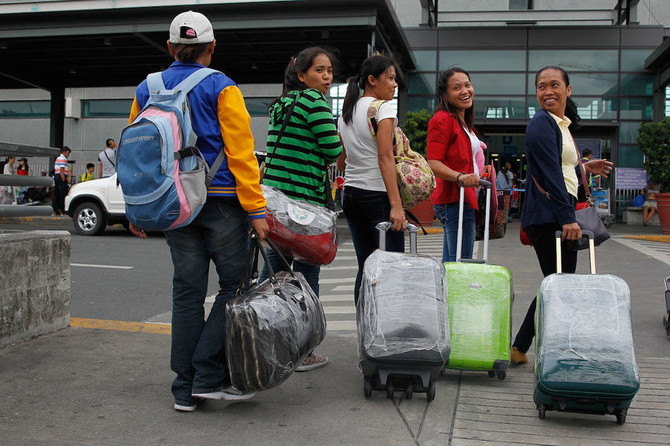
There are approximately 10 million overseas Filipino workers in 170 countries, with 1 million in Saudi Arabia alone. (Reuters)
Updated 04 July 2017
Follow

Philippine government to replace OECs required for overseas Filipino workers with identification cards

The Philippine labor department by the end of July will start to issue identification cards for overseas Filipino workers and do away with the overseas employment certificates being required before they are deployed abroad.
“We will start implementing I-DOLE (Department of Labor and Employment) cards to all bona fide OFWs at no cost. This will be the substitute for the OECs,” labor secretary Silvestre Bello III said in a live commentary with Presidential Communications Office assistant secretary Margaux Uson over Facebook.
The initiative, one of the major priorities under president Rodrigo Duterte’s administration, will be launched on July 12.
Filipinos working abroad have long complained about the difficulty of obtaining OECs whenever they have to go back home or return to their workplaces since they have to hurdle long queues just to get one.
Aside from providing the basic information and replacing the OEC, the ID will also serve as the migrant workers’ Social Security System (SSS), Pag-ibig Fund and PhilHealth membership IDs.
The labor secretary, in a separate briefing at Malacañan Palace, also said that they are exploring a system that would allow the I-DOLE cards to also be designated passport of OFWs.
“We are talking to the DFA (Department of Foreign Affairs) and the DOJ (Department of Justice) through its agency, the Bureau of Immigration, so that the IDOLE may be used as a passport,” he said.
There are approximately 10 million OFWs in 170 countries, with 1 million in Saudi Arabia alone, followed by Japan, Hong Kong, the United Arab Emirates and Taiwan.
Last year, OFW remittances reached a record $26.9 billion, up 5 percent from $25.61 billion in 2015 with almost 80 percent of the amount send from countries like Saudi Arabia, the UAE, Kuwait, Qatar, Singapore, Germany, Hong Kong, Japan, the UK and the US.


Philippines signs free trade pact with UAE

Updated 4 sec ago
Follow

Philippines signs free trade pact with UAE

  • UAE deal is Philippines’ fourth free trade pact, after South Korea, Japan, and EFTA
  • Business body warns of uneven gains if domestic safeguard mechanisms insufficient

MANILLA: The Philippines signed on Tuesday a comprehensive economic partnership agreement with the UAE, its first such deal with a Middle Eastern nation.

The Philippines and the UAE first agreed to explore a free trade pact in February 2022 and formalized the process with terms of reference in late 2023. Negotiations started in May 2024 and were finalized in 2025.

The CEPA signing was witnessed by President Ferdinand R. Marcos Jr. who led the Philippine delegation to Abu Dhabi.

“The CEPA is the Philippines’ first free trade pact with a Middle Eastern country, marking a milestone in expanding the nation’s global trade footprint,” Marcos’s office said.

“The agreement aims to reduce tariffs, enhance market access for goods and services, increase investment flows, and create new opportunities for Filipino professionals and service providers in the UAE.”

The UAE is home to some 700,000 Filipinos, the second-largest Filipino diaspora after Saudi Arabia.

With bilateral trade worth about $1.8 billion, it is also a key trading partner of the Philippines in the Middle East, and accounted for almost 39 percent of Philippine exports to the region in 2024.

The Philippine Department of Trade and Industry earlier estimated it would lead to at least 90 percent liberalization in tariffs and give the Philippines wider access to the GCC region.

“Preliminary studies indicate the CEPA could boost Philippine exports to the UAE by 9.13 percent, generate consumer savings, and strengthen overall trade linkages with the Gulf region,” Marcos’s office said.

The Philippine Chamber of Commerce and Industry-Makati expects the pact to bring stronger trade flows, capital and technology for renewable energy, infrastructure, food, and water security projects as long as domestic policy supports it.

“CEPA can serve as a trade accelerator and investment catalyst for the Philippines,” Nunnatus Cortez, the chamber’s chairman, told Arab News.

The pact could result in “expanding exports, attracting capital, diversifying economic partners, upgrading industries, and supporting long-term growth — provided the country actively supports exporters and converts provisions into concrete commercial outcomes,” said Cortez.

“The main downside risk of CEPA lies in domestic readiness. Without strong industrial policy, MSME (Micro, Small and Medium Enterprises) support, safeguard mechanisms, and export development, CEPA could lead to import dominance, uneven gains, fiscal pressure, and limited structural transformation.”

The deal with the UAE is the Philippines’ fourth bilateral free trade pact, following agreements with South Korea, Japan, and the European Free Trade Association, which comprises Iceland, Liechtenstein, Norway, and Switzerland.