KACST Badir program to set up 600 more companies to provide 3,600 jobs

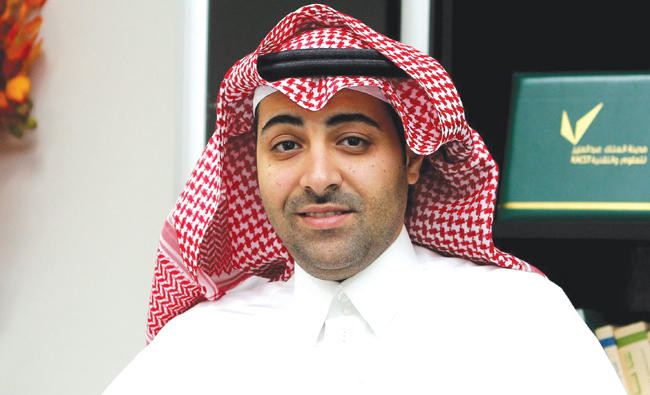
Nawaf Al-Sahhaf
Updated 04 July 2017
Follow

KACST Badir program to set up 600 more companies to provide 3,600 jobs

RIYADH: King Abdul Aziz City for Science and Technology (KACST) through the Badir program is seeking to establish more than 600 additional companies that would contribute to the creation of 3,600 jobs.
Nawaf Al-Sahhaf, chief executive officer of Badir, said here that the program has incubated 127 technical projects through its five incubators, generating a market value of SR331 million ($88.26 million) for 34 of these projects alone.
He added that some 786 jobs for young Saudis were created as a result. Also, the program is in the process of opening new incubators in the cities of Abha, Buraida, Dammam, and other cities around the Kingdom by 2020.
KACST is seeking to promote incubators and accelerators, and expand activities into nine regions, in line with the Kingdom’s vision at the technical level, and help stimulate the national economy and development.
This plan falls within KACST’s policy to encourage, support and promote the cognitive economy and entrepreneurship. It is a step in the government’s efforts to diversify economic sources by developing non-oil technical industries and promoting innovations and creations.
“Saudis and Saudi companies, when properly empowered, can deliver extraordinary innovative solutions to local and regional problems. We foresee further innovation in solving issues in the fields of medicine and energy, with the use of IT applications to innovate solutions that further streamline the everyday tasks that we do,” Al-Sahhaf said.


Saudi traveler drives in search of the aurora 

Updated 6 sec ago
Follow

Saudi traveler drives in search of the aurora 

  • ‘It felt like a dream,’ says 27-year-old Malik Al-Sultan after seeing the famed Northern Lights 

JEDDAH: A Saudi adventurer has driven thousands of kilometers across continents in pursuit of one of the planet’s rarest natural spectacles.

Malik Al-Sultan set out from Riyadh in a modified Toyota Hilux, crossing Europe by road to reach northern Norway, where he witnessed the Northern Lights. 

Auroras, or Northern Lights, are colorful and often delicate displays that occur when charged solar particles collide with Earth’s magnetic field and upper atmosphere. In the northern hemisphere, these shifting curtains of light are visible only during certain seasons. 

“I love trying new experiences, seeking adventure, and facing challenges,” Al-Sultan told Arab News. 

The idea of traveling long distances by car began in 2017 while Al-Sultan was in Switzerland with his family. “I saw a car there with a plate from one of the Gulf countries, and from that moment I was inspired,” he said.  

Once his plans were complete, the destination was clear. “When everything was ready, I chose Norway.” 

Al-Sultan, 27, is a university graduate and an employee who prefers simple travel. “I try to share my experience without exaggeration or change,” he said. “My goal is to visit as many countries as I can and share what I learn, what people need, and how much it costs.” 

His journey took nearly three weeks of driving, with extended stops to explore several countries. 

The route passed through Saudi Arabia, Kuwait, Turkiye, Bulgaria, North Macedonia, Albania, Kosovo, Montenegro, Bosnia, Croatia, Slovenia, Austria, Italy, Switzerland, Liechtenstein, France, the UK, Belgium, the Netherlands, Germany, Denmark, Sweden, and finally Norway. 

Along the way, Al-Sultan relied on ferry crossings between France and the UK and between Denmark and Norway, as well as for some travel within Norway. 

Driving alone for long distances was challenging. “It was a bit tiring, but I took breaks to rest,” he said. Friends joined him on some stages during the trip. 

Al-Sultan made only essential modifications to his 2020 Toyota Hilux 4x4. “I changed the tires and some consumable parts,” he said. For winter conditions in Norway, he used special snow tires with metal studs. 

He said the vehicle was tested in difficult conditions — “especially in remote areas, high elevations, changing weather, and long distances.” Among the main challenges were “long distances and difficulty finding accommodation late at night.” 

The Northern Lights are best seen in the night sky and far away from city lights. The aurora season usually begins in late September and lasts until late March. Even during this period, witnessing the phenomenon requires luck, and many aurora hunters return home disappointed. 

Al-Sultan reached northern Norway near the city of Bodo, where he saw the Northern Lights earlier this month, close to the Rana area.

“It felt like a dream,” he said. “At first, I thought it was clouds or factory smoke reflecting light.” 

The lights appeared in green and red, and remained visible for more than half an hour.  

Reflecting on the experience, Al-Sultan said the journey taught him patience and self-reliance. “It showed me the value of endurance, trusting my own judgment, and making decisions independently,” he said. “I also discovered how to embrace and even enjoy challenges.” 

During the trip, he was warmly hosted by families in different countries. People “were genuinely excited about my journey, and their enthusiasm grew even more when they learned I’m from Saudi Arabia,” he said. “They were also curious about the purpose of my journey and where I was headed.” 

Despite the freezing temperatures during the trip, Al-Sultan chose to wear traditional Saudi attire. 

“The thobe and shemagh are part of my identity, and I’m proud of them,” he said. “I feel most comfortable wearing them, so it was the natural choice.”  

Al-Sultan added that this helped showcase “the true image of the Saudi citizen,” and he hoped he had represented his country positively. 

His journey is far from over. “My next goal,” he said, “is to reach Iceland.”