JEDDAH: For most the threat of an asteroid striking Earth is something we watch in Hollywood movies – but with real life scientists the threat is increasingly real. The challenge they are faced with is what they are going to do about it.
According to press reports, NASA has been working with the European Space Agency (ESA) on creating a spacecraft that might one day deflect an asteroid that would otherwise potentially kill millions.
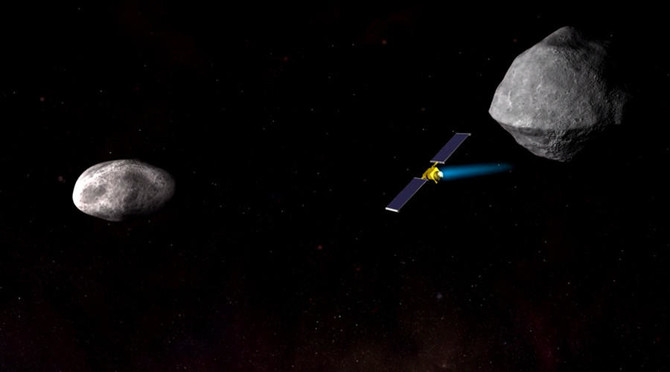
The design for the Double Asteroid Redirection Test (DART) has been given the green light. Now NASA experts hope the craft will be ready for its inaugural outer space test in 2022.
Czech researchers recently revealed that they had seen increased meteor activity close to Earth. The rise led the scientists to believe there was a greater risk of a meteor striking our planet with potentially lethal consequences.
Hollywood famously touched on this subject with the science fiction action movies “Deep Impact” and “Armageddon,” in which the heroes traveled into space with nuclear bombs intended to either shift the meteors, or obliterate them altogether.
Of course in the movies, while the planet and mankind were saved, there were the inevitable casualties who sacrificed themselves. But in reality it would seem that while NASA is taking a similar approach with the deflection approach — it will be done, hopefully, without the human sacrifice.
“DART would be NASA’s first mission to demonstrate what’s known as the “kinetic impactor technique” — striking the asteroid to shift its orbit — to defend against a potential future asteroid impact,” NASA spokesperson Lindley Johnson told Russia Today.
Johnson said the approval for the design meant the probe could then be created for a “historic test with a non-threatening small asteroid.”
The test will target a small, non-threatening asteroid system called “Didymos,” which is made up of two space rocks, which are 160 meters and 780 meters long. It is predicted that “Didymos” will pass Earth between 2022 and 2024.
There will be various aspects to the mission, including data retrieval on the make up of the rock and its orbit around the larger of the two.
Then the DART probe will be programed for one mission — to hit the smaller “Didymos” nine times faster than a bullet. The intention is that the force of the impact will be so great that it will change the direction of the asteroid.
Further data will then be collected on the material found in the crater caused by the impact, and how much the orbit of the smaller rock has changed — if at all.
The following video explains how NASA and the European Space Agency will carry out the mission.