MOSCOW: A court convicted five men of murdering Russian opposition leader Boris Nemtsov on Thursday, but the late politician’s allies said the investigation had been a cover-up and that the people who had ordered his killing remained at large.
Nemtsov, one of President Vladimir Putin’s most vocal critics, was murdered in 2015 as he walked across a bridge near the Kremlin after dining with his girlfriend. Aged 55, he had been working on a report examining Russia’s role in Ukraine. His killing sent a chill through opposition circles.
After more than eight months of hearings, a jury trial convicted five ethnic Chechen men of his murder, including the man prosecutors said pulled the trigger, Zaur Dadayev, a former soldier in Chechnya.
The court said the four others had acted as his accomplices and that the group had been promised a bounty of 15 million roubles ($253,889.59) for the high-profile assassination.
Nemtsov’s supporters gave a muted welcome to the verdict, but said Dadayev and the others were only low-level operatives. The case remained unsolved, they said, because those who had ordered, financed and organized the hit had not been caught.
“It’s the biggest crime of the century and yet they haven’t identified the real organizers or those who ordered it,” Vadim Prokhorov, a lawyer for the late politician’s daughter, told reporters after the verdict.
“The Russian government was not prepared to look into the entourage of (Chechen leader Ramzan) Kadyrov,” he said, despite his view that one of the masterminds was a close associate of the Chechen strongman.
Zhanna Nemtsova, the slain politician’s daughter, repeatedly said she wanted Kadyrov, the Kremlin-backed head of Chechnya who calls himself “Putin’s footsoldier,” to be questioned about what he knew about the case. Kadyrov has praised the trigger man Dadayev as a “true patriot of Russia.”
Kadyrov, who has denied allegations he was personally involved, was never summoned by the court.
Nemtsova said she was disappointed but not surprised that her father’s murder case remained unsolved.
“Clearly, investigators and the court did not strive to establish the truth,” Nemtsova said in a statement on social media. “It was of course not a proper investigation, but only an imitation of one.”
BLAME GOES ‘STRAIGHT TO THE TOP’
The Kremlin, as it did when journalist Anna Politkovskaya was murdered in 2006, has downplayed Nemtsov’s significance, calling his killing a “provocation” designed to cause problems for the Russian authorities.
Dmitry Peskov, President Vladimir Putin’s spokesman, said after the verdict it was up to investigators to decide if further examination of the case was necessary.
Before the verdict, Peskov had said it was “an extraordinarily complex case” and that it sometimes took years to identify and arrest the masterminds in such cases.
Investigators have said they are still seeking a man they suspect of having helped organize the killing. Nemtsova said she saw no willingness on the authorities’ part to pursue the case.
Her father, a former deputy prime minister who was once tipped to succeed Boris Yeltsin as president, a job Putin got, had authored an excoriating report on Putin’s rule. Shortly before he was killed, he had been working on a report examining the Russian military’s role in Ukraine.
Kremlin critics say the trial was flawed. The authorities never made public any CCTV footage of the killing despite it taking place in sight of the Kremlin’s walls.
A murder weapon was never recovered, and many witnesses were never summoned. One of the main suspects was also killed — in unclear circumstances — when authorities tried to detain him in Chechnya.
Olga Mikhailova, a lawyer for Nemtsova, said during the trial that Nemtsov had been a major irritant to the authorities.
“We are absolutely convinced, considering how the murder was organized and carried out, that the roots of the killing go straight to top Russian and Chechen officials,” she said.
Ilya Yashin, Nemtsov’s one-time spokesman, said he and other supporters would now try to pressure the authorities into pursuing the people who were really behind the murder.
Nemtsov’s memory is kept alive in central Moscow where, for more than 700 days and nights, a small group of anti-Kremlin activists has guarded a makeshift memorial to him on the bridge opposite Moscow’s Red Square where he was gunned down.
The city authorities have dismantled the memorial several times, but each time activists have rebuilt it.
The five Chechen men will be sentenced by the court at a later date. A lawyer for at least one of them said he would appeal.
Nemtsova said she would not rest until the case was solved.
“We will fight on to find out the full truth using all means at our disposal,” she said.


![]()
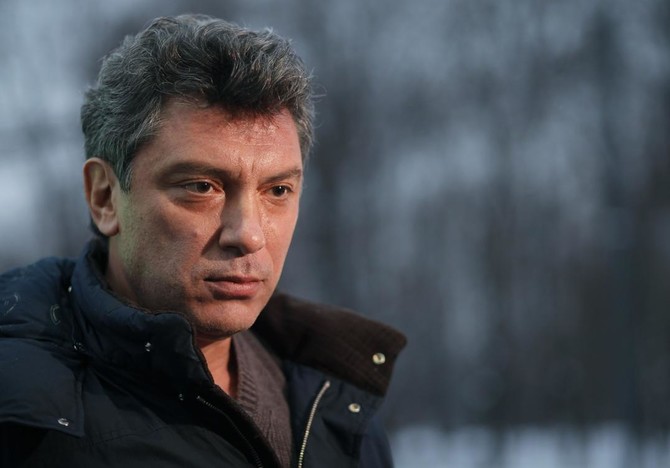
Allies of slain Putin critic Nemtsov allege cover-up after guilty verdict
Allies of slain Putin critic Nemtsov allege cover-up after guilty verdict
Latest updates


© 2026 SAUDI RESEARCH & PUBLISHING COMPANY, All Rights Reserved And subject to Terms of Use Agreement.