

Car bomb in Syria’s Idlib province kills 10: War monitor

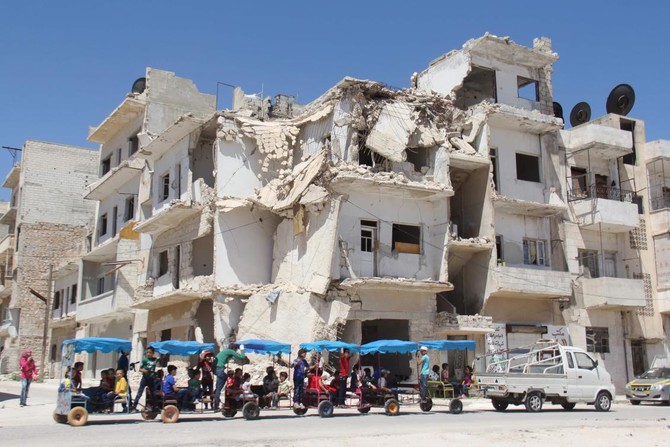
Syrian children ride a makeshift train of wagons in the northern city of Idlib on Sunday on the first day of Eid Al-Fitr holidays which mark the end of the holy fasting month of Ramadan. (AFP)
Updated 25 June 2017
Follow

Car bomb in Syria’s Idlib province kills 10: War monitor

BEIRUT: A car bomb killed 10 people in Syria’s opposition-held Idlib province on Saturday, the Syrian Observatory for Human Rights, a Britain-based war monitor, reported on Sunday.
The attack occurred in a market in the town of Al-Dana, located in the north of the province near the border with Turkey, according to the Observatory.
Three people under 18 were among the dead and the blast also injured at least 30 other people, it said. Another bombing in the town after midnight on Friday killed two people, it added.
Opposition groups in Idlib province have been sporadically fighting each other since early this year. Opposition fighters have also accused Daesh of carrying out attacks in the area.
Idlib province is a major stronghold of the opposition in Syria and is situated along the border with Turkey, one of the main backers of their rebellion against President Bashar Assad.
Large numbers of fighters, along with their relatives and many other civilians, have moved into the area under amnesty after surrendering to the army in other parts of Syria.
The UN and aid agencies have voiced concern about the humanitarian situation in Idlib, where large numbers of people live in poor conditions and face aerial bombardment.
Syria’s civil war has lasted over six years, killed hundreds of thousands of people, driven millions more from their homes in a global refugee crisis and dragged in regional and world powers.

Assad gives Eid prayers in Hama
Meanwhile, Assad delivered prayers for Islam’s Eid Al-Fitr holiday in Hama on Sunday, the furthest he has traveled inside Syria in years, showing his growing confidence.
State television broadcast footage of Assad standing to pray in a large mosque in Hama behind its imam, with other clerics standing alongside and a large crowd of worshippers.
Since the war began in 2011, the regime has killed hundreds of thousands, driven millions more from their homes, sparked a global refugee crisis and drawn in regional and world powers.
The conflict is far from over. Opposition fighters hold swathes of the country, including around Idlib province near Hama, and launched a new attack in Quneitra in the southwest on Saturday.
The fighters also hold the Eastern Ghouta area near Damascus, parts of the desert in the southeast and a large pocket south of Hama around the city of Rastan.
As recently as March, fighters advanced from Idlib province to within a few kilometers of Hama, before the army and its allies pushed them back in weeks of fierce fighting.
However, the army drove fighters from their biggest urban stronghold in Aleppo in December and have also forced several important rebel enclaves to surrender over the past year.

Focus on Daesh
Assad has not made a declared visit to Hama, which is about 185 km from Damascus, since the war began. Last year he delivered Eid prayers in Homs, about 40 km closer to Damascus.
Early in the crisis he visited Raqqa, a city that has since become the Syrian capital of Daesh and now faces an assault by a US-backed coalition to drive out the militants.
The fight against Daesh, which has attacked Western cities, has become the focus of Western leaders, some of whom have softened demands that Assad must quit to end the crisis.


Lebanon ex-central bank chief's corruption case being sent to top court, officials say

Updated 58 min 57 sec ago
Follow

Lebanon ex-central bank chief's corruption case being sent to top court, officials say

  • The trial of Salameh, 75, and his two legal associates, Marwan Khoury and Michel Toueini, will now be heard at the Court of Cassation

BEIRUT: The corruption case of Lebanon's former central bank governor, who is widely blamed for the country’s economic meltdown, has been transferred to the country's highest court, judicial officials told The Associated Press on Tuesday.
Riad Salameh was released on $14 million bail in September after a year in prison while awaiting trial in Lebanon on corruption charges, including embezzlement and illicit enrichment.
The trial of Salameh, 75, and his two legal associates, Marwan Khoury and Michel Toueini, will now be heard at the Court of Cassation, according to a copy of the notice obtained by the AP. Salameh and the others will be issued with arrest warrants if they don't show up for trial at the court.
No trial date has been set yet. Salameh denies the charges. The court’s final ruling can't be appealed, according to the four officials who spoke on condition of anonymity, because they weren't authorized to speak with the media.
In September 2024, he was charged with the embezzlement of $42 million, with the court later adding charges of illicit enrichment over an apartment rented in France, supposedly to be a substitute office for the central bank if needed. Officials have said that Salameh had rented from his former romantic partner for about $500,000 annually.
He was once celebrated for steering Lebanon’s economic recovery, after a 15-year civil war, upon starting his long tenure in 1993 and keeping the fragile economy afloat during long spells of political gridlock and turmoil.
But in 2023, he left his post after three decades with several European countries investigating allegations of financial crimes. Meanwhile, much of the Lebanese blame his policies for sparking a fiscal crisis in late 2019 where depositors lost their savings, and the value of the local currency collapsed.
On top of the inquiry in Lebanon, he is being investigated by a handful of European countries over various corruption charges. In August 2023, the United States, United Kingdom and Canada imposed sanctions on Salameh.
Salameh has repeatedly denied allegations of corruption, embezzlement and illicit enrichment. He insists that his wealth comes from inherited properties, investments and his previous job as an investment banker at Merrill Lynch.
Lebanon’s current central bank governor, Karim Souaid, announced last week that he's filing legal complaints against a former central bank governor and former banking official who diverted funds from the bank to what he said were four shell companies in the Cayman Islands. He didn't name either individual.
But Souaid said that Lebanon's central bank would become a plaintiff in the country's investigation into Forry Associates. The U.S. Treasury, upon sanctioning Salameh and his associates, described Forry Associates as “a shell company owned by Raja (Salameh’s brother) in the British Virgin Islands” used to divert about $330 million in transactions related to the central bank.
Several European countries, among them France, Germany, and Luxembourg, have been investigating the matter, freezing bank accounts and assets related to Salameh and his associates, with little to no cooperation from the central bank and Lebanese authorities.
Souaid said that he will travel later this month to Paris to exchange “highly sensitive” information as France continues its inquiries.