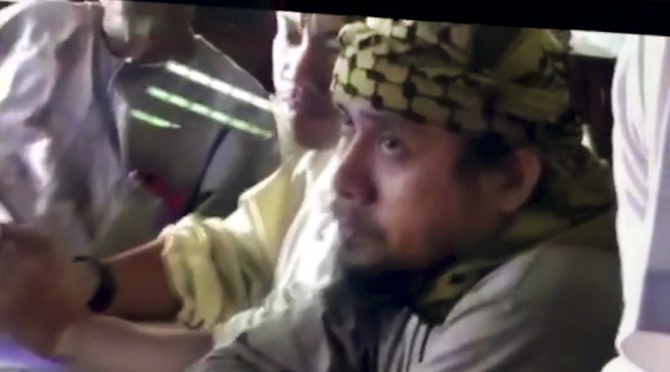
WASHINGTON: Southeast Asia’s militants who fought by the hundreds for the Daesh group in Iraq and Syria now have a different battle closer to home in the southern Philippines. It’s a scenario raising significant alarm in Washington.
The recent assault by Daesh-aligned fighters on the Philippine city of Marawi has left more than 300 people dead, exposing the shortcomings of local security forces and the extremist group’s spreading reach in a region where counterterrorism gains are coming undone.
Defense Secretary Jim Mattis told Congress last week a long-running US military operation to help Philippine forces contain extremist fighters was canceled prematurely three years ago. Small numbers of US special forces remain in an “advise and assist” role, and the US is providing aerial surveillance to help the Philippines retake Marawi, an inland city of more than 200,000 people.
But lawmakers, including from President Donald Trump’s Republican Party, want a bigger US role, short of boots on the ground. They fear the area is becoming a new hub for militant fighters from Southeast Asia and beyond.
“I don’t know that ISIS are directing operations there but they are certainly trying to get fighters into that region,” said Republican Sen. Joni Ernst of Iowa, using another acronym for the group. “We need to address the situation. It should not get out of control.”
US intelligence and counterterrorism officials note that Daesh has publicly accepted pledges from various groups in the Philippines. In a June 2016 video, it called on followers in Southeast Asia to go to the Philippines if they cannot reach Syria.
About 40 foreigners, mostly from neighboring Indonesia and Malaysia, have been among 500 involved in fighting in Marawi, the Philippine military says. Reports indicate at least one Saudi, a Chechen and a Yemeni killed. In all, more than 200 militants have died in the standoff, now in its fourth week.
Video obtained by The Associated Press from the Philippine military indicates an alliance of local militant fighters, aligned with Daesh, are coordinating complex attacks. They include the militant group’s purported leader in Southeast Asia: Isnilon Hapilon, a Filipino on Washington’s list of most-wanted terrorists, with a $5 million bounty on his head.
US officials are assessing whether any of the estimated 1,000 Southeast Asians who traveled to Iraq and Syria in recent years are fighting in Catholic-majority Philippines. They fear ungoverned areas in the mostly Muslim region around Marawi could make the area a terror hub as in the 1990s.
Then, the Philippines was a base of operations for Al-Qaeda leaders like Khalid Sheikh Mohammed and Ramzi Yousef, who plotted in 1994-95 to blow up airliners over the Pacific. The plot was foiled. But the same men were instrumental in the 9/11 attacks on the United States.
Other nations share the fear. Singapore recently warned of Daesh exerting a radicalizing influence “well beyond” what that of Al-Qaeda and Jemaah Islamiyah ever mustered. Jemaah Islamiyah carried out major terror attacks around the region in the 2000s. Daesh already has been linked to attacks in Indonesia and Malaysia, and foiled plots in Singapore, this past year.
This month, Mattis told the region’s defense chiefs that “together we must act now to prevent this threat from growing.”
In Congress this past week, he stressed intelligence sharing and nations like Singapore sharing the burden, rather than deploying US troops.
More than 500 US special forces were based in the Mindanao region from 2002 to 2014, advising and training Filipino forces against the Abu Sayyaf, a group notorious for bombings and kidnappings. When it ended, Philippine and US officials voiced concern the US withdrawal “could lead to a resurgence of a renewed terrorist threat,” the RAND Corp. later reported. Months before the withdrawal, Abu Sayyaf pledged support to IS.
Supporting the Philippines isn’t straightforward in Washington. President Rodrigo Duterte is accused of overlooking and even condoning indiscriminate killings by his forces in a war on drugs. Thousands have died. But that campaign has involved mainly police and anti-narcotic forces, not the military leading the anti-Daesh fight.
Still, the Philippine government is partly to blame for Marawi’s violence, said Zachary Abuza, a Southeast Asia expert at the National War College. He said the root cause was the government’s failure to fulfill a 2014 peace agreement with the nation’s largest Muslim insurgency, which fueled recruitment for Daesh-inspired groups.
Ernst, who chairs a Senate panel on emerging threats, wants the US military to restart a higher-profile, “named operation” helping the Philippines counter Daesh. The Pentagon retains between 50 and 100 special forces in the region. At the request of the Philippine military, it has deployed a P3 Orion plane to surveil Marawi. It gave more than 600 assault firearms to Filipino counterterrorism forces last week.
Duterte has retreated from threats to expel US forces from the Philippines as he seeks better ties with China. He said recently he hadn’t sought more US help, but was thankful for what he was getting.
“They’re there to save lives,” Duterte said.

Daesh threat in Southeast Asia raises alarm in Washington
Rubio defends US ouster of Venezuela’s Maduro to Caribbean leaders unsettled by Trump policies
BASSETERRE, St. Kitts and Nevis: US Secretary of State Marco Rubio on Wednesday defended the Trump administration’s military operation to capture Venezuela’s Nicolás Maduro, telling Caribbean leaders, many of whom objected to that move, that the country and the region were better off as a result.
Speaking to leaders from the 15-member Caribbean Community bloc at a summit in the country of St. Kitts and Nevis, Rubio brushed aside concerns about the legality of Maduro’s capture last month that have been raised among Venezuela’s island-state neighbors and others.
“Irrespective of how some of you may have individually felt about our operations and our policy toward Venezuela, I will tell you this, and I will tell you this without any apology or without any apprehension: Venezuela is better off today than it was eight weeks ago,” Rubio told the leaders in a closed-door meeting, according to a transcript of his remarks later distributed by the US State Department.
Rubio said that since Maduro’s ouster and the effective takeover of Venezuela’s oil sector by the United States, the interim authorities in the South American country have made “substantial” progress in improving conditions by doing “things that eight or nine weeks ago would have been unimaginable.”
The Caribbean leaders have gathered to debate pressing issues in a region that President Donald Trump has targeted for a 21st-century incarnation of the Monroe Doctrine meant to ensure Washington’s dominance in the Western Hemisphere. The Republican administration has declared a focus closer to home even as Washington increasingly has been preoccupied by the possibility of a US military attack on Iran.
Rubio downplays antagonism in US regional push
In his remarks to the group, America’s top diplomat tried to play down any antagonistic intent in what Trump has referred to as the “Donroe Doctrine.” Rubio said the administration wants to strengthen ties with the region in the wake of the Venezuela operation and ensure that issues such as crime and economic opportunities are jointly addressed.
“I am very happy to be in an administration that’s giving priority to the Western Hemisphere after largely being ignored for a very long time,” Rubio said. “We share common opportunities, and we share some common challenges. And that’s what we hope to confront.”
He said transnational criminal organizations pose the biggest threat to the Caribbean while recognizing that many are buying weapons from the United States, a problem he said authorities are tackling.
Rubio also said the US and the Caribbean can work together on economic advancement and energy issues, especially because many leaders at the four-day summit have energy resources they seek to explore. “We want to be your partner in that regard,” he said.
Rubio said the US recognizes the need for fair, democratic elections in Venezuela, which lies just miles away from Trinidad and Tobago at the closest point.
“We do believe that a prosperous, free Venezuela who’s governed by a legitimate government who has the interests of their people in mind could also be an extraordinary partner and asset to many of the countries represented here today in terms of energy needs and the like, and also one less source of instability in the region,” he said.
Rubio added: “We view our security, our prosperity, our stability to be intricately tied to yours.”
Trump plays up Maduro’s ouster
Trump, in his State of the Union address Tuesday night, called the operation that spirited Maduro out of Venezuela to face drug trafficking charges in New York “an absolutely colossal victory for the security of the United States.”
The US had built up the largest military presence in the Caribbean Sea in generations before the Jan. 3 raid. That has now been exceeded by the surge of American warships and aircraft to the Middle East as the administration pressures Iran to make a deal over its nuclear program.
In the Caribbean, Trump has stepped up aggressive tactics to combat alleged drug smuggling with a series of strikes on boats that have killed over 150 people and he has tightened pressure on Cuba. Regional leaders have complained about administration demands for nations to accept third-country deportees from the US and to chill relations with China.
One regional leader who has backed the US escalation is Trinidad and Tobago Prime Minister Kamla Persad-Bissessar, whom Rubio thanked for her “public support for US military operations in the South Caribbean Sea,” the State Department said.
Persad-Bissessar told reporters that her conversation with Rubio focused on “Haiti; we talked about Cuba of course; we talked about engagements with Venezuela and the way forward.”
She was asked if she considered the latest US military strikes in Caribbean waters as extrajudicial killings: “I don’t think they are, and if they are, we will find out, but our legal advice is they are not.”
Rubio had other one-on-one meetings with heads of government, including from St. Kitts and Nevis, Haiti, Jamaica and Guyana.
Caribbean leaders point to shifting global order
Trump said during the State of the Union that his administration is “restoring American security and dominance in the Western Hemisphere, acting to secure our national interests and defend our country from violence, drugs, terrorism and foreign interference.”
Terrance Drew, prime minister of St. Kitts and Nevis and chair of the Caribbean Community bloc, said the region “stands at a decisive hour” and that “the global order is shifting.”
Drew and other leaders said Cuba’s humanitarian situation must be addressed.
“It must be clear that a prolonged crisis in Cuba will not remain confined to Cuba,” Jamaican Prime Minister Andrew Holness warned. “It will affect migration, security and economic stability across the Caribbean basin.”
The US Treasury Department on Wednesday slightly eased restrictions on the sale of Venezuelan oil to Cuba, which instituted austere fuel-saving measures in the weeks after the US raid in Venezuela.
That move came hours before Cuba’s government announced that its soldiers killed four people aboard a speedboat registered in Florida that had opened fire on officers in Cuban waters.