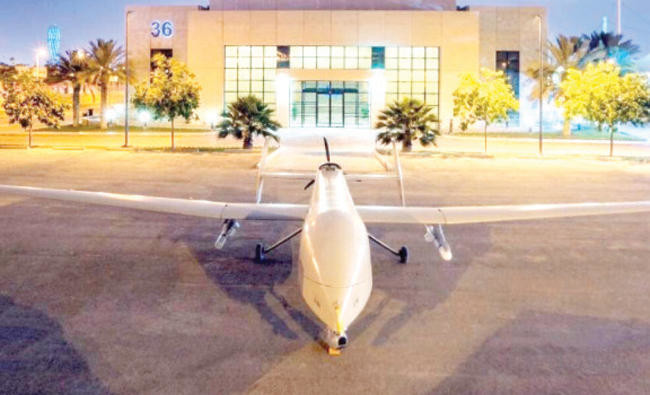
JEDDAH: The King Abdulaziz City for Science and Technology (KACST) has announced that the first stage of a drone factory in Riyadh is almost complete.
KACST’s Supervisor General of Special Programs Khaled Al-Hussan, who is overseeing the Saudi drone project, said that the factory is projected to manufacture drones suitable for military and civil purposes, scientific research, urban planning and security.
One of the drones that will be manufactured at the facility is the Saqr 1 drone which is made of carbon and glass fiber and is equipped with a satellite communications system. The drone can fly within a range of 2,500 km for 24 to 48 hours.
When it comes to who will use the drones, Al-Hussan told Arab News that “Taqnia Aeronautics is the party concerned with marketing and determining the market demand for the projected drones.”
KACST has also produced another three drones of medium size — the Saqr 2, 3 and 4. The units were first developed in 2012 with a total of 38 built as of August 2014.
Saqr 2 can fly for eight-hours at a speed of 120 km per hour at an altitude of 5,000 meters while the Saqr 4 is capable of carrying a load of up to 5 kg.
The Saqr 4 can reach a maximum speed of 120 kph at an altitude of 5,000 meters and can fly for five to six hours.
All the models are equipped with cameras for aerial photography.

First stage of Saudi drone factory complete: KACST
Japanese researchers hope to restore coral from Saudi-made structures
- Coral skeletons made for Saudi Pavilion at Japan expo last year
- Results of Japanese study to be revealed at Riyadh Expo 2030
TOKYO: Japanese universities are seeking to restore coral reefs and marine ecosystems after receiving artificial structures that Saudi Arabia made and showcased at last year’s Osaka-Kansai Expo.
The coral skeletons were donated to the University of the Ryukyus in Okinawa and Kansai University in Osaka Prefecture, Kyodo News reported at the weekend.
The structures are made from calcium carbonate, a material on which corals are believed to grow more easily compared to artificial alternatives such as concrete or metal.
The skeletal structures were created using 3-D printers, with one piece produced a day during the expo, and displayed across an entire wall in the Saudi Arabia Pavilion, which had an area focusing on sustainable marine environments.
Coral reefs serve as habitats for much marine life, but over 40 percent of the world’s 892 species face possible extinction, according to the International Union for Conservation of Nature.
The University of the Ryukyus, which received about 150 of the artificial coral skeletons, will place them in waters off the eastern coast of Okinawa’s main island and then examine their impact on the ecosystem.
Kansai University has placed theirs in the sea around Kagoshima Prefecture’s Yoron Island to observe their growth after transplanting coral polyps onto the structures.
The results of the research are expected to be revealed at the Riyadh Expo in 2030.
“I had never imagined that Japan and Saudi Arabia would cooperate on coral research,” said Masato Ueda, a professor specializing in regenerative medicine at Kansai University.
Ueda said he wants to demonstrate to children that “humanity is attempting to restore the environment.”