BEIRUT: The US has deployed a truck-mounted missile system into Syria, an official said Wednesday, to a forward operating group of rebels and US military advisers that have repeatedly clashed with government forces.
The deployment raises the stakes in eastern Syria, where Iranian-sponsored pro-government forces have outflanked US advisers and rebels holding the Tanf border crossing to establish their own link to Iraq for the first time in years.
They are now waiting for pro-Iranian forces to link up with them on the Iraqi side of the border, while preparing to march on Islamic State positions to the north, in the Euphrates River Valley.
Shifting the HIMARS missile system into eastern Syria from Jordan will give the US a precise, long-range weapon to protect its advisers and allies in Tanf, and to attack Daesh militants further downfield. It has a range of 300 kilometers (186 miles).
The deployment also insures that the military can protect itself from attacks in the area when weather would limit the ability of strike aircraft to reach there in time.
The Pentagon official requested anonymity, to discuss unannounced military movements.
US-backed rebels were advancing north along the Syrian-Iraqi frontier, against IS militants, when pro-government forces cut them off with a flanking maneuver last week.
US special forces operators are embedded with the rebels in an advisory capacity, the Pentagon says, though they have fought alongside their allies in defense battles. They hold two outposts in the desert region.
The US central military command has said it remains committed to reaching and defeating the IS group in its strongholds along the Euphrates, beginning with Boukamal, 220 kilometers (137 miles) northeast of Tanf.
Meanwhile, a UN investigative commission for Syria reported that last month’s “de-escalation” agreement has reduced violence in only one of the four zones included in the deal and has not led to greater humanitarian access to besieged areas across the war-torn country.
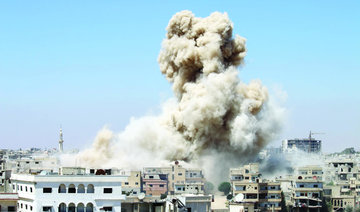
Underscoring the ongoing violence, a barrage of airstrikes and artillery shells pummeled different areas of southern Daraa province Wednesday, leaving at least eight people dead, including children, first responders and activists said.
A western diplomat said that the US, Russia, and Jordan were holding closed door-meetings in Amman to halt the fighting between rebels and the government in southern Syria.
The three states are debating the boundaries of a cease-fire line between the government and rebels in what is hoped to be a comprehensive agreement that would delineate the control of border crossings with Jordan, the diplomat said, speaking on condition of anonymity because he was not authorized to brief the media.
In Geneva, the Independent International Commission of Inquiry told the UN Human Rights Council that fighting around the central province of Homs, near Damascus and in the southern city of Daraa has continued — despite the deal brokered by Russia, Turkey and Iran in May.
Only in the northern Idlib province and western Aleppo has there been “discernible reduction” in violence, said the chair of the UN commission, Paulo Sergio Pinheiro.
Violence in Daraa has escalated, with some of the most intense bombing reported in recent weeks.
On Wednesday, activists and rescue workers reported at least 12 airstrikes and artillery shelling in different areas of Daraa, the southern province divided between insurgents and government forces. Syrian Civil Defense first responders, also known as White Helmets, reported airstrikes on a school that served as a shelter for displaced people in Tafs, in the province’s west.
Initial reports said at least eight people from the same family were killed, according to the first responders who said the displaced had gathered at the site of the aftermath of an earlier strike nearby.
The Syrian Observatory for Human Rights put the death toll at nine. A video from first responders distributed on social media shows bodies strewn on the floor as rescuers search for survivors, lifting children out of the rubble amid wails from women.
“Whether it be the unrestrained use of airstrikes against residential neighborhoods, attacks against doctors and hospitals, or the use of suicide bombers that deliberately target civilians, fighting remains brutal in purpose and reprehensible in method,” Pinheiro said.
A map of the de-escalation zones and a mechanism of how to monitor them have yet to be released. Pinheiro said there has also not been any improvement in the delivery of humanitarian aid.
“In those areas more urgently in need of humanitarian assistance, the United Nations has only been permitted one humanitarian delivery in 2017,” he told the council. “Time and time again, warring parties and influential states have failed to capitalize on the opportunities presented by the respites from hostilities.”
Outside the four zones, Pinheiro said some 600,000 people remain trapped in besieged areas where many are subjected to daily airstrikes.
___
Associated Press writers Robert Burns and Lolita Baldor in Washington contributed to this report.


![]()

Outflanked by Iran-backed forces, US deploys mobile missile system in eastern Syria
Outflanked by Iran-backed forces, US deploys mobile missile system in eastern Syria
Latest updates


© 2026 SAUDI RESEARCH & PUBLISHING COMPANY, All Rights Reserved And subject to Terms of Use Agreement.