



Muslims observing Ramadan ‘saved lives in London tower blaze’

1 / 4
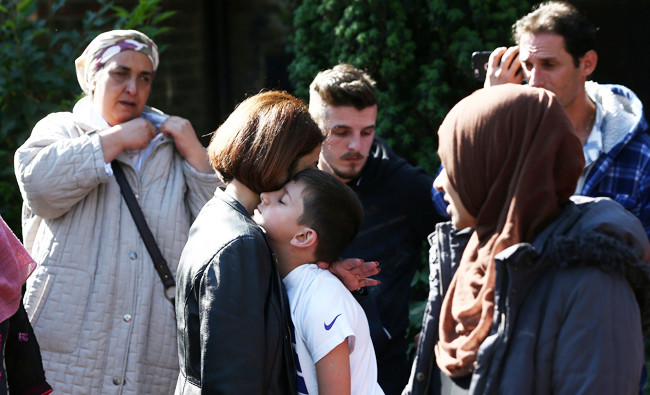
A woman comforts a boy after a tower block was severly damaged by a serious fire, in north Kensington, West London, Britain June 14, 2017. (Reuters)
2 / 4
Reception centres, such as these at the Latymer Christian Centre and Muslim Cultural Heritage Centre in north Kensington, along with other locations in the area, have been receiving donations of food, drinks, blankets and clothing all day
3 / 4
Reception centres, such as these at the Latymer Christian Centre and Muslim Cultural Heritage Centre in north Kensington, along with other locations in the area, have been receiving donations of food, drinks, blankets and clothing all day
4 / 4
Reception centres, such as these at the Latymer Christian Centre and Muslim Cultural Heritage Centre in north Kensington, along with other locations in the area, have been receiving donations of food, drinks, blankets and clothing all day
Updated 14 June 2017
Follow

Muslims observing Ramadan ‘saved lives in London tower blaze’

DUBAI: Muslims living in — and near — the London tower gutted by a massive blaze early this morning were among the hero residents who saved lives, because they were awake eating suhoor.

Many residents banged on doors of sleeping neighbors and guided them to safety as the fire started to take hold of Grenfell tower, filling corridors with thick smoke, eyewitness said.

Muslims were among some of the first to notice the smoke and were able to alert neighbors, according to reports from the scene.

One Somali man told Arab News that many lives had been saved due to the hours people keep during Ramadan. 
 
“The fast saved a lot of people, as they were... up preparing to eat before sunrise,” he said. “It saved them.”
 
Safia, a Sudanese mother who lives locally, said that residents were still awake ahead of the daylight fast.
 
“People were up… I heard somebody (wanting to rescue) their kids... a Muslim man gave him the key (to the building) to help get the kids,” she told Arab News. “We helped people out in the morning.”
 
The eyewitness said that many Somalians, Sudanese and Moroccans live in the area. “I lost two family members in there, an elderly lady and children, they are all Muslims,” she said.
 
Safia also claimed that access to the blazing building was a problem for rescue crews, and raised concerns over the fire-safety standards.
 
“There was no fire alarm,” she said. “Access is a huge problem… The fire engines can’t break through. My friend called me and said they broke some barrier to access (the building).”
 
One woman identifying herself as Rashida told Sky News that many local Muslims would have still been awake as they observed Ramadan.

“Most Muslims now observing Ramadan will normally not go to bed until about 2 a.m. maybe 2:30 a.m.,” Rashida explained. “Until they have their late night last meal. They do their last prayer.

“So most of the families around here would have been awake and I think even with the noise with the helicopters, it would have brought a lot of attention to a lot of residents non-Muslim as well that would have thought something’s going on that’s not quite normal.”

She explained that the West London community, where the vast residential tower is, was “tightly-knit,” like many areas of the British capital, and had a particularly large Moroccan population.

“It’s a very diverse area, we have all nationalities, all religions… We all live peacefully among each other, there is not much crime higher than anywhere else,” she explained.
Rashida said people were generally able to walk around safely late at night, because “we all know each other.”

Speaking to the website, BuzzFeed, Nadia Yousuf, 29, said Muslim residents were some of the first people to spot the blaze, because they had woken for suhoor.
“They saw it just after they woke up to eat,” she said.

US NATO envoy says allies must ‘pull weight’ after Czech defense cut

Updated 6 sec ago
Follow

US NATO envoy says allies must ‘pull weight’ after Czech defense cut

PRAGUE, March 12 : The United States’ ambassador to ‌NATO said on Thursday that all allies must “pull their weight,” after Czech lawmakers approved a 2026 budget that cuts defense outlays.
Czech Prime Minister ​Andrej Babis’ government, in power since December, pushed a revamped budget through the lower house on Wednesday evening which cut the defense ministry’s allocation versus a previous proposal to 154.8 billion crowns ($7.31 billion), or 1.73 percent of gross domestic product.
That is below a NATO target of 2 percent of GDP already expected before alliance members pledged last year in the Hague ‌to raise defense spending ‌to 3.5 percent of GDP plus ​1.5 percent ‌on ⁠other defense-relevant investments ​over ⁠the next decade.
The Czech Finance Ministry says total defense spending in the budget will reach 2.07 percent of GDP, but the country’s budget watchdog has warned that includes money earmarked elsewhere, like for the transport ministry for road projects, that may not be recognized by NATO.
“All Allies must pull their weight and ⁠honor The Hague Defense Commitment,” US Ambassador to ‌NATO Matthew Whitaker said on X ‌on Thursday with a picture of ​a news headline on the Czech ‌budget approval.
“These numbers are not arbitrary. They are about ‌meeting the moment — and the moment requires 5 percent as the standard. No excuses, no opt-outs.”
European NATO countries are under pressure to raise defense spending amid the Ukraine-Russia war ‌and at US President Donald Trump’s urging.
Babis, whose populist ANO party won elections last year, said ⁠in February ⁠the country was “certainly not” on the path to raising core defense spending to the 3.5 percent target, saying there was a different focus, like on health care.
The budget watchdog on Thursday reiterated “strong doubts” that some spending deemed defense in this year’s budget would meet NATO’s definition.
President Petr Pavel, a former NATO official, has also said defense cuts risked a loss of trust from allies — but has signalled he would not veto the budget.
US Ambassador to Prague Nicholas Merrick said last ​week the Czech Republic may ​slip to the bottom of NATO’s defense-spending ranks.