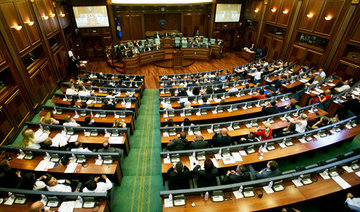
PRISTINA: Kosovo began voting Sunday for a new Parliament that will have to navigate tense relations with Serbia, endemic corruption and possible war crimes indictments for some of its leaders.
The early general election is only the third since Kosovo unilaterally declared independence in 2008. But it “might be the hardest to predict,” according to Florian Bieber, professor of Southeast European Studies at the University of Graz in Austria.
A month after the last government lost a confidence vote, the battle for a new prime minister pitches an ex-guerrilla commander against a former student protest leader and an economist likened to French President Emmanuel Macron.
Polls opened at 0500 GMT across the country of about 1.8 million people, most of whom are ethnic Albanian.
“This election has to open a new chapter,” said 66-year-old Ekrem Haziri, one of dozens of pensioners queueing in the early morning rain in the capital Pristina.
“It is time to end the huge abuse of tax-payers’ money. We need a government that will take care of its own people.”
Officials said 8.45 percent of the electorate had voted four hours after polls opened, down on the last election in 2014.
Overshadowing the vote is a new special court set up to try war crimes allegedly committed by members of the pro-independence Kosovo Liberation Army (KLA), which fought Serbian forces in the late 1990s.
Among those some speculate could be on the list of indictees — which may be announced later this year — are President Hashim Thaci and outgoing speaker Kadri Veseli, who both hail from the powerful Democratic Party of Kosovo (PDK).
The European Center for Minority Issues, a Germany-based research institute, said the court’s arrest warrants “compounded with the political agenda, may severely hamper or even bring about the fall of the future government.”
The new court was largely absent from the debate during the short election campaign.
But the threat it poses could explain why the PDK decided to end its ruling coalition with the Democratic League of Kosovo (LDK), said political scientist Loic Tregoures, a Balkans specialist.
The party may have pushed for a snap election to consolidate its position before the court begins work, he said.
The PDK’s new alliance is the favorite to win and has been dubbed the “war wing” coalition owing to the prominence of former KLA fighters.
The coalition’s candidate for prime minister is Ramush Haradinaj, known as “Rambo,” whom Serbia wants to try for war crimes.
Haradinaj has criticized EU-brokered talks between Belgrade and Pristina aimed at “normalizing” relations. He says they should only move forward if Serbia recognizes Kosovo — an unlikely prospect.
Another coalition has emerged around the center-right LDK party, closer to civil society groups.
Its candidate for premier is outgoing finance minister Avdullah Hoti. He has pushed a strongly pro-European platform and earned the nickname “Kosovo’s Macron,” promising to take on corruption.
Nearly 20 years after the war, political elites in Kosovo are “characterised by crime, corruption and nepotism,” according to an assessment by the Slovenia-based International Institute for Middle-East and Balkan Studies.
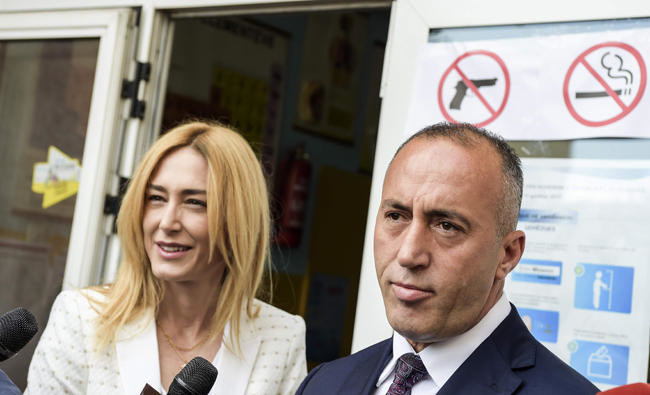
After voting with his wife, Hoti called on voters to decide “the future of their families.”
In a country where half of the population is aged under 30, the unemployment rate is officially at 27.5 percent and young people are leaving in droves in search of a better life elsewhere.
To deny the “war wing” alliance power, Hoti would have to turn to the Vetevendosje (Self-Determination) party of former student leader Albin Kurti, which has adopted radical methods.
Kurti and fellow party members repeatedly threw tear gas in Parliament to prevent a law passing on a border demarcation deal with Montenegro.
The EU has made the deal a prerequisite to liberalising Kosovo’s visa regime, but its opponents say it deprives Kosovo of land.
The protesters are also opposed to an association — agreed on in the talks with Belgrade — that would grant Kosovo’s Serb minority greater autonomy.
Progress on this issue has stalled and tensions remain palpable in the ethnically divided northern city of Mitrovica.
For although Kosovo’s independence has been recognized by more than 110 countries, Serbia still refuses to acknowledge it.
Kosovo’s Serbs, who number between 100,000 and 150,000, will on Sunday elect 10 of the 120 deputies in Parliament.
The embassies of Germany, Italy, Britain and the United States recently issued a joint statement denouncing “deeply concerning reports” of “threats and intimidation” — particularly targeting Serbs — during the campaign.
An EU mission is monitoring the polls, which close at 1700 GMT, and the first results are expected later Sunday.

Kosovo votes with war crimes court, corruption in mind
Trump’s new tariffs shift focus to balance of payments; economists see no crisis
President Donald Trump’s temporary 15 percent tariffs to replace those struck down by the US Supreme Court are meant to resolve a problem that many economists say does not exist: a US balance of payments crisis, making them potentially vulnerable to new legal challenges.
Hours after the high court on Friday struck down a huge swath of tariffs Trump had imposed under the International Emergency Economic Powers Act, the president announced the new duties under Section 122 of the Trade Act of 1974 — a never-used statute that even his own legal team dismissed as irrelevant months ago.
Collections of the new 15 percent tariffs began at midnight on Tuesday as IEEPA tariff collections of 10 percent to 50 percent halted.
The Section 122 law allows the president to impose duties of up to 15 percent for up to 150 days on any and all countries to address “large and serious” balance-of-payments deficits and “fundamental international payments problems.”
Trump’s tariff order argued that a serious balance of payments deficit existed in the form of a $1.2 trillion annual US goods trade deficit and a current account deficit of 4 percent of GDP and a reversal of the US primary income surplus.
Some economists, including former International Monetary Fund First Deputy Managing Director Gita Gopinath, disagreed with the Trump administration’s alarm.
“We can all agree that the US is not facing a balance of payment crisis, which is when countries experience an exorbitant increase in international borrowing costs and lose access to financial markets,” Gopinath told Reuters.
Gopinath rejected the White House’s claim that a negative balance on the US primary income for the first time since 1960 was evidence of a large and serious balance of payment problem.
She attributed the negative balance to a large increase in foreign purchases of US equities and risky assets over the past decade, which outperformed foreign equities over this period.
Mark Sobel, a former US Treasury and IMF official, said that balance of payments crises are more associated with countries that have fixed exchange rates, and noted that the floating-rate dollar has been steady, the 10-year Treasury yield fairly stable, with US stocks performing well.
Josh Lipsky, chair of international economics at the Atlantic Council think tank, agreed, noting that a balance of payments crisis occurred when a country could not pay for what it was importing or was unable to service foreign debt. That was fundamentally different from a trade deficit, he added.
Brad Setser, a currency and trade expert at the Council on Foreign Relations who served as a senior adviser to the US Trade Representative in the Biden administration, took a somewhat contrarian view, arguing in lengthy X posts on Sunday that the Trump administration may have a reasonable case that there is a “large and serious” balance of payments deficit.
He noted that the current account deficit was far higher than when then-president Richard Nixon erected tariffs in 1971 to address a balance of payments crisis, and the US net international investment position is much worse. This “gives the administration a real argument,” in favor of its tariffs, Setser wrote.
The White House, US Treasury and US Trade Representative did not immediately respond to requests for comment about the use of Section 122.
WRONG STATUTE FOR THE JOB
Despite the Trump administration’s new focus on balance of payments, the Justice Department had previously argued that Section 122 was the wrong statute to handle a national emergency over the trade deficit.
In court filings in its defense of IEEPA tariffs, the Justice Department said Section 122 would not have “any obvious application here, where the concerns the president identified in declaring an emergency arise from trade deficits, which are conceptually distinct from balance-of-payments deficits.”
Neal Katyal, who argued at the Supreme Court on behalf of plaintiffs challenging the IEEPA tariffs, told CNBC that the Trump administration’s stance against the use of Section 122 for a trade deficit will make those tariffs vulnerable to litigation.
“I’m not sure it will necessarily even need to get to the Supreme Court, but if the president adheres to this plan of using a statute that his own Justice Department has said he can’t use, yeah, I think that’s a pretty easy thing to litigate,” Katyal said.
It is unclear who might take the lead in challenging the Section 122 tariffs.
Sara Albrecht, chair of the Liberty Justice Center, a nonprofit, public-interest law firm representing several small businesses that challenged the IEEPA tariffs, said the group would closely monitor any new statutes being invoked.
Albrecht did not reveal any future litigation strategy, adding: “Our immediate focus is simple: making sure the refund process begins and that checks start flowing to the American businesses that paid those unconstitutional duties.”
In its ruling, the Supreme Court did not give instructions regarding refunds, instead remanding the case to a lower trade court to determine next steps.
Hours after the high court on Friday struck down a huge swath of tariffs Trump had imposed under the International Emergency Economic Powers Act, the president announced the new duties under Section 122 of the Trade Act of 1974 — a never-used statute that even his own legal team dismissed as irrelevant months ago.
Collections of the new 15 percent tariffs began at midnight on Tuesday as IEEPA tariff collections of 10 percent to 50 percent halted.
The Section 122 law allows the president to impose duties of up to 15 percent for up to 150 days on any and all countries to address “large and serious” balance-of-payments deficits and “fundamental international payments problems.”
Trump’s tariff order argued that a serious balance of payments deficit existed in the form of a $1.2 trillion annual US goods trade deficit and a current account deficit of 4 percent of GDP and a reversal of the US primary income surplus.
Some economists, including former International Monetary Fund First Deputy Managing Director Gita Gopinath, disagreed with the Trump administration’s alarm.
“We can all agree that the US is not facing a balance of payment crisis, which is when countries experience an exorbitant increase in international borrowing costs and lose access to financial markets,” Gopinath told Reuters.
Gopinath rejected the White House’s claim that a negative balance on the US primary income for the first time since 1960 was evidence of a large and serious balance of payment problem.
She attributed the negative balance to a large increase in foreign purchases of US equities and risky assets over the past decade, which outperformed foreign equities over this period.
Mark Sobel, a former US Treasury and IMF official, said that balance of payments crises are more associated with countries that have fixed exchange rates, and noted that the floating-rate dollar has been steady, the 10-year Treasury yield fairly stable, with US stocks performing well.
Josh Lipsky, chair of international economics at the Atlantic Council think tank, agreed, noting that a balance of payments crisis occurred when a country could not pay for what it was importing or was unable to service foreign debt. That was fundamentally different from a trade deficit, he added.
Brad Setser, a currency and trade expert at the Council on Foreign Relations who served as a senior adviser to the US Trade Representative in the Biden administration, took a somewhat contrarian view, arguing in lengthy X posts on Sunday that the Trump administration may have a reasonable case that there is a “large and serious” balance of payments deficit.
He noted that the current account deficit was far higher than when then-president Richard Nixon erected tariffs in 1971 to address a balance of payments crisis, and the US net international investment position is much worse. This “gives the administration a real argument,” in favor of its tariffs, Setser wrote.
The White House, US Treasury and US Trade Representative did not immediately respond to requests for comment about the use of Section 122.
WRONG STATUTE FOR THE JOB
Despite the Trump administration’s new focus on balance of payments, the Justice Department had previously argued that Section 122 was the wrong statute to handle a national emergency over the trade deficit.
In court filings in its defense of IEEPA tariffs, the Justice Department said Section 122 would not have “any obvious application here, where the concerns the president identified in declaring an emergency arise from trade deficits, which are conceptually distinct from balance-of-payments deficits.”
Neal Katyal, who argued at the Supreme Court on behalf of plaintiffs challenging the IEEPA tariffs, told CNBC that the Trump administration’s stance against the use of Section 122 for a trade deficit will make those tariffs vulnerable to litigation.
“I’m not sure it will necessarily even need to get to the Supreme Court, but if the president adheres to this plan of using a statute that his own Justice Department has said he can’t use, yeah, I think that’s a pretty easy thing to litigate,” Katyal said.
It is unclear who might take the lead in challenging the Section 122 tariffs.
Sara Albrecht, chair of the Liberty Justice Center, a nonprofit, public-interest law firm representing several small businesses that challenged the IEEPA tariffs, said the group would closely monitor any new statutes being invoked.
Albrecht did not reveal any future litigation strategy, adding: “Our immediate focus is simple: making sure the refund process begins and that checks start flowing to the American businesses that paid those unconstitutional duties.”
In its ruling, the Supreme Court did not give instructions regarding refunds, instead remanding the case to a lower trade court to determine next steps.
© 2026 SAUDI RESEARCH & PUBLISHING COMPANY, All Rights Reserved And subject to Terms of Use Agreement.