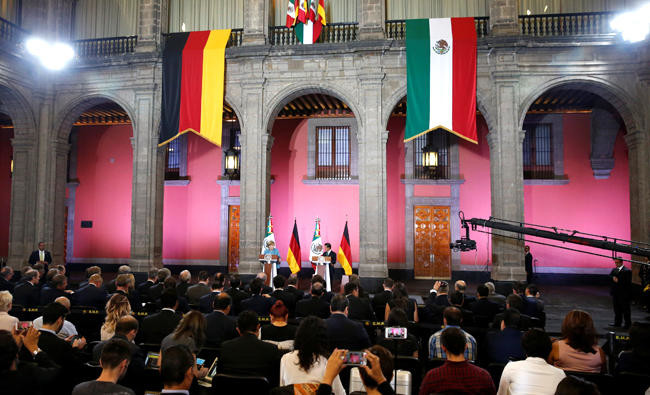
MEXICO CITY: German Chancellor Angela Merkel said on Friday she was concerned about the situation in Qatar, adding that all Gulf nations, and also Iran and Turkey, should work together to resolve the regional dispute.
Merkel, who was speaking in Mexico City alongside Mexican President Enrique Pena Nieto, said it would be impossible to sort out the “very unsettling” situation unless all regional actors were involved. She added that it was vital the states of the Gulf Cooperation Council (GCC) worked together to end the crisis.
“We have to see that the political solution of conflicts... such as the situation in Syria, such as the situation in Libya or the situation in Iraq, won’t happen if certain players are no longer even included in the conversation, and that includes Qatar, it includes Turkey, it includes Iran,” she said.
Merkel said she wanted the balance of power to be maintained “sensibly” in the region, and that combating terrorism would be on the agenda when G-20 leaders meet next month in Hamburg.
Arab states tightened their squeeze on Qatar by putting dozens of figures with links to the country on terrorism blacklists, while its ally, Turkey, rushed to its side with plans to send troops.
The Pentagon said the blockade was hindering US ability to plan for long-term operations in the region.
US Secretary of State Rex Tillerson said he expected all parties to find a resolution.
Meanwhile, Egypt President Abdel-Fattah El-Sisi praised US President Donald Trump for his role in “the formation of a united front to combat terrorism” after he called on Qatar to stop its financial support of extremist groups.
El-Sisi’s praise-filled phone call Saturday came after Trump echoed accusations made against Qatar by a Saudi-led group that cut diplomatic ties with the small country earlier this week.
El-Sisi thanked Trump for his participation in a counter-terrorism summit in Riyadh last May, in which he abandoned some of the harsh anti-Muslim rhetoric of his presidential campaign and vowed to fight terrorism in partnership with Middle East leaders.
The escalating crisis in the Arabian Gulf erupted this week when Saudi Arabia, the UAE, Egypt and Bahrain cut diplomatic ties with Qatar.
Niger said Saturday it had recalled its ambassador to Qatar in solidarity with the countries that have cut ties with Doha.
Some African countries have cautiously come out in support of attempts to isolate Qatar.
Mauritania, an Arab League member, cut ties on Tuesday and central African oil producer Gabon condemned Qatar for failing “on counter-terrorism.”
Senegal has said it would recall its ambassador in Qatar and expressed its “active solidarity.”

All Gulf nations, Iran, Turkey must work to ease Doha standoff: Merkel
Trump tells Iranians ‘help on its way’
- US president says Iranians should 'keep protesting' and that he canceled all meetings with Iranian officials
- Successive nights of mass protests nationwide may have killed thousands, NGO says
PARIS: US President Donald Trump urged Iranians on Tuesday to keep protesting against the country’s theocratic leadership, telling them “help is on its way” as international outrage grows over a crackdown one rights group said has likely killed thousands.
Iranian authorities insisted they had regained control after successive nights of mass protests nationwide since Thursday that have posed one of the biggest challenges to the clerical leadership since the 1979 Islamic revolution that ousted the shah.
Rights groups accuse the government of fatally shooting protesters and masking the scale of the crackdown with an Internet blackout that has now lasted almost five days.
New videos on social media, whose location AFP verified, showed bodies lined up in the Kahrizak morgue just south of the Iranian capital, with the corpses wrapped in black bags and distraught relatives searching for loved ones.
International phone links were restored on Tuesday, but only for outgoing calls, according to an AFP journalist, and the quality remains spotty, with frequent interruptions.
Trump, who has repeatedly threatened Iran with military intervention, said Iranians should continue their nationwide protests, take over institutions and record the names of “killers and abusers.”
“Iranian Patriots, KEEP PROTESTING,” Trump wrote on his Truth Social platform. “I have canceled all meetings with Iranian Officials until the senseless killing of protesters STOPS. HELP IS ON ITS WAY.”
It was not immediately clear what meetings he was referring to or what the nature of the help would be.
European nations also signalled their anger, with France, Germany and the United Kingdom among the countries that summoned their Iranian ambassadors to protest what French Foreign Minister Jean-Noel Barrot called “state violence unquestioningly unleashed on peaceful protesters.”
“The rising number of casualties in Iran is horrifying,” said EU chief Ursula von der Leyen, vowing further sanctions against those responsible.
- ‘In the thousands’ -
The Norway-based NGO Iran Human Rights (IHR) said it had confirmed 734 people killed during the protests, including nine minors, but warned the death toll was likely far higher.
“The figures we publish are based on information received from fewer than half of the country’s provinces and fewer than 10 percent of Iran’s hospitals. The real number of those killed is likely in the thousands,” the director of Norway-based NGO Iran Human Rights (IHR) Mahmood Amiry-Moghaddam said.
Fears have also grown that the Islamic republic could use the death penalty to crack down on the protests after Tehran prosecutors said Iranian authorities will press capital charges of “moharebeh,” or “waging war against God,” against some suspects arrested over recent demonstrations.
“Concerns are mounting that authorities will once again resort to swift trials and arbitrary executions to crush and deter dissent,” Amnesty International said.
IHR highlighted the case of Erfan Soltani, 26, who was arrested last week in the Tehran satellite city of Karaj and who, according to a family source, has already been sentenced to death and is due to be executed as early as Wednesday.
Iranian state media has said dozens of members of the security forces have been killed, with their funerals turning into large pro-government rallies. Authorities have declared three days of national mourning for those killed.
Amir, an Iraqi computer scientist, returned to Baghdad on Monday and described dramatic scenes in Tehran.
“On Thursday night, my friends and I saw protesters in Tehran’s Sarsabz neighborhood amid a heavy military presence. The police were firing rubber bullets,” he told AFP in Iraq.
‘Last days’
The government on Monday sought to regain control of the streets with mass nationwide rallies that supreme leader Ayatollah Ali Khamenei hailed as proof that the protest movement was defeated, calling them a “warning” to the United States.
In power since 1989 and now 86, Khamenei has faced significant challenges, most recently the 12-day war in June against Israel, which resulted in the killing of top security officials and forced him to go into hiding.
“When a regime can only hold on to power through violence, then it is effectively finished,” said German Chancellor Friedrich Merz during a trip to India. “I believe that we are now witnessing the last days and weeks of this regime.”
Analysts, however, have cautioned that it is premature to predict the immediate demise of the theocratic system, pointing to the repressive levers the leadership has, including the Revolutionary Guards Corps (IRGC), which are charged with safeguarding the Islamic revolution.
“These protests arguably represent the most serious challenge to the Islamic republic in years, both in scale and in their increasingly explicit political demands,” Nicole Grajewski, professor at the Sciences Po Center for International Studies in Paris, told AFP.
She said it was unclear if the protests would unseat the leadership, pointing to “the sheer depth and resilience of Iran’s repressive apparatus.”
Iranian authorities insisted they had regained control after successive nights of mass protests nationwide since Thursday that have posed one of the biggest challenges to the clerical leadership since the 1979 Islamic revolution that ousted the shah.
Rights groups accuse the government of fatally shooting protesters and masking the scale of the crackdown with an Internet blackout that has now lasted almost five days.
New videos on social media, whose location AFP verified, showed bodies lined up in the Kahrizak morgue just south of the Iranian capital, with the corpses wrapped in black bags and distraught relatives searching for loved ones.
International phone links were restored on Tuesday, but only for outgoing calls, according to an AFP journalist, and the quality remains spotty, with frequent interruptions.
Trump, who has repeatedly threatened Iran with military intervention, said Iranians should continue their nationwide protests, take over institutions and record the names of “killers and abusers.”
“Iranian Patriots, KEEP PROTESTING,” Trump wrote on his Truth Social platform. “I have canceled all meetings with Iranian Officials until the senseless killing of protesters STOPS. HELP IS ON ITS WAY.”
It was not immediately clear what meetings he was referring to or what the nature of the help would be.
European nations also signalled their anger, with France, Germany and the United Kingdom among the countries that summoned their Iranian ambassadors to protest what French Foreign Minister Jean-Noel Barrot called “state violence unquestioningly unleashed on peaceful protesters.”
“The rising number of casualties in Iran is horrifying,” said EU chief Ursula von der Leyen, vowing further sanctions against those responsible.
- ‘In the thousands’ -
The Norway-based NGO Iran Human Rights (IHR) said it had confirmed 734 people killed during the protests, including nine minors, but warned the death toll was likely far higher.
“The figures we publish are based on information received from fewer than half of the country’s provinces and fewer than 10 percent of Iran’s hospitals. The real number of those killed is likely in the thousands,” the director of Norway-based NGO Iran Human Rights (IHR) Mahmood Amiry-Moghaddam said.
Fears have also grown that the Islamic republic could use the death penalty to crack down on the protests after Tehran prosecutors said Iranian authorities will press capital charges of “moharebeh,” or “waging war against God,” against some suspects arrested over recent demonstrations.
“Concerns are mounting that authorities will once again resort to swift trials and arbitrary executions to crush and deter dissent,” Amnesty International said.
IHR highlighted the case of Erfan Soltani, 26, who was arrested last week in the Tehran satellite city of Karaj and who, according to a family source, has already been sentenced to death and is due to be executed as early as Wednesday.
Iranian state media has said dozens of members of the security forces have been killed, with their funerals turning into large pro-government rallies. Authorities have declared three days of national mourning for those killed.
Amir, an Iraqi computer scientist, returned to Baghdad on Monday and described dramatic scenes in Tehran.
“On Thursday night, my friends and I saw protesters in Tehran’s Sarsabz neighborhood amid a heavy military presence. The police were firing rubber bullets,” he told AFP in Iraq.
‘Last days’
The government on Monday sought to regain control of the streets with mass nationwide rallies that supreme leader Ayatollah Ali Khamenei hailed as proof that the protest movement was defeated, calling them a “warning” to the United States.
In power since 1989 and now 86, Khamenei has faced significant challenges, most recently the 12-day war in June against Israel, which resulted in the killing of top security officials and forced him to go into hiding.
“When a regime can only hold on to power through violence, then it is effectively finished,” said German Chancellor Friedrich Merz during a trip to India. “I believe that we are now witnessing the last days and weeks of this regime.”
Analysts, however, have cautioned that it is premature to predict the immediate demise of the theocratic system, pointing to the repressive levers the leadership has, including the Revolutionary Guards Corps (IRGC), which are charged with safeguarding the Islamic revolution.
“These protests arguably represent the most serious challenge to the Islamic republic in years, both in scale and in their increasingly explicit political demands,” Nicole Grajewski, professor at the Sciences Po Center for International Studies in Paris, told AFP.
She said it was unclear if the protests would unseat the leadership, pointing to “the sheer depth and resilience of Iran’s repressive apparatus.”
© 2026 SAUDI RESEARCH & PUBLISHING COMPANY, All Rights Reserved And subject to Terms of Use Agreement.