British police name two London attackers, say one previously known to them

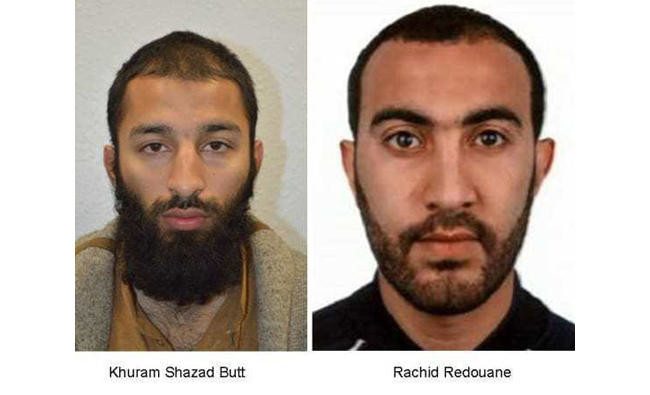
Khuram Shazad Butt and Rachid Redouane. (Metropolitan Police via AP)
Updated 05 June 2017
Follow

British police name two London attackers, say one previously known to them

LONDON: British police on Monday named two of the three attackers who killed seven people near London Bridge late on Saturday and injured dozens more, and said one of them was previously known to the security services.
London’s Metropolitan Police said one attacker was Khuram Shazad Butt, aged 27. Butt was previously known to police and domestic spy agency, MI5 and was a British citizen who had been born in Pakistan, the police said.
“However, there was no intelligence to suggest that this attack was being planned and the investigation had been prioritized accordingly,” police said.
The second attacker was named as Rachid Redouane, aged 30, who also went by the identity Rachid Elkhdar and was not known to police. Redouane claimed to be Moroccan and Libyan.
Police said they were still working to establish the identity of the third attacker.


End of US-Russia nuclear pact a ‘grave moment’: UN chief

Updated 05 February 2026
Follow

End of US-Russia nuclear pact a ‘grave moment’: UN chief

  • Guterres urged Washington and Moscow “to return to the negotiating table without delay and to agree upon a successor framework”

UNITED NATIONS, United States: UN chief Antonio Guterres on Wednesday urged the United States and Russia to quickly sign a new nuclear deal, as the existing treaty was set to expire in a “grave moment for international peace and security.”
The New START agreement will end Thursday, formally releasing both Moscow and Washington from a raft of restrictions on their nuclear arsenals.
“For the first time in more than half a century, we face a world without any binding limits on the strategic nuclear arsenals of the Russian Federation and the United States of America,” Guterres said in a statement.
The UN secretary-general added that New START and other arms control treaties had “drastically improved the security of all peoples.”
“This dissolution of decades of achievement could not come at a worse time — the risk of a nuclear weapon being used is the highest in decades,” he said, without giving more details.
Guterres urged Washington and Moscow “to return to the negotiating table without delay and to agree upon a successor framework.”
Russia and the United States together control more than 80 percent of the world’s nuclear warheads but arms agreements have been withering away.
New START, first signed in 2010, limited each side’s nuclear arsenal to 1,550 deployed strategic warheads — a reduction of nearly 30 percent from the previous limit set in 2002.
It also allowed each side to conduct on-site inspections of the other’s nuclear arsenal, although these were suspended during the Covid-19 pandemic and have not resumed since.