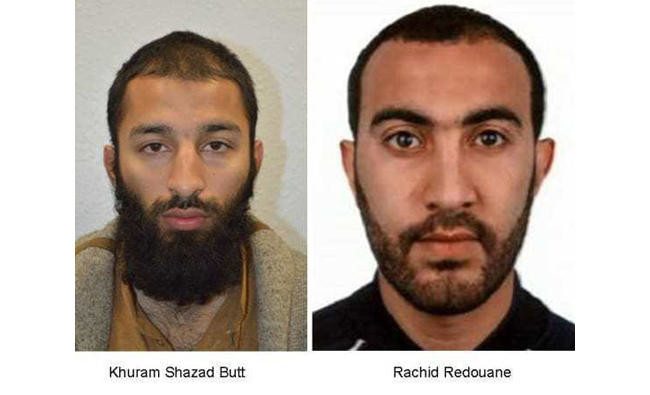
LONDON: British police on Monday named two of the three attackers who killed seven people near London Bridge late on Saturday and injured dozens more, and said one of them was previously known to the security services.
London’s Metropolitan Police said one attacker was Khuram Shazad Butt, aged 27. Butt was previously known to police and domestic spy agency, MI5 and was a British citizen who had been born in Pakistan, the police said.
“However, there was no intelligence to suggest that this attack was being planned and the investigation had been prioritized accordingly,” police said.
The second attacker was named as Rachid Redouane, aged 30, who also went by the identity Rachid Elkhdar and was not known to police. Redouane claimed to be Moroccan and Libyan.
Police said they were still working to establish the identity of the third attacker.

British police name two London attackers, say one previously known to them
Mine collapse in eastern Congo leaves 200 dead, authorities say, but rebels dispute the number
- Senior M23 official Fanny Kaj disputed the figure, saying that the collapse was caused by “bombings”
- Ibrahim Taluseke, a miner at the site, said that he had helped to recover more than 200 bodies from the area
GOMA, Congo: A mine collapse at a major coltan mining site in eastern Congo left at least 200 dead, according to Congolese authorities, a number disputed by the rebel group that controls the mine.
The collapse took place Tuesday at the Rubaya mines, which are controlled by the M23 rebel group, Congo’s Ministry of Mines said in a statement on Wednesday. It was the latest such tragedy in the mineral-rich and rebel-controlled territories of the country.
But senior M23 official Fanny Kaj disputed the figure, saying that the collapse was caused by “bombings” and only five people had been killed.
“I can confirm that what people are publishing is not true. There was no landslide; there were bombings, and the death toll isn’t what people are saying. It’s simply about five people who died,” Kaj said.
Ibrahim Taluseke, a miner at the site, said that he had helped to recover more than 200 bodies from the area.
“We are afraid, but these are lives that are in danger,” said Taluseke. “The owners of the pits do not accept that the exact number of deaths be revealed.”
Rubaya lies in the heart of eastern Congo, a mineral-rich part of the Central African nation which for decades has been ripped apart by violence from government forces and different armed groups, including the Rwanda-backed M23 group, whose recent resurgence has escalated the conflict, worsening an already acute humanitarian crisis.
Congo is a major supplier of coltan, a black metallic ore that contains the rare metal tantalum, a key component in the production of smartphones, computers and aircraft engines.
The country produced about 40 percent of the world’s coltan in 2023, according to the US Geological Survey, with Australia, Canada and Brazil being other big suppliers. More than 15 percent of the world’s supply of tantalum comes from Rubaya’s mines.
In May 2024, M23 seized the town and took control of its mines. According to a UN report, since seizing Rubaya, the rebels have imposed taxes on the trade and transport of coltan, generating at least $800,000 a month.
Eastern Congo has been in and out of crisis for decades. Various conflicts have created one of the world’s largest humanitarian crises with more than 7 million people displaced, including more than 300,000 who have fled their homes since December.
In June, the Congolese and Rwandan government signed a peace deal brokered by the US and negotiations continue between rebels and Congo. However, fighting continues on several fronts in eastern Congo, continuing to claim numerous civilian and military casualties.
The deal between Congo and Rwanda also opens up access to critical minerals for the US government and American companies.
A similar collapse last month killed more than 200 people.