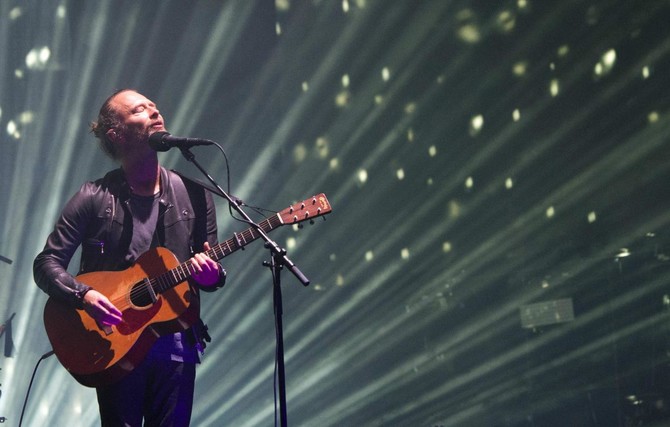
NEW YORK: Radiohead hit back Friday at a campaign urging the band to scrap a show in Israel, calling the boycott effort divisive, patronizing and “an extraordinary waste of energy.”
The experimental rock icons are scheduled to close a tour on July 19 in Tel Aviv but artists including Roger Waters have urged Radiohead to heed Palestinian activists’ calls to shun Israel.
Radiohead frontman Thom Yorke responded that the campaign sowed divisions that fueled right-wing leaders such as Israeli Prime Minister Benjamin Netanyahu, US President Donald Trump and British Prime Minister Theresa May.
“All of this creates divisive energy. You’re not bringing people together. You’re not encouraging dialogue or a sense of understanding,” Yorke told Rolling Stone magazine.
“It’s such an extraordinary waste of energy. Energy that could be used in a more positive way,” he said.
The petitioners — who also include Nobel Prize-winning anti-apartheid icon Desmond Tutu, novelist Alice Walker and Thurston Moore of alternative rock pioneers Sonic Youth — in an open letter pointed to Radiohead’s past activism.
The British band has played concerts to support Tibetan rights, Amnesty International and the battle against climate change.
Yorke called it “patronizing in the extreme” to presume Radiohead is unfamiliar with the Israeli-Palestinian conflict, pointing out that guitarist Jonny Greenwood’s wife is an Israeli Arab.
“It’s really upsetting that artists I respect think we are not capable of making a moral decision ourselves after all these years,” he said.
“They talk down to us and I just find it mind-boggling that they think they have the right to do that,” he said.
The campaign took on a personal dimension as Nigel Godrich, the longtime Radiohead producer often considered the band’s sixth member, produced the latest album by Waters, the most vocal artist in pressing the Israel boycott.
Godrich, also speaking to Rolling Stone, said he disagreed with cultural boycotts but considered Waters and Yorke “two peas in a pod” in other respects.
Radiohead had initially stayed silent on the boycott calls, even as a banner urging them to cancel the Tel Aviv show was hung at a recent concert in Berkeley, California.
Yorke was speaking as part of an interview for the 20th anniversary of “OK Computer,” the group’s foray into digital experimentation that marked a landmark in the direction of rock.
Radiohead on June 23 will issue an expanded version of “OK Computer” with remastered sound and previously unreleased tracks.
On Friday, the band released as a single one song that didn’t make the original 1997 album — “I Promise.” Less electronic than much of the album, “I Promise” is driven by Yorke’s falsetto voice and acoustic guitar before a gentle build on percussion.
The most eagerly awaited track on the updated “OK Computer” will be “Lift,” an anthemic song reminiscent of 1990s Britpop that Radiohead played live at the time but did not put on the album.
Guitarist Ed O’Brien, speaking recently to BBC 6 radio, said Radiohead saw the commercial potential of “Lift” when playing it as an opening act for Alanis Morissette, who had become a megastar with her album “Jagged Little Pill.”
“If that song had been on that album, it would have taken us to a different place, and we’d have probably sold a lot more records if we’d done it right,” O’Brien said.
“I think we kind of subconsciously killed it because if ‘OK Computer’ had been like a ‘Jagged Little Pill,’ like Alanis Morissette, it would have killed us,” he said.