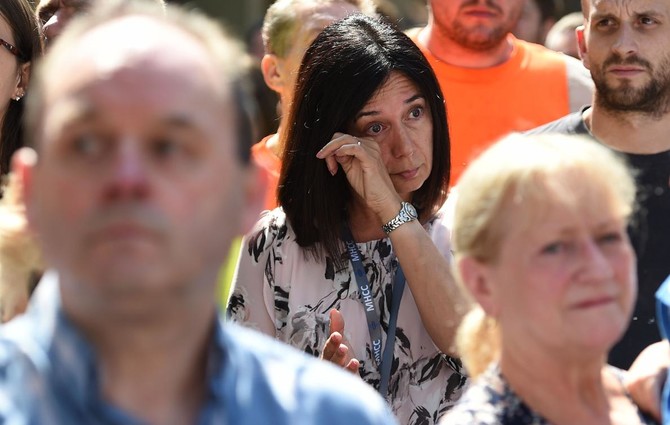
LONDON: US leaks about the British investigation into the Manchester bomber have strained the two countries’ “special relationship” and thrown into doubt the sharing of information among the “Five Eyes” intelligence alliance.
Greater Manchester Police are trying to establish who made the bomb detonated by 22-year-old Salman Abedi on Monday, killing 22, but they have reportedly stopped sharing intelligence information with US law enforcement agencies after key details were leaked to newspapers.
British Prime Minister Theresa May vowed to confront US President Donald Trump when the pair meet at Thursday’s NATO meeting in Brussels, with the American leader already struggling domestically to stem a tide of damaging leaks from law enforcement agencies.
May said she would “make clear to President Trump that intelligence which is shared between our law enforcement agencies must remain secure,” after key details of the investigation were published in US media, including the New York Times.
Her Downing Street office insisted that any decision to stop sharing intelligence on the case was “an operational matter for police,” and it was reported that general intelligence sharing was still ongoing.
A Foreign Office source told the domestic Press Agency that the government was “furious” with the leaks.
May was the first foreign leader to visit Trump’s White House, underlining the importance of the so-called “special relationship” between the two countries.
The two countries are also members of the “Five Eyes” intelligence alliance, along with Australia, New Zealand and Canada, highlighting the seriousness of the row.
Experts warned the leaks could hinder collaboration.
“It damages decades of confidence between the UK and US services, the cohesion of the “Five Eyes” group, and sharing of information with French, German and other security services,” said former reviewer of terrorism legislation Alex Carlile.
“These leaks made yesterday a very bad day for national security in several countries, and those responsible should be called to account.”
Former British intelligence officer Ben Owen told the BBC that the US could respond by withholding information from British officials, and urged a solution.
“It is critical that this is fixed, we need to go back to the drawing board, it’s happening far too often.”
British Interior Minister Amber Rudd on Wednesday said it was “irritating” that US media outlets named the bomber despite a British authorities request not to, adding she had “been very clear with our friends that it should not happen again.”
But just hours later, the New York Times published forensic photographs showing components of the bomber’s device strewn across the foyer of the Manchester Arena, enraging British politicians, intelligence agencies and police.
European allies were also accused of releasing secret information after French Interior Minister Gerard Collomb revealed, before British authorities, that the suspect was of Libyan descent, had recently likely traveled to Syria and that he had proven links with Daesh.
Ian Blair, former Metropolitan police commissioner, said that foreign leaks of intelligence were not a new phenomenon.
“I’m afraid this reminds me exactly of what happened after 7/7 when the US published a complete picture of the way the bombs had been made up. We had the same protests,” he told BBC Radio 4.
Greater Manchester Police chief constable Ian Hopkins revealed said Thursday that the leaks had had an immediate human impact, as-well as damaging intelligence links.
“Last night, the family liaison officers shared with them the fact that intelligence had been leaked and published in the New York Times,” he said.
“It is absolutely understandable that this has caused much distress for families that are already suffering terribly with their loss.”
THE NEW YORK TIMES COMPANY

US leaks over Manchester test ‘special relationship’
Militants kill 6 officers and a civilian in ambushes on police vehicles in northwest Pakistan
- Assailants ambushed a police vehicle and killed one officer in Kohat — When police reinforcements arrived minutes later, they launched another attack and killed five more officers and a civilian
- No group claimed responsibility for this week’s attacks, but suspicion may fall on the Pakistani Taliban, also known as Tehrik-e-Taliban Pakistan, or the TTP
PESHAWAR, Pakistan: A pair of attacks on police vehicles by suspected militants killed at least six police officers and a civilian in northwest Pakistan on Tuesday, authorities said.
The assailants ambushed a police vehicle and killed one officer in Kohat, a district in Khyber Pakhtunkhwa province. When police reinforcements arrived minutes later, they launched another attack and killed five more officers and a civilian, police official Kamran Khan said.
Separately on Tuesday, a suicide bomber detonated explosives at a police post in Bukkur, a district in eastern Punjab province, killing two officers and wounding four others, police official Shahzad Rafiq said.
He provided no further details and only said officers were still investigating.
No group immediately claimed responsibility for the attacks, which have increased across the country in recent months.
President Asif Ali Zardari condemned the attacks in Kohat and Bukkur and offered condolences to the victims’ families.
The latest violence followed an attack on a paramilitary post in Karak on Monday, when a drone loaded with explosives wounded several officers. The attackers later ambushed two ambulances transporting the wounded, killing three officers and burning their bodies before fleeing. The driver of the second ambulance transported several wounded officers despite suffering burn injuries and authorities recovered the remains of the three officers.
No group claimed responsibility for this week’s attacks, but suspicion may fall on the Pakistani Taliban, also known as Tehrik-e-Taliban Pakistan, or the TTP. The TTP is separate from, but closely allied with, Afghanistan’s Taliban. Islamabad has accused the group of operating from inside Afghanistan, a claim the TTP and Kabul deny.
Pakistan’s military said it killed at least 70 militants on Sunday in strikes along the Afghan border, targeting hideouts of Pakistani militants blamed for recent attacks inside the country.
The assailants ambushed a police vehicle and killed one officer in Kohat, a district in Khyber Pakhtunkhwa province. When police reinforcements arrived minutes later, they launched another attack and killed five more officers and a civilian, police official Kamran Khan said.
Separately on Tuesday, a suicide bomber detonated explosives at a police post in Bukkur, a district in eastern Punjab province, killing two officers and wounding four others, police official Shahzad Rafiq said.
He provided no further details and only said officers were still investigating.
No group immediately claimed responsibility for the attacks, which have increased across the country in recent months.
President Asif Ali Zardari condemned the attacks in Kohat and Bukkur and offered condolences to the victims’ families.
The latest violence followed an attack on a paramilitary post in Karak on Monday, when a drone loaded with explosives wounded several officers. The attackers later ambushed two ambulances transporting the wounded, killing three officers and burning their bodies before fleeing. The driver of the second ambulance transported several wounded officers despite suffering burn injuries and authorities recovered the remains of the three officers.
No group claimed responsibility for this week’s attacks, but suspicion may fall on the Pakistani Taliban, also known as Tehrik-e-Taliban Pakistan, or the TTP. The TTP is separate from, but closely allied with, Afghanistan’s Taliban. Islamabad has accused the group of operating from inside Afghanistan, a claim the TTP and Kabul deny.
Pakistan’s military said it killed at least 70 militants on Sunday in strikes along the Afghan border, targeting hideouts of Pakistani militants blamed for recent attacks inside the country.
© 2026 SAUDI RESEARCH & PUBLISHING COMPANY, All Rights Reserved And subject to Terms of Use Agreement.