LONDON: Saudi Arabia was very much on the global news agenda last weekend, as US President Donald Trump visited the Kingdom on his first foreign trip since taking office.
Awwad Al-Awwad, minister of culture and information, said last week that more than 500 journalists from around the world were expected to cover Trump’s visit.
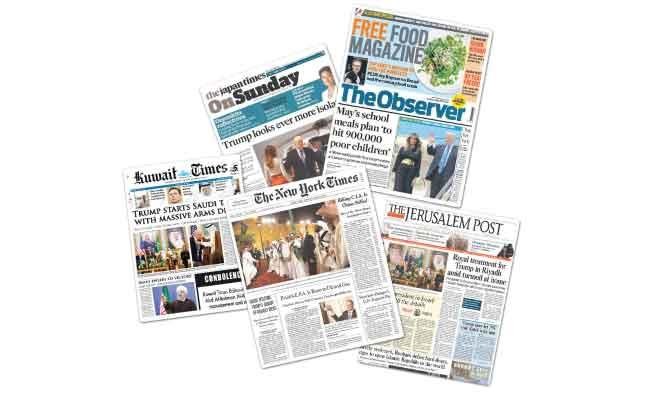
Here is how five newspapers covered news about Trump the day after he arrived in Riyadh.
1. The Observer, UK
“The heat is on: Trump lands in Riyadh,” said one edition of the UK’s Observer newspaper.
2. The New York Times
The paper featured a photograph of Trump taking part in a traditional sword dance. The story beneath was headlined: “Saudis welcome Trump’s rebuff of Obama’s views.”
3. The Kuwait Times
Arms deals between Saudi Arabia and the US headlined the front page of The Kuwait Times, which also mentioned the overall business and investment deals, worth some $380 billion, that were inked in Riyadh.
4. The Jerusalem Post
Trump’s “royal treatment” in Riyadh amid “turmoil at home” made the front page of The Jerusalem Post, which also featured details of Trump’s subsequent visit to Israel.
5. The Japan Times
Trump’s political issues in Washington also featured on The Japan Times front page, which carried a photograph of the US president as he was about to board Air Force One on his way to KSA.

Trump visit to Saudi Arabia hits the headlines
Saudi Arabia strengthens global ranking in 2026 Soft Power Index
- UAE maintains 10th place, Qatar climbs 2 spots
DUBAI: Saudi Arabia climbed three positions to 17th place in this year’s Soft Power Index, released on Tuesday by marketing consultancy Brand Finance.
Other Gulf nations also performed well, with the UAE maintaining its 10th-place ranking and Qatar and Bahrain each climbing two spots to No. 20 and No. 49, respectively, marking a rebound for the region after a softer showing in 2025.
The report indicates that the performance reflects sustained investment in proactive diplomacy, economic diversification and expanded initiatives across culture, tourism and sports.
It also comes at a time when several Western powers are recording declines in their rankings, highlighting the growing influence of Gulf states.
“The UAE remains a clear regional leader, while Saudi Arabia and Qatar have strengthened their global positions through focused economic diplomacy and international engagement,” said Savio D’Souza, managing director for the Middle East and Africa, Brand Finance.
Saudi Arabia and the UAE either maintained or improved their rankings across all key pillars, including familiarity, reputation and influence.
The Kingdom recorded notable gains, with increases of 25 points in the People & Values pillar and 12 points in the Culture & Heritage pillar.
“Although perceptions across some markets remain mixed, renewed upward movement in the rankings suggests that targeted, long-term soft power strategies are beginning to pay off,” D’Souza said.
Globally, the US retained its top position despite recording the steepest overall decline in its score, followed by China in second place. Japan rose to third place, overtaking the UK, which ranked fourth, while Germany placed fifth.
Brand Finance defines “soft power” as a “nation’s ability to influence the preferences and behaviors of various actors in the international arena (states, corporations, communities, publics, etc.) through attraction and persuasion rather than coercion.”
Each nation is assessed across 55 individual metrics, producing an overall score out of 100 and a ranking from first to 193rd.