BRUSSELS: France and Germany are resisting a plan by US officials for North Atlantic Treaty Organization (NATO) to take a bigger role in the fight against Daesh in Syria and Iraq, in line with calls from President Donald Trump for the alliance to do more to combat terrorism.
The top US military commander floated the idea late Wednesday of NATO assuming some responsibility for training troops in Iraq after Daesh forces are defeated there. The 28-member Atlantic alliance “might be uniquely posturing to provide a training mission for an enduring period of time” in Iraq, Gen. Joe Dunford told reporters during his flight back to the US from Brussels, where he attended a planning meeting ahead of next week’s NATO summit.
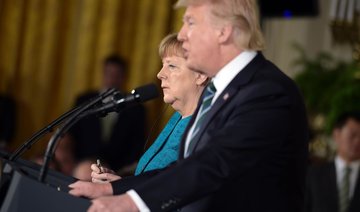
Many alliance members hope the plan will be announced in Brussels next Thursday, when Trump attends his first NATO summit. But France and Germany have misgivings, allies involved in the discussions said.
Among the concerns: NATO might be caught up in another costly, Afghan-style deployment, irk some Arab countries or risk confrontation with Russia in Syria.
“They are not buying it,” said a senior European NATO diplomat, who said some other nations including Greece and Italy were also wary of the plan.
“They want to know what difference would it make. All 28 NATO allies are already part of this effort,” the diplomat said, referring to a 68-nation US-led coalition against Daesh that includes all NATO members.
French and German officials declined to comment, but German Chancellor Angela Merkel left open the possibility of NATO as an institution joining the coalition when she met NATO Secretary General Jens Stoltenberg last week. Both ruled out any combat role for NATO in Syria and Iraq.
France’s new President Emmanuel Macron will have lunch with Trump — who last month withdrew his earlier charge that NATO was ‘obsolete’ because it was not ‘taking care of terror’ — before the Brussels meeting next Thursday.
While Daesh is on the verge of defeat in its Iraqi stronghold of Mosul, and bracing for an assault against its de facto capital in Raqqa, Syria, US officials are concerned fleeing militants could leave a vacuum that could prompt Arab tribal fighters to turn on each other to gain control.
US officials say the NATO as an institution could contribute equipment, training and the expertise it gained leading a coalition against Al-Qaeda and the Taliban in Afghanistan. NATO military chiefs favor the move, said Gen. Petr Pavel, chairman of the alliance’s military committee.
Diplomats said this could mean NATO using its surveillance planes over Syria, running command-and-control operations and providing air-to-air refueling.
Symbolic step
One compromise would be for NATO as an institution to formally join the coalition at the dinner with Trump next week, but leave the details of any involvement to a later stage.
“If allies can be convinced that it is only a symbolic step, a deal should be possible,” said a second NATO diplomat. “Trump goes home with a message that NATO is joining the coalition and NATO doesn’t have to do anything extra, at least for now.”
A broader hesitancy among European allies stems from the long mission that NATO has undertaken in Afghanistan, taking over the US bid to defeat militants in 2003 after the attacks on New York and Washington two years earlier.
Given Russia’s concerns over NATO expansion in eastern Europe, and its role in Syria as the key military ally of President Bashar Assad, some allies also worry that deeper NATO involvement there could be taken by Moscow as a provocation.
But a stronger role in Iraq and Syria could also address concerns expressed by Mediterranean allies, such as Spain, Italy and Portugal, that NATO lacks a strategy for tackling the root causes of the migrant and refugee crisis.
Stoltenberg has talked about NATO’s “untapped potential” in building up armed forces. Options include more NATO training of Iraqi troops and police, as well as strengthening government departments in areas taken back from Daesh.
“NATO is the only security organization with the skills and breadth to take on this task,” wrote Hans Binnendijk and David Gompert in a paper for the US think-tank RAND Corporation.


France, Germany resist US plan for bigger NATO role against Daesh

France, Germany resist US plan for bigger NATO role against Daesh

SpaceX acquires xAI in record-setting deal as Musk looks to unify AI and space ambitions
- The deal is the biggest M&A transaction of all time
- Deal values xAI at $250 billion, SpaceX at $1 trillion
Elon Musk said on Monday that SpaceX has acquired his artificial-intelligence startup xAI in a record-setting deal that unifies Musk’s AI and space ambitions by combining the rocket-and-satellite company with the maker of the Grok chatbot. The deal, first reported by Reuters last week, represents one of the most ambitious tie-ups in the technology sector yet, combining a space-and-defense contractor with a fast-growing AI developer whose costs are largely driven by chips, data centers and energy. It could also bolster SpaceX’s data-center ambitions as Musk competes with rivals like Alphabet’s Google, Meta, Amazon-backed Anthropic and OpenAI in the AI sector.
The transaction values SpaceX at $1 trillion, and xAI at $250 billion, according to a person familiar with the matter.
“This marks not just the next chapter, but the next book in SpaceX and xAI’s mission: scaling to make a sentient sun to understand the Universe and extend the light of consciousness to the stars!” Musk said. The purchase of xAI sets a new record for the world’s largest M&A deal, a distinction held for more than 25 years when Vodafone bought Germany’s Mannesmann in a hostile takeover valued at $203 billion in 2000, according to data compiled by LSEG. The combined company of SpaceX and xAI is expected to price shares at about $527 each, another person familiar with the matter said. SpaceX was already the world’s most valuable privately held company, last valued at $800 billion in a recent insider share sale. XAI was last valued at $230 billion in November, according to the Wall Street Journal. The merger comes as the space company plans a blockbuster public offering this year that could value it at over $1.5 trillion, two people familiar with the matter said.
SpaceX, xAI and Musk did not immediately respond to requests for comment.
The deal further consolidates Musk’s far-flung business empire and fortunes into a tighter, mutually reinforcing ecosystem – what some investors and analysts informally call the “Muskonomy” – which already includes Tesla, brain-chip maker Neuralink and tunnel firm the Boring Company. The world’s richest man has a history of merging his ventures together. Musk folded social media platform X into xAI through a share swap last year, giving the AI startup access to the platform’s data and distribution. In 2016, he used Tesla’s stock to buy his solar-energy company SolarCity.
The agreement could draw scrutiny from regulators and investors over governance, valuation and conflicts of interest given Musk’s overlapping leadership roles across multiple firms, as well as the potential movement of engineers, proprietary technology and contracts between entities.
SpaceX also holds billions of dollars in federal contracts with NASA, the Department of Defense and intelligence agencies, which all have some authority to review M&A transactions for national security and other risks.


