LONDON: Mohammed bin Abdulkarim Al-Issa, secretary-general of the Muslim World League (MWL), told participants at the League’s “Tolerance in Islam” conference that moderation underlines the texts of Shariah and the Prophet’s teachings, and that those moderate values are incompatible with extremism and inciting violence.
Al-Issa spoke at the conference held at the University of London that came to a close Tuesday with senior leaders from the Muslim community in Europe, and Western politicians from the UK and abroad, in attendance.
At the opening of the conference, Professor Mohammed Abdel Halim of the University of London and Chair of the King Fahd Chair for African and Middle Eastern Studies, welcomed the participants. He stressed that the conference aims to emphasize the tolerance of the Islamic religion and its values of mercy and justice.
Al-Issa said in a speech that the League is eager to promote a culture of peace and tolerance, and constructive dialogue of understanding among different groups.
Al-Issa added that extremism disregards jurisprudence and legitimacy, often changing fatwas and provisions when necessary, and is far from compassion and facilitation of good and moral doings.
He stressed the need for an intellectual defeat of extremism, as terrorist organizations are based on an extreme ideology, rather than a military entity and has no political power. Through such ideological power, they were able to attract followers from 100 countries. He went on to quote verses of the Qur’an, which are often misinterpreted by terrorists to fuel misguided attempts to incite violence.
In a final conference statement, participants called for spreading a culture of understanding among others of different faiths by promoting positive communication between followers of different religions and cultures. The statement also called on all members of society to promote citizenship, constructive dialogue and sustain the positive spirit of coexistence practiced by Muslims over past centuries.
Participants condemned the phenomenon of “Islamophobia,” citing it as the result of lack of knowledge of the reality of Islam, and called for objectivity and the elimination of prejudices by identifying Islam through its origins and principles, not through false representations.
Participants also called on religious and educational institutions to promote a culture of cooperation and understanding, and to promote religious values that entrench tolerance and positive coexistence.
Muslim communities in non-Muslim countries should demand their religious rights or preferences through peaceful and legal methods, including the hijab, halal slaughter, Islamic schools, the adoption of Islamic holidays, and the need to cooperate for the sake of humanity to form a universal alliance and resolve plaguing issues, the statement said.


![]()
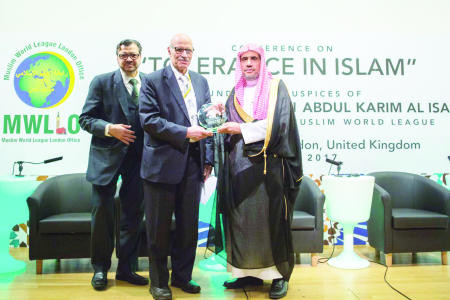
Muslim World League, University of London host ‘Tolerance in Islam’ conference
Muslim World League, University of London host ‘Tolerance in Islam’ conference
Latest updates


Recommended


© 2026 SAUDI RESEARCH & PUBLISHING COMPANY, All Rights Reserved And subject to Terms of Use Agreement.