THE HAGUE: The world may be close to a “serious act of digital sabotage” which could trigger unrest, “chaos and disorder,” Dutch spy chief Rob Bertholee warned Tuesday.
Sabotage of critical infrastructure “is the kind of thing that might keep you awake at night,” Bertholee told a timely cybersecurity conference in The Hague, as global experts grapple with the fallout of a massive cyberattack over the past days.
Digital threats “are not imaginary, they are everywhere around us,” the head of the country’s intelligence services (AIVD) told the conference organized by the Dutch government.
“In my opinion, we might be closer to a serious act of digital sabotage than a lot of people can imagine,” he told hundreds of experts and officials.
Bertholee highlighted how in 2012 the computers at Saudi Arabia’s largest oil company came under brief attack, or how three years later Ukrainian electricity companies were hacked causing a massive blackout lasting several hours.
The world’s infrastructure was heavily interconnected, which had huge benefits, but also “vulnerabilities.”
“Imagine what would happen if the entire banking system were sabotaged for a day, two days, for a week,” he asked.
“Or if there was a breakdown in our transportation network. Or if air traffic controllers faced cyberattacks while directing flights. The consequences could be catastrophic.”
Added Bertholee: “Sabotage on one of these sectors could have major public repercussions, causing unrest, chaos and disorder.”
The threat of “cyber terrorism” from terror groups such as the so-called Daesh militants and Al-Qaeda was still limited, he said, but “jihadist-inspired terrorism is the number one priority” of the Dutch intelligence services.
“The level of technical expertise available to a militant group is still insufficient to inflict significant damage or personal injury through digital sabotage,” Bertholee said.
“They may not yet have the capability but they definitely have the intent,” he warned.
Countries must be prepared for future threats in the digital domain, with governments and private sector working closely together, as this is “where our societies have become most vulnerable,” he said.
Security researchers investigating the massive cyberattack campaign over past days on Tuesday reported signs that it might be slowing, and suggested a possible North Korean link.
In the first clues of the origin of the massive ransomware attacks, Google researcher Neel Mehta posted computer code that showed similarities between the “WannaCry” malware and a vast hacking effort widely attributed to Pyongyang.
Europol meanwhile said the number of affected IP addresses around the world was 163,745 — a 38 percent percent fall from the 226,000 reported on Sunday.


World close to ‘serious digital sabotage,’ says Dutch spy chief

World close to ‘serious digital sabotage,’ says Dutch spy chief



Old Delhi iftars revive Mughal heritage, one course at a time
- Dastarkhwan-e-Jahaanuma iftars have been held in Old Delhi since 2017
- Muslim and non-Muslim participants arrive from across India and abroad
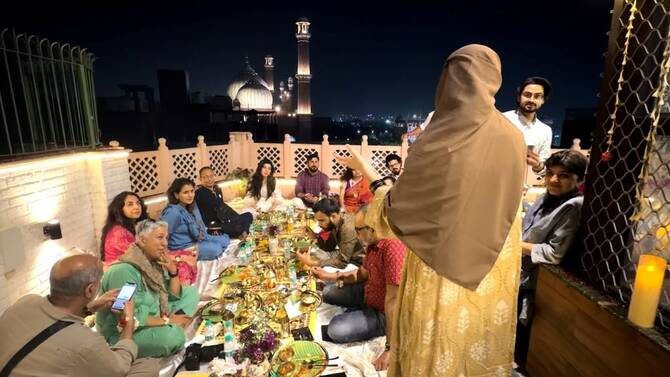
NEW DELHI: On a rooftop in Delhi’s historic walled city, guests from across India sit on cushions around a low table overlooking Jama Masjid, waiting for its sunset call to prayer — the signal to start a special iftar that will take them back four centuries, to the Mughal era, if only for a while.
Mughals ruled the Indian subcontinent between the 16th and 19th centuries. Originally from Central Asia, they carried traditions borrowed from Arabs, Persians and Ottomans, which they merged with the various local Indian styles — a fusion that marked the global revival of Islamic architecture and culture.
Jama Masjid is one of the most iconic examples of the Mughal style — a scenic background to the curated iftars that bring 40 to 50 people from across India to share a meal, knowledge and experience.
“People getting together from different walks of life, different parts of the country, different religions, different cultures coming together — it was absolutely and completely amazing,” said Arvind Sirohi, who took part in the event with his wife.
“Lovely storytelling, amazing food, and end of the day, right next to Jama Masjid in Old Delhi. The ambience, the environment, the atmosphere came together so beautifully.”
The community-led iftar experience is called Dastarkhwan-e-Jahaanuma — from Urdu words meaning a “spread of food” and “showing the world.”
For Veena Sirohi, it did exactly what the name promised by bringing together people from different communities, different parts of India, and abroad.
“I think that’s a great way of synthesizing different cultures, bringing people together, bringing the human aspect of what we all are ... we are actually all one,” she told Arab News.
“And we had some wonderful comperes who told us about … the history of Ramadan, what goes behind it, how the food is curated, and how each and every item has a specific place in the menu.”
Served in gilded bowls and plates from traditional Indian crockery, with rose petals dotting the dastarkhwan cloth, the dishes were some of the festive Ramadan delicacies, offering a taste of Mughal culinary heritage.
Among them was mutanjan, or fragrant rice cooked with ghee, sugar, saffron, cardamom, and studded with nuts, which for many Indian Muslims is traditionally the first dish to break the fast.
It was followed by shabde, a rich, slow-cooked aromatic meat stew or the Delhi biryani — a fragrant, mildly spiced saffron rice and meat dish, where marinated chicken or mutton is layered with basmati rice and cooked slowly.
The hearty feast closed with nihari, a hearty stew simmered overnight with spices and bone marrow, which emerged in the 18th century and was originally eaten by Mughal royals for breakfast.
“These are the traditional dishes which are not usually available in the market, but are specially prepared by the bawarchees (cooks) of Old Delhi. Some of the dishes are occasional dishes,” said Abu Sufiyan Khan, the founder of Tales of City, the cultural experience company that has been curating Dastarkhwan-e-Jahaanuma since 2017.
The special iftars are hosted once a week throughout the fasting month, usually on weekends. There are variations in dishes served as they come from different kitchens, as Tales of City collaborates with various local artisans and cooks.
“We are curating this with different experts and every time the menu changes,” Khan said.
“We bring all these dishes onto a single dastarkhwan, and we share this meal with the people coming from all over India to break bread together in the holy month of Ramadan, know each other, learn about each other’s culture, and create a dialogue space where we can have more meaningful conversations and an opportunity to get to know each other.”
Those who take part, like Ayandrali Dutta, a food critic, appreciate everything about the experience, especially as it takes place in Old Delhi, where the vibe is always “jovial, lively, in all positive ways” during Ramadan.
“You get to meet interesting people, you get to hear interesting stories ... It’s a great initiative to show what Ramadan is, what kind of food is eaten, talk about the cultures between Lucknow and Delhi and other parts of the country. And it just brings a lot of happiness,” she said.
“I loved it. My heart is happy, my belly is full. Nothing else I can ask for.”