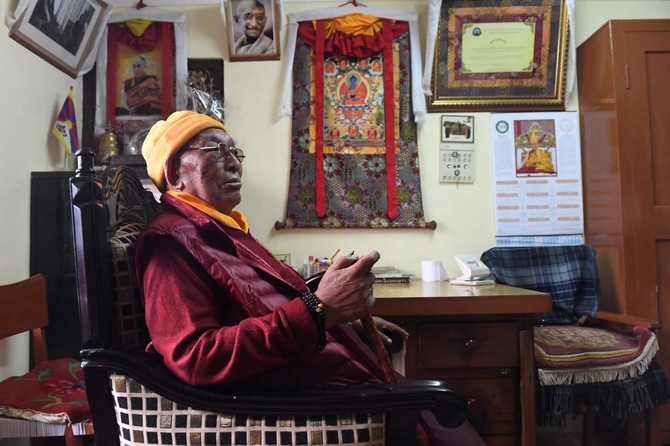
INDIA: Before dawn in the Indian Himalayas, scores of patients clutching small vials of urine queue patiently to see Yeshi Dhonden, a Tibetan monk who became a legend as personal healer to the Dalai Lama.
Tibetan medicine, known as Sowa-Rigpa, draws on centuries-old techniques such as blood-letting, cupping, and moxibustion — burning herbs on energy points of the body — to try to heal ailments.
The practice draws on aspects of traditional Chinese medicine and India’s Ayurvedic system as well as its own unique theories and treatments. It also features spiritual practices including meditation and Buddhist prayer.
Today it attracts devotees from all over the globe, hoping for help with conditions from back pain to cancer and degenerative diseases.
“If the sick come to me I will take care of them,” Dhonden told AFP at his private clinic in McLeodganj, surrounded by Tibetan scrolls and beaming images of his most famous client.
Dhonden — who spent three decades tending the health of Tibet’s spiritual leader — relies on his senses to divine what ails patients.
“I don’t go for tests like X-ray and all. I trust myself. I just test the pulse and the urine,” he explained.
A touch at the wrist is how he ascertains the health of vital organs and blood pressure.
The urine, held in a white porcelain cup, is stirred with two small bamboo sticks. Color, bubble formation, sediment and smell can all shape the diagnosis.
Devotees swear Tibetan medicine works, though few scientific studies have been conducted into its efficacy.
The teachings — contained in some 2,000 textbooks and the messages of the Buddha, considered the guardian deity for all spiritual healers — are believed to have originated in Tibet.
But as it features elements of both ancient Chinese and Indian healing practices, and is rapidly evolving from a niche tradition into popular alternative treatment, both nations have scrambled to claim it as their own.
In April, the Asian giants nominated Tibetan medicine for inclusion on a UNESCO list for “intangible culture.” China and India have engaged in countless spats over the Tibetan community since New Delhi granted sanctuary to the Dalai Lama in 1959.
Beijing took control of Tibet eight years earlier and was furious when India granted the Dalai Lama permission to headquarter a government-in-exile in McLeodganj.
The traditions of Tibetan medicine are based on four root texts known as the ‘tantras’ that evolved in two medical colleges, Chakpori and Men-Tsee-Khang, in the Tibetan capital Lhasa.
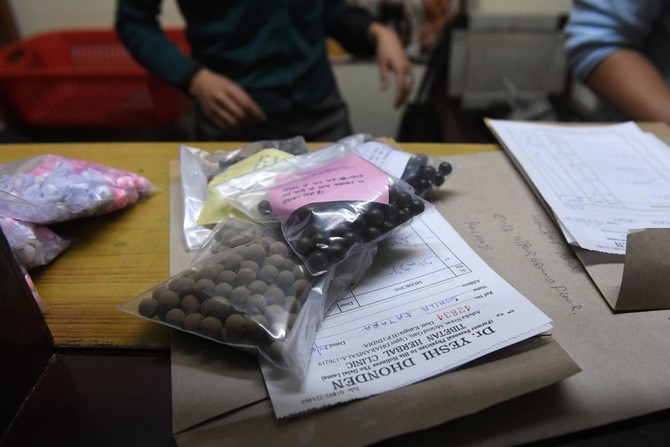
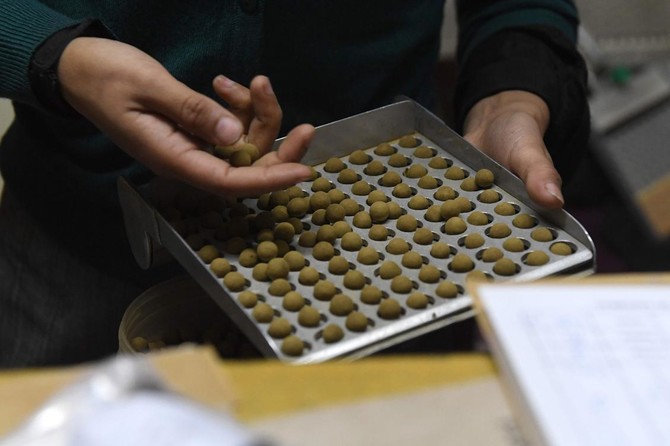
These tantras classify thousands of diseases into separate categories, with unique mixtures of herbs and minerals — mostly sourced from the upper reaches of the Himalayas — listed as remedies for each ailment.
“We believe diseases are caused when our inner energies are imbalanced,” said Tsewang Tam Din, a medical practitioner at the McLeodganj branch of the Men-Tsee Khang school, one of many across India.
Taking a delicate golden hammer, Din demonstrated how healers heat the instrument over fire and place it against the body to offset pain and other common malaises.
“The idea behind our medicine system is that one should not have to take medication all his life for chronic problems like arthritis and diabetes,” Din said in McLeodganj, nicknamed “Little Lhasa” for the large Tibetan community residing there.
The increasing popularity of Buddhism in the west, as well as a global Tibetan diaspora has helped spread awareness about its unique alternative medicine.
But like other Eastern health treatments, it is viewed with skepticism among the conventional medical fraternity.
A lack of standardization and clinical trials means it will be some time before Tibetan medicine can go mainstream, said cardiologist D. Prabhakaran from the Public Health Foundation of India.
But even doubters acknowledge the natural treatment appears to assist some patients in certain cases.
“I know of anecdotal examples where people with terminal diseases have lived much longer than predicted after taking Tibetan medicine,” Prabhakaran said.
“I think there’s a lot of empathy toward the patient in Tibetan medicine. Basically it comes from the thinking of Buddhism and that may be one of the reasons why it’s becoming more popular,” he added.
In 2010, India officially recognized Tibetan medicine as a “science of healing” and enshrined it within the nation’s health care system, paving the way for future research and investment into the spiritual discipline.
It’s good news for devotees like 60-year-old Abdul Rehman, who has eschewed mainstream medicine his entire life in favor of Tibetan alternatives.
“I suffered from a recurrent cold which was cured in one year,” said Rehman as he collected herbal pills at a clinic in a posh Delhi suburb.
He added: “Now I have some back and neck pain and I think it will also be cured soon.”